The black hole shadow is the dark, roughly circular region seen in images of a black hole, caused by the event horizon and the strong gravitational bending of light. It is not the event horizon itself, but rather the 'shadow' cast by the black hole against the bright background of hot gas or radiation behind it. Photons that pass too close to the black hole are captured and never reach the observer, creating a dark void. The size and shape of this shadow depend on the black hole's mass, spin, and charge, as well as on the geometry of space-time around it. The shadow is a direct visual manifestation of strong gravity, and its observation provides a powerful test of general relativity and alternative theories of gravity.
History
The concept of the black hole shadow was first discussed by James Bardeen in 1973, and later by Jean-Pierre Luminet in 1979, who produced the first simulated image. The first actual image of a black hole shadow was captured by the Event Horizon Telescope in 2019, for the supermassive black hole M87*.
How it works
The shadow forms because of the photon sphere — a region around the black hole where gravity is so strong that light can orbit. Photons that cross this sphere are either captured by the black hole or deflected into it, so they never escape to the observer. The boundary of the shadow corresponds to the set of photon trajectories that just barely escape. For a non-rotating (Schwarzschild) black hole, the shadow is a perfect circle with a radius of about 2.6 times the gravitational radius. For a rotating (Kerr) black hole, the shadow is slightly flattened on one side and offset, due to frame-dragging effects. The shadow's size scales directly with the black hole's mass, so measuring it can provide a precise mass estimate.
In practice
The shadow is used to measure black hole masses and spins, to test general relativity, and to constrain alternative theories of gravity, such as those involving extra dimensions or quantum corrections.
Fun fact
The shadow of a black hole is about 2.6 times larger than the event horizon itself, so the dark region we see in images is not the 'surface' of the black hole, but a gravitational illusion.
An invisible scaffold holds galaxies together, keeping them from flying apart. This is dark matter — matter that doesn't shine and barely interacts with ordinary stuff. Astrophysicists have long debated what it's made of.
A black hole's shadow isn't just a black circle. Usually, we see a dark void surrounded by a glowing ring of hot gas. But if a black hole wasn't born from a dying star but has existed forever, its shadow might hide a surprise.
An eternal black hole is a solution to Einstein's equations with no past and no collapse.
Buried in Antarctic ice, there's a detector the size of a cubic kilometer. It doesn't catch light but ghostly particles — neutrinos. Yet sometimes, a different beast might flash through: a pair of muons born together and flying apart in a wide fan. No known particle of ordinary matter can paint that pattern.
In 2019, the world saw the first image of a black hole's shadow — an orange doughnut on a black background, becoming a symbol of scientific progress. But this image wasn't captured by a camera: it was born from mathematical alchemy, where data from eight radio telescopes, which gathered only crumbs of signal, merged into a single picture.
A black hole is not just a dark silhouette against the stars. Its shadow is surrounded by a thin glowing ring of photons that loop around the event horizon before escaping to an observer.
The quantum world is often compared to a musical instrument. Each system, whether an atom or a chain of particles, sounds at its own frequencies, which physicists call energy levels. In chaotic systems, like an orchestra without a conductor, these frequencies usually fill the entire available range without gaps.
Since Saul Perlmutter and his colleagues discovered the accelerated expansion of the universe, physicists have been scratching their heads over the nature of dark energy.
At the center of galaxy M87, 55 million light-years away, lurks a black hole with a mass of 6.5 billion Suns. In 2019, the Event Horizon Telescope (EHT) gave us its first portrait: an orange donut with a dark core. But the donut is not the abyss itself.
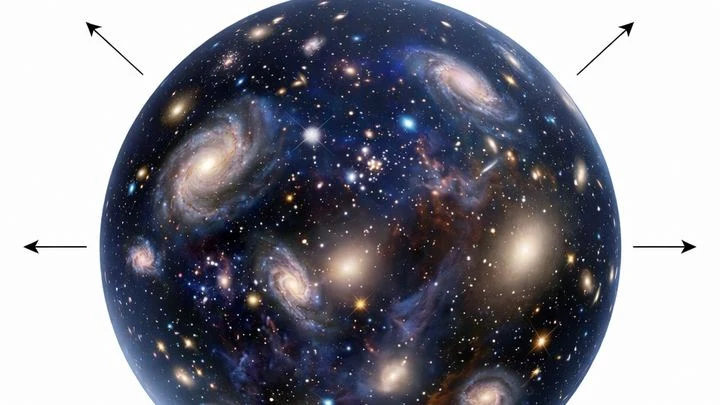
The Universe behaves like a soap bubble swelling in a multidimensional foam. The dark bubble model explains why it's expanding ever faster: the spacetime bubble grows, and its membrane gains a tiny thickness — about a micron, like a bacterium. At such distances, gravity 'blurs' across this thickness and weakens.
A black hole is a place where gravity is so strong that even light cannot escape. But around it there is a glowing ring of gas, and in the center a dark void known as the shadow. The size of this shadow depends on how spacetime is curved.
Moments before totality, swift shadow bands glide across the ground, like ripples from pebbles tossed into water. For centuries, this phenomenon baffled scientists. It turns out the key is that light is a wave.
The Sun isn't a pinpoint lamp but a vast disk. When the Moon nearly covers it, a thin glowing crescent remains.
Emptiness can surprise you. In general relativity, there is a solution where space itself gives birth to a black hole — literally from a point. It all starts at the moment when the event horizon (the surface from which not even light can escape) appears with zero radius and immediately begins to grow.
In 2019, the image of the M87* shadow was a sensation: for the first time, humanity saw the outlines of a black hole, predicted by Schwarzschild and shrouded in myth. But what if that glowing crescent isn't a portrait of an absolute abyss, but of a cosmic portal?
Spacetime flows like a river, and a black hole is a whirlpool. Particles in this flow are like waves with their own rhythm: alternating crests and troughs. It turns out the whirlpool shifts the wave's rhythm from a distance, without even sucking it in.
Around an invisible fire, glowing gas swirls. The fire itself is hidden, but its outline can be guessed from the way the flames dance. That's roughly how astronomers 'see' black holes — not the object itself, but the superheated matter that, before plunging into the abyss, accelerates to enormous speeds and shines.
The shadow of a black hole is not just a silhouette. It's the edge of the abyss, where space and time are twisted so tightly that even light is forced to swirl like a wood chip in a whirlpool. This 'cosmic whirlpool' arises from the monstrous mass warping spacetime.
In a water vortex swirling toward the drain, the flow speed near the center can exceed the speed of sound. Sound gets trapped: waves cannot escape back, forming a silent region — a sound shadow. Half a century ago, William Unruh realized that this is an exact copy of a black hole, but for sound instead of light.
A ball on a slope with two pits usually rolls into the nearest one and comes to rest. But if the slope is slightly deformed and 'remembers' recent nudges, the ball can hang around halfway for a long time — in a narrow spot it doesn't want to leave. That's exactly the trick physicists played with light.
Normally, by rapidly oscillating a mirror in a vacuum, you can conjure real particles from nothing: this is the dynamical Casimir effect. But near a black hole, things are different. The spacetime curvature itself stifles any attempt to create something.
In causal set theory, spacetime is not a smooth sheet but a web of tiny points connected by arrows of cause and effect. A point is linked to another only if the first can influence the latter. In such a web, a black hole is described differently: its horizon, the boundary from which signals cannot return, must be redefined.
The universe resembles a giant sponge: bright filaments of galaxies weave around enormous dark voids. Inside these filaments and walls hide clumps of invisible dark matter — halos. When dark matter particles collide and decay, they produce ordinary particles that telescopes can catch.
In the kitchen, there's a bucket of water and an identical bucket of sand. Pour the sand into the water, and you get a mixture where there's exactly five times more sand than water. That's roughly how our universe is arranged: one part ordinary matter — the stuff stars, planets, and we ourselves are made of — and five parts elusive dark matter.
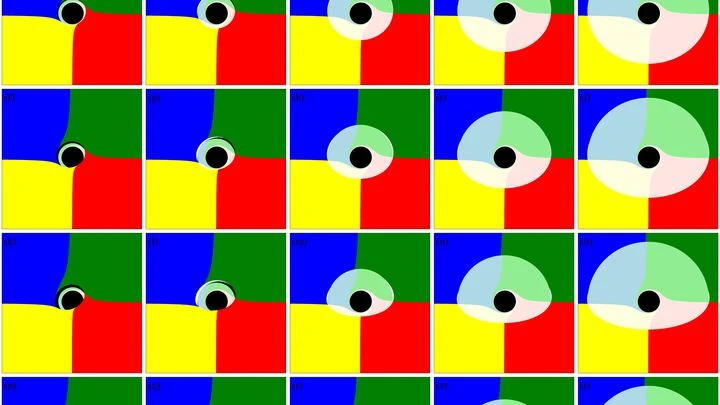
A black hole is not just a dark sphere in space. If there is gas and dust nearby, they swirl into a flat, glowing disk that gradually falls inward. This disk acts like a lamp, illuminating the hole itself, and against the bright background you can see its shadow — a dark silhouette with sharp edges.
But what if the disk is not flat but torn into pieces?
A black hole is not just a void but a massive object that warps the space around it. If it finds itself in a cloud of invisible dark matter, matter that emits no light but makes itself known through gravity, its behavior changes.
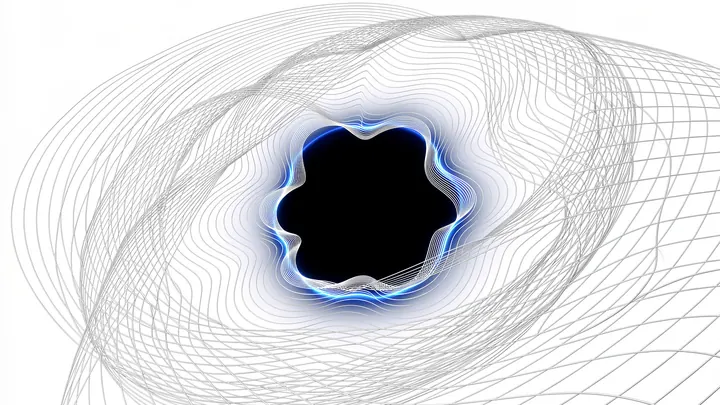
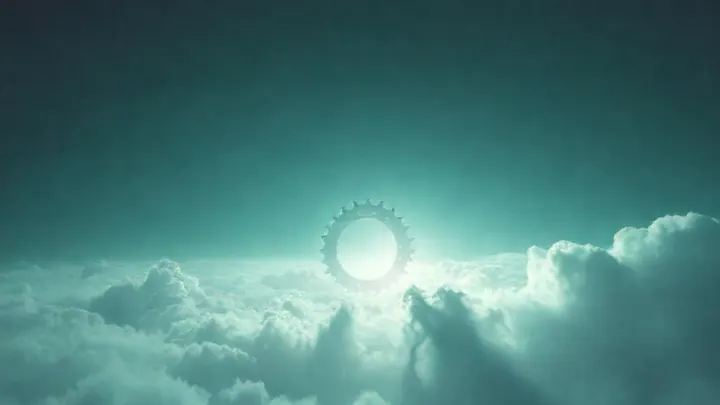
A wormhole is a tunnel through space, connecting distant regions of the Universe. Its shadow against a bright gas background was long thought to be as round as that of a black hole. But for a rotating wormhole (one you could actually traverse), the shape of the shadow might be surprising: the edge becomes jagged, like a gear.
When two black holes merge, the newborn hole should ring like a bell, emitting gravitational waves — ripples in space. Yet before the ring, a silence can fall: the black hole gets caught in a phantom trap, as if an invisible hand grips the bell’s clapper.
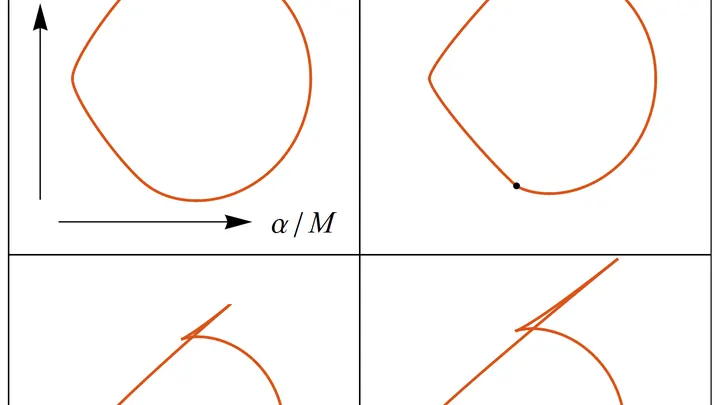
A black hole's shadow is a dark spot against the bright light bent by strong gravity. Usually, this spot is an almost perfect circle with a smooth edge. But if a black hole is not quite what Einstein's theory predicts, a sharp kink, like a corner on a crumpled piece of paper, can appear at the shadow's edge.
Although invisible, dark matter’s gravity governs the motion of stars and galaxies. It was first proposed by Fritz Zwicky in the 1930s, and later confirmed by Vera Rubin. Scientists have long suspected it accumulates around black holes, but direct proof was lacking.
An ordinary black hole is an abyss into which everything falls irretrievably. But a new model paints a different picture: at its edge, time freezes, and the hole becomes a frozen whirlpool. Light and matter don't fall in but stick fast to the surface — causing a bright spot to appear within the shadow.
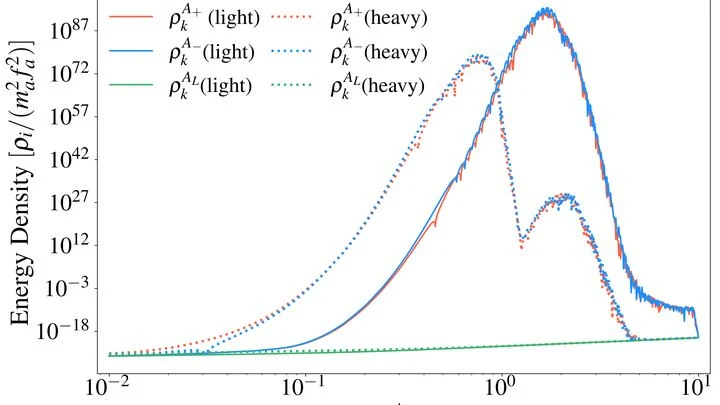
Supermassive black holes at the centers of galaxies appeared so quickly after the Big Bang that astronomers are scratching their heads. The solution lies in the trembling of an invisible axion field.
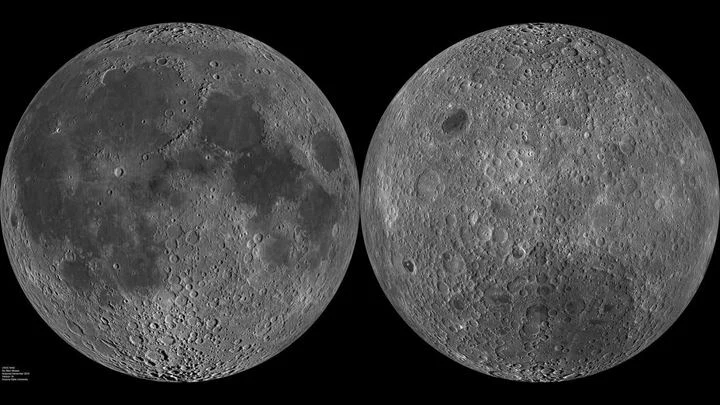
The farther apart the antennas, the finer the details they pick up. By merging signals, astronomers effectively turn multiple dishes into a single telescope as big as the distance between them. Add a lunar antenna to the Earth-based array, and you get a virtual eye 384 000 km wide.
Someone has thrown an invisible stone into the stellar pond of the Milky Way. The ripples spread not through water but through the motion of stars: in a region 200 by 50 parsecs across, their average vertical velocity is 7 km/s lower than that of their neighbors. The deviation is statistically significant at the 6σ level, so chance cannot explain it.