phenomenon

black hole photon ring

A bright ring of light around a black hole formed by photons orbiting near the event horizon.
22 related articles

Description

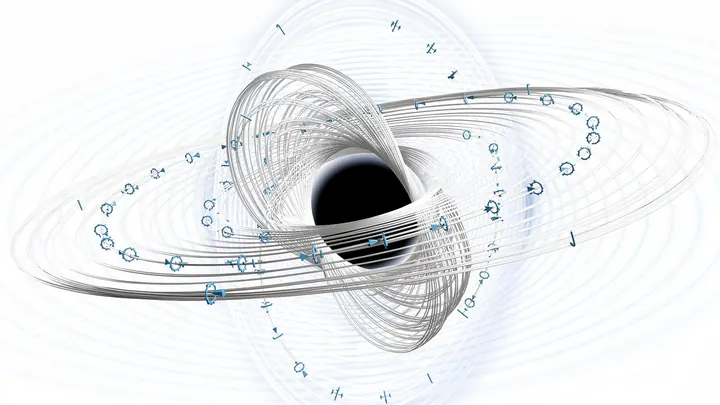
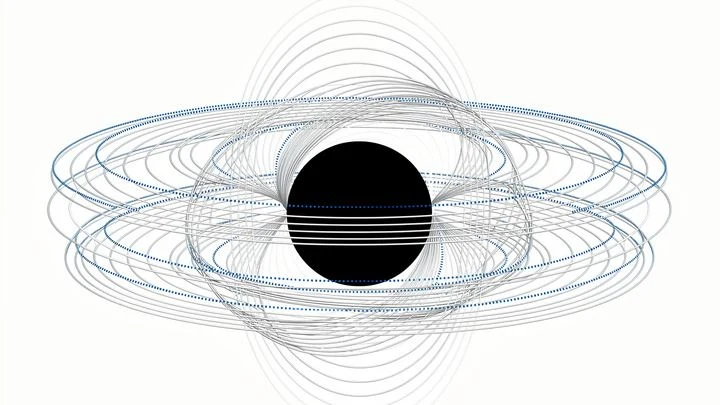
The photon ring is the bright, thin halo of light that appears around a black hole's shadow when we observe it. It is not light emitted by the black hole itself — nothing escapes from inside the event horizon — but rather light from distant stars or hot gas that gets bent by the black hole's extreme gravity. Some of that light loops around the black hole one or more times before reaching our telescopes, creating a distinctive ring that is a direct visual signature of the warped spacetime.

History

The concept of a photon sphere was first derived by David Finkelstein and others in the late 1950s, and the term 'photon ring' became prominent with the 2019 Event Horizon Telescope image of M87*. The detailed theory of photon rings as observable features was developed by astronomers like Avery Broderick and Avi Loeb in the 2000s.

How it works

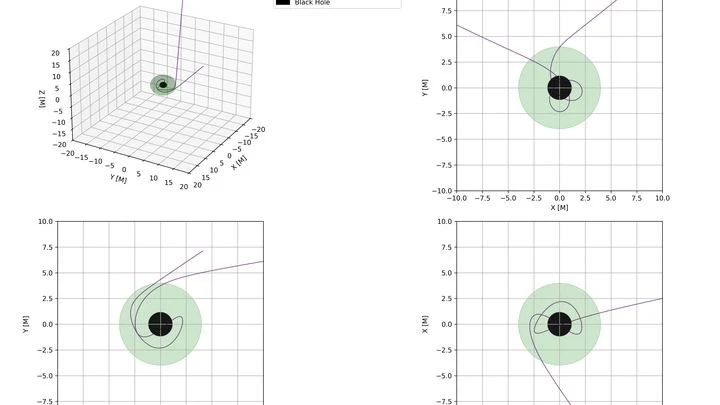
Photons passing near a black hole follow curved paths dictated by general relativity. Those that come within a certain critical distance — the photon sphere, at 1.5 times the Schwarzschild radius for a non-rotating black hole — can be deflected so strongly that they orbit the black hole several times. The light that escapes after these loops arrives at our detectors slightly delayed and concentrated into a narrow ring. The ring's size and shape encode the black hole's mass and spin, while its brightness distribution can reveal chaotic photon trajectories and even subtle effects from dark matter or modified gravity.

In practice

Photon rings are used to measure black hole spin and test general relativity in strong gravity, and they are a key target for next-generation very-long-baseline interferometry (VLBI) arrays like the Event Horizon Telescope.

Fun fact

The photon ring of a black hole can be up to several times brighter than the surrounding accretion disk because light can loop around the black hole multiple times, effectively amplifying the signal.

Concept graph →

Related articles · 22

HEP Theory2026-08-102 minarXiv:2608.09797express
Black Hole Rings Like a Hot Bell
Drop a pebble into a pond, and ripples spread across the water. Something similar happens when a black hole merges with another: it emits gravitational waves that resemble the fading ring of a bell.
HEP Phenomenology2026-07-311 minarXiv:2607.29149express
Birth of Dark Matter in the Inflationary Furnace
In the first moments after the Big Bang, the universe underwent a rapid expansion — inflation. Space stretched faster than light, and quantum jitters of the vacuum turned into real particles. This is how dark matter, the invisible substance that holds galaxies together, could have been born.
Shadow Symphony: How Data Became a Portrait of a Black Hole
In 2019, the world saw the first image of a black hole's shadow — an orange doughnut on a black background, becoming a symbol of scientific progress. But this image wasn't captured by a camera: it was born from mathematical alchemy, where data from eight radio telescopes, which gathered only crumbs of signal, merged into a single picture.
A Top on the Abyss's Edge: How Polarized Light Betrays Black Hole Spin
At the hearts of many galaxies, cosmic tops of incredible power spin — supermassive black holes. Their nature was first described by Schwarzschild right after Einstein gifted the world with general relativity.
General Relativity2026-07-122 minarXiv:2607.10658express
A Black Hole in Polarized Glasses
A black hole is not just a dark silhouette against the stars. Its shadow is surrounded by a thin glowing ring of photons that loop around the event horizon before escaping to an observer.
General Relativity2026-07-011 minarXiv:2607.01118express
How Black Holes Actually Glow: A Simple Discovery
A black hole is not just a vacuum cleaner. It glows faintly, emitting particles — this idea was proposed by Jacob Bekenstein, who connected the hole's temperature to its degree of disorder. Detecting such radiation in space is incredibly difficult.
General Relativity2026-06-151 minarXiv:2606.17284express
The Shadow of a Charged Black Hole
A black hole is a place where gravity is so strong that even light cannot escape. But around it there is a glowing ring of gas, and in the center a dark void known as the shadow. The size of this shadow depends on how spacetime is curved.
Popular Physics2026-06-141 minarXiv:2606.28366express
The Mystery of Eclipse Shadow Bands Solved
Moments before totality, swift shadow bands glide across the ground, like ripples from pebbles tossed into water. For centuries, this phenomenon baffled scientists. It turns out the key is that light is a wave. The Sun isn't a pinpoint lamp but a vast disk. When the Moon nearly covers it, a thin glowing crescent remains.
HEP Theory2026-05-282 minarXiv:2605.29923express
How a Black Hole's Photon Ring Reveals Its Chaos
A light beam approaches a black hole not head-on, but at a glancing angle. If the angle is just right, the light neither falls in nor escapes: it starts looping around, like a figure skater circling the rim of a funnel. This narrow track is the photon ring. It acts like a lens, repeatedly reflecting the image of everything that falls into the hole.
General Relativity2026-05-261 minarXiv:2605.27242express
Light Delay Near Black Holes Will Uncover the Mystery of Dark Matter
The gravity of a black hole creates a curvature of spacetime, acting like a lens: light from a distant galaxy splits in two, stretching into arcs. Dark matter around the hole barely changes the picture, as if a transparent curtain was added to a window pane.
General Relativity2026-05-251 minarXiv:2605.25709express
When Black Holes Turn Inside Out
A black hole is a cosmic pocket into which everything, even light, falls. But the pioneering work of John Wheeler, Stephen Hawking, and Roger Penrose showed: sometimes, due to the colossal spacetime curvature, the pocket turns inside out.
General Relativity2026-05-232 minarXiv:2605.24369express
The Shadow of a Black Hole: How Bent Light Paints a Portrait of the Invisible
Around an invisible fire, glowing gas swirls. The fire itself is hidden, but its outline can be guessed from the way the flames dance. That's roughly how astronomers 'see' black holes — not the object itself, but the superheated matter that, before plunging into the abyss, accelerates to enormous speeds and shines.
General Relativity2026-05-211 minarXiv:2605.22696express
Black Hole Pinball: How Spin Creates Dark Matter
Light passing by a black hole falls into a gravitational trap: its trajectory curves and the particle bounces along a nearly closed orbit, like a pinball.
General Relativity2026-05-191 minarXiv:2605.19588express
How Black Holes Erase Quantum Secrets
A quantum particle can be in two states at once, like a coin spinning, both heads and tails. Near a black hole, the event horizon, where spacetime curvature bends space and time to the extreme, acts as a one-way gate.
Polarization Echo: Light Catches the Gravitational Ringing of a Black Hole
When two black holes merge, they shake the very fabric of spacetime. The newborn giant doesn't settle instantly (it rings like a cosmic bell, emitting a characteristic pattern of damped gravitational waves) the so-called ringdown.
High Energy2026-05-121 minarXiv:2605.12659express
The Dance of Light Around a Black Hole: How to Keep the Main Frame Sharp
Photographing the vicinity of a black hole is like shooting a fountain: a short exposure freezes the droplets, a long one blends everything into blurry streaks. Light from the superheated gas swirling around the hole reaches us along different paths. Some rays curve around it in an arc, others make multiple loops due to spacetime curvature.
General Relativity2026-04-172 minarXiv:2604.16628express
A Black Hole in a Cloud of Dark Matter
A black hole is not just a void but a massive object that warps the space around it. If it finds itself in a cloud of invisible dark matter, matter that emits no light but makes itself known through gravity, its behavior changes.
Quantum Physics2026-04-091 minarXiv:2604.07782express
Picture from Nothing: Silence Paints Ghosts
A drummer stays silent, but from the pauses you can tell where he didn’t hit. Similarly, physicists built an image by catching not light, but moments of absolute darkness. The picture emerged from silence. In the experiment, they shone light from an ordinary lamp onto the object.
High Energy2026-04-082 minarXiv:2604.07453express
Collision Inside a Gamma-Ray Burst
A gamma-ray burst is a brief but extremely powerful flash of light, born from the merger of neutron stars or the collapse of a massive star. Inside such a flash, plasma flows race at enormous speeds and collide with each other.
Materials2026-04-072 minarXiv:2604.06083express
Light That Makes Current Out of Nothing
An ordinary sheet of black phosphorus looks like a layered cake of atoms. If you shine a regular lamp on it, nothing special happens: the electrons sit still, like spectators in a dark theater. But a short laser flash lasting millionths of a billionth of a second shakes up that theater.
HEP Phenomenology2026-01-081 minarXiv:2601.05351express
Cosmic Fireflies: How Dark Matter Turns into Visible Light
Dark matter is the invisible framework of the Universe. It doesn't emit light, but its gravity keeps galaxies from flying apart. A new hypothesis: dark matter consists of dark photons — ghostly particles that are invisible under ordinary conditions.
Cosmology2025-12-031 minarXiv:2512.03357express
Invisible Vortices of Dark Matter
Dark matter is an invisible ocean that, as shown by observations by Vera Rubin, keeps stars in galaxies from flying apart. Physicists suspect that if dark matter consists of ultralight particles, in the cosmic cold it turns into a frictionless fluid — a so-called condensate.