When a Material Bends Only One Way express
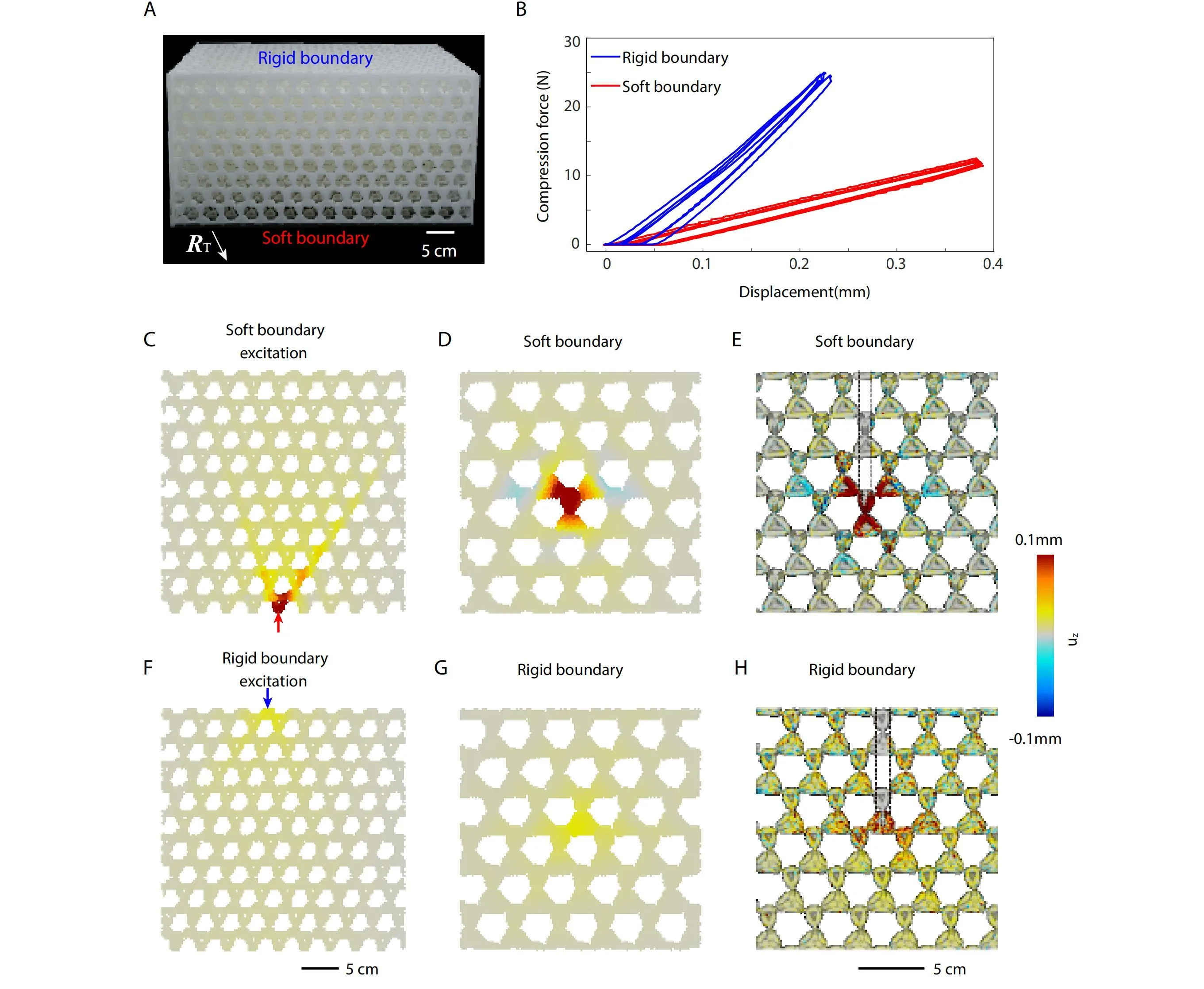
Bending a sheet of paper is easy. But compressing it by pushing from the edge is a different story: the paper will crumple but barely transmit the force further. That's how ordinary elasticity works — deformation depends on where and how you press. The new three-dimensional lattice pushes this contrast to the limit. It conducts mechanical vibrations in only one direction, while remaining almost motionless in the reverse, and it does so in all three dimensions at once.
The secret lies in the clever geometry of the struts. They don't just stretch or compress; they also bend. Bending lifts zero topological modes (states that get stuck in flat structures) to a finite frequency. Phonon modes localized near one face emerge. An ordinary beam dampens a push by vibrating as a whole. Here, the energy of the push goes into bending the nearest struts and gets trapped at the edge, not leaking deeper. As a result, one side of the structure turns out to be noticeably stiffer than the other — both for static pressure and for fast vibrations.
Experiments confirmed that the asymmetry remains reliable even when frequencies and directions change. Such a metamaterial could become the basis for vibration shields that protect sensitive electronics, or for waveguides that transmit mechanical signals without loss in a strictly defined direction. In essence, it's a three-dimensional analog of a diode, but for sound and deformation rather than electric current.
In everyday life, we encounter a similar asymmetry when sawing wood: the saw moves forward easily but catches on the backward stroke. Here, though, the effect comes not from friction but from the material's internal geometry.
In Peter Watts's novel Blindsight, an alien ship uses asymmetric fields to selectively pass or block signals. Three-dimensional topological lattices are a first step toward such control of mechanical waves.