Magnetic Tracks with a Secret express
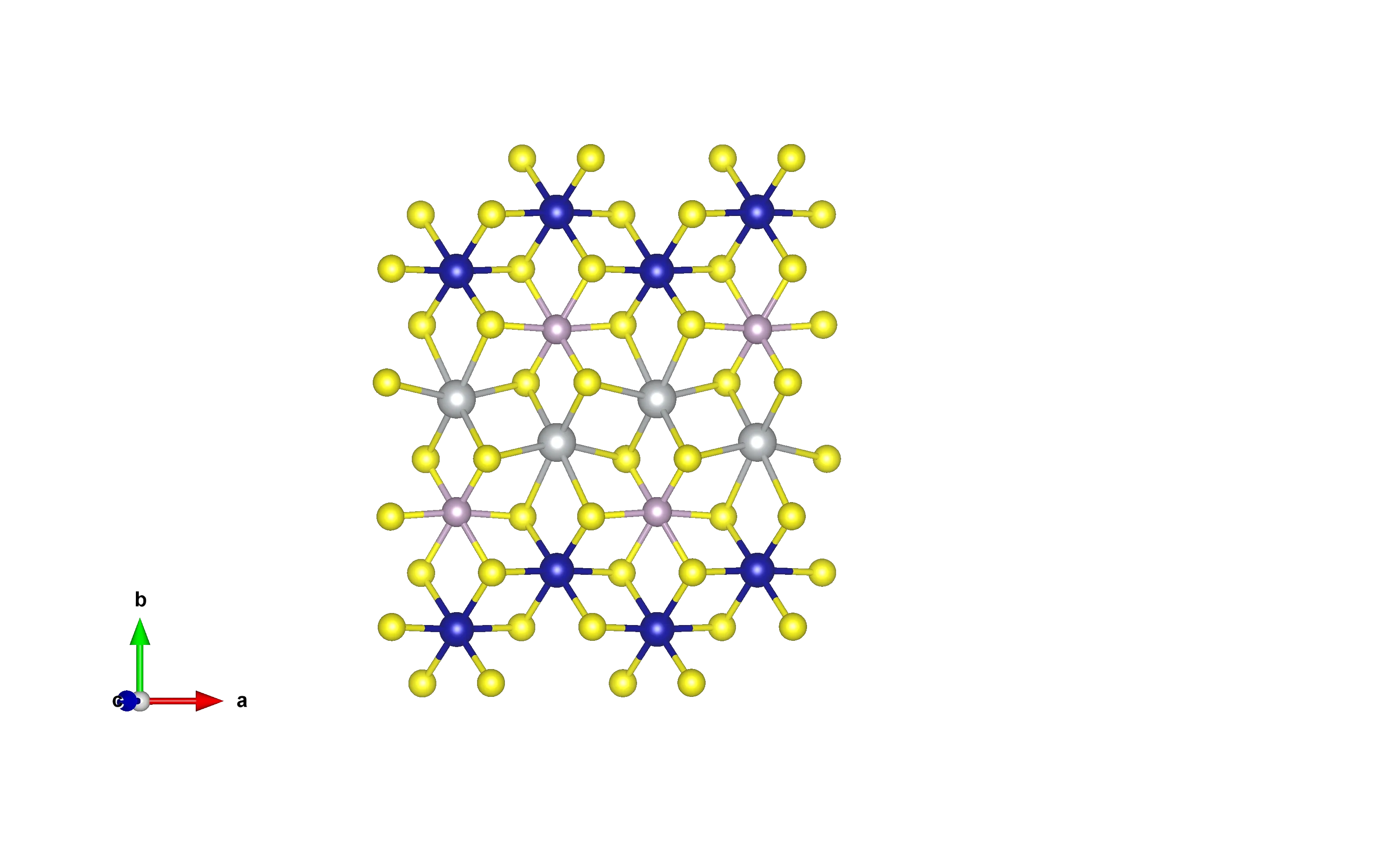
A parquet floor where every other plank is turned the opposite way looks symmetric. But if you run your hand over it, in one direction your fingers glide along the grain, and in the other they catch. That's roughly how the new type of magnetism studied in the crystal AgCrP2S6 works.
In this layered material, chromium atoms are arranged in long chains, like strings of beads. Within each chain, the magnetic moments (tiny compasses) of the atoms point the same way, but neighboring chains point in opposite directions. So the whole sample remains nonmagnetic on the outside. However, calculations showed that if you slightly break the crystal's symmetry, for example by applying an electric field across the layers, electrons start to feel the difference. Their energy depends on which way their own spin points, as if on a slippery parquet floor, one foot glides easily while the other drags.
The authors built a simplified model linking this effect to electron hops between distant neighbors — the third chains over. The stronger the field, the greater the energy difference for "up" and "down" spins. Reversing the field flips the sign of the difference, as if the parquet were tilted the other way. Moreover, a similar effect arises if some sulfur atoms are replaced with selenium (called Janus substitution), or if a ferroelectric CuInP2S6 layer is placed on top — then the spin splitting can be controlled simply by switching the neighbor's polarization.
This approach paves the way for devices where information is encoded not by charge but by electron spin, and switching happens without a magnetic field, just by an electric signal. That promises faster and cooler electronics. And all this is in a material that looks nonmagnetic from the outside, like that parquet floor whose pattern hides an inner order.
In ordinary magnets, spins align in the same direction and create a strong external field, like a crowd waving flags. In altermagnets, neighbors' flags point opposite ways, so the field cancels outside, but electrons still sense the internal order.