The antiproton is the antimatter counterpart of the proton: it has the same mass and spin, but carries a negative electric charge. When an antiproton meets a proton, they annihilate, converting their entire mass into energy in the form of other particles, typically pions. This makes antiprotons a key player in understanding the fundamental asymmetry between matter and antimatter in the universe — why we observe a universe made almost entirely of matter, when the Big Bang should have produced equal amounts of both.
History
The antiproton was predicted by Paul Dirac in 1933 as a consequence of his relativistic equation for the electron, which implied the existence of positively charged electrons (positrons) and, by extension, antiprotons. It was first observed experimentally in 1955 by Owen Chamberlain, Emilio Segrè, and colleagues at the University of California, Berkeley, using the Bevatron particle accelerator.
How it works
Antiprotons are produced in high-energy collisions, such as those at CERN's Antiproton Decelerator, where protons are smashed into a metal target. The resulting antiprotons are slowed down and can be trapped using electric and magnetic fields. Their properties are studied by comparing them directly with protons, for example by measuring their mass and charge with extreme precision. In experiments like ALPHA, antiprotons are combined with positrons to form antihydrogen atoms, allowing tests of whether antimatter behaves identically to matter under gravity and spectroscopy.
In practice
Antiprotons are used in particle physics research to test fundamental symmetries, and are also explored for potential medical applications, such as in antiproton therapy for cancer treatment, where their annihilation could deposit energy more precisely than conventional proton therapy.
Fun fact
When an antiproton and a proton annihilate, the energy released is about 1.9 gigaelectronvolts, which is roughly the rest energy of two protons, and this energy appears as a burst of pions that can be detected.
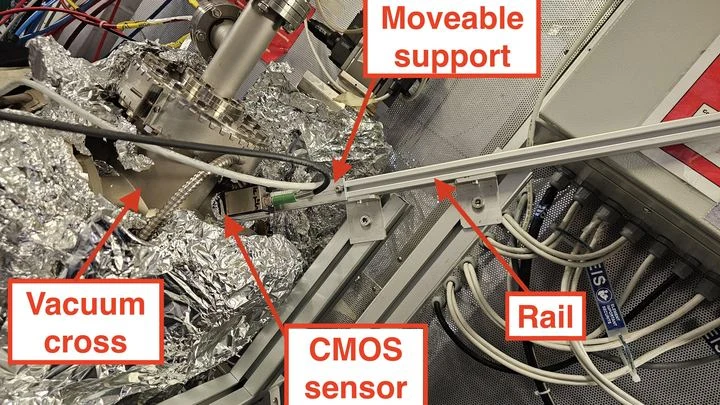
The antiproton beam hits the plate, and each impact bursts into a shower of charged particles. In the GBAR experiment at CERN, this picture is captured not by a sophisticated detector but by an ordinary industrial camera without a lens, pressed against the vacuum window from the outside.
The antiproton is the mirror twin of the proton: same mass, but negative charge. When it hits matter, it usually annihilates instantly — disappearing in a burst of energy upon colliding with an atomic nucleus.
In the first moments after the Big Bang, matter and antimatter should have been created in equal amounts. But today, everything around us is ordinary matter, and antimatter is almost nowhere to be found. Where did it all go? The standard answer: a tiny imbalance in favor of matter wiped out almost all antimatter.
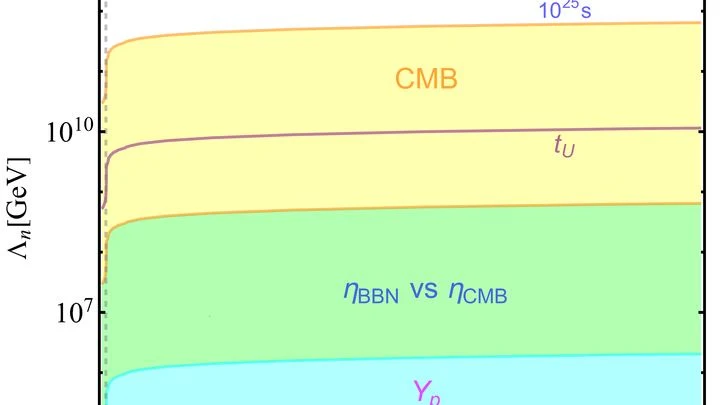
Light from the hottest stage of the universe has been traveling toward us for nearly 14 billion years. This is the cosmic microwave background — a faint glow filling the entire sky.
Dark matter is the invisible scaffolding of the universe. It's there, we know from the motion of stars and galaxies, but what this scaffolding is made of remains unknown. One guess is ultra-light particles similar to axions. They barely interact with ordinary matter, yet occasionally they do get involved.
In the first moments after the Big Bang, the universe was a searing 'soup' of particles. As it cooled, phase transitions occurred — much like water turning to ice. At one such moment, magnetic monopoles of dark matter could have been born: tiny clumps of field with a single magnetic pole.
At the centers of many galaxies, not only supermassive black holes lurk, but also vast clouds of invisible matter. If this matter consists of ultralight particles, it can gather into dense clumps — a kind of 'star' made of dark matter.
A parquet floor where every other plank is turned the opposite way looks symmetric. But if you run your hand over it, in one direction your fingers glide along the grain, and in the other they catch. That's roughly how the new type of magnetism studied in the crystal AgCrP2S6 works.
Imagine a green beam that, passing through an ingenious optical setup, twists into a three-dimensional funnel of light — an optical vortex. At its heart, like in the eye of a hurricane, the intensity drops to zero. It is there that photons disappear.
The interiors of neutron stars are a realm of degenerate matter. Here, protons condense into a superconducting condensate, threaded by quantum vortices. Imagine tiny magnetic tops: each carries a quantum of magnetic flux and glides through the electron fluid.
Since Saul Perlmutter and his colleagues discovered the accelerated expansion of the universe, physicists have been scratching their heads over the nature of dark energy.
A pebble falls into a pond, and ripples spread across the water. In the quantum world, the pond is not made of water but of many identical particles, and the pebble is also a particle, just a foreign one. Such a foreign particle is called a Fermi polaron.
In very dim light, photons arrive one by one, like drops from a leaky faucet — never in pairs. This effect, predicted by Roy Glauber and confirmed by Leonard Mandel, directly proves that light is made of particles.
A stone thrown into water leaves ripples. A satellite orbiting Earth also leaves a trace — not on water, but in the laws of physics. Its orbit is not a frozen line: it slowly rotates, like the hand of a giant clock.
Two teams pull a rope with equal force in opposite directions — the rope doesn't move, and the net force is zero. That's how many antiferromagnets behave: the magnetic moments of atoms are aligned oppositely and cancel each other out.
A giant tank of ultrapure water sits deep underground in Japan. Its walls are lined with thousands of light-sensitive sensors that catch faint flashes — the traces of ghostly particles passing through the water.
Just after the Big Bang, clumps weighing as much as a trillion Suns and with an electric charge of colossal strength, like trillions of electrified balloons, could have drifted through space.
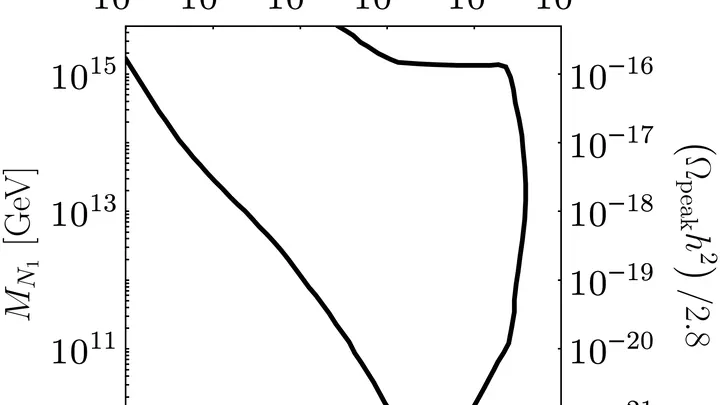
In the very beginning, moments after the Big Bang, the universe was ridiculously symmetric: particles and antiparticles in equal measure. But a tiny imbalance occurred, like one extra grain of sugar in a kilogram, and the entire familiar world, stars, planets, people, arose from that surplus. How nature created this imbalance remains a mystery.
A translator halfway across the hall suddenly starts rendering the message backwards. That's roughly how a neutrino, a ghost particle that barely notices matter, might behave if it encounters a cloud of ultralight dark matter.
A massive nanodiamond inside a quantum interferometer splits in two, pulling itself into two realities. Its gravity — tiny, almost imperceptible — stirs the quantum field of the vacuum, giving rise to coherent clouds of gravitons. These are the gravitational shadows cast by each position of the mass.
A stack of magnetic plates, each magnetized opposite to its neighbor, is like a layered sandwich where electrons move as a single organism. The whole material starts mimicking an axion — a ghost particle that physicists suspect might be dark matter.
In the kitchen, there's a bucket of water and an identical bucket of sand. Pour the sand into the water, and you get a mixture where there's exactly five times more sand than water. That's roughly how our universe is arranged: one part ordinary matter — the stuff stars, planets, and we ourselves are made of — and five parts elusive dark matter.
Inside a neutron star, the density doesn't change smoothly but drops abruptly at sharp cliffs — density staircases. At these steps, the void suddenly births pairs: neutrinos and antineutrinos.
To uncover the proton's true size, physicists swapped the electron in a hydrogen atom for its heavy copy — the muon. Acting like a magnifying glass with thousandfold power, the muon gets right up against the nucleus and 'probes' the proton with unprecedented precision.
When particles collide at enormous speeds, they produce a shower of new particles. Among them are antiprotons — twins of ordinary protons but with the opposite charge. Each of these particles has its own spin, like a tennis ball sent with a twist. But whether antiprotons are actually spun up at birth has never been checked.
In the first instants after the big bang, the universe was a quantum vacuum where pairs of particles and antiparticles, virtual "guests" from physical nothingness, spontaneously appeared and almost immediately annihilated.
The universe wasn't born alone — alongside it came a mirror twin where everything is reversed: left and right are swapped and time flows from future to past. After the Big Bang, the world, according to Alan Guth's idea of superfast inflation, should have contained equal amounts of matter and antimatter.
A single antiproton, trapped and cooled to near absolute zero, behaves like a tuning fork that needs a very precise strike to produce a clean note. Catching that 'note' directly is nearly impossible — the signal is too weak.
The antiproton is the proton's twin, only with a negative charge. When such a twin approaches a nucleus, it doesn't just bounce off: a whole dance of attraction and repulsion unfolds between them.
Two metal plates in a perfect vacuum attract each other. Even Richard Feynman compared emptiness to a boiling foam: particle pairs are born and immediately vanish, creating the Casimir effect. If the plates are asymmetric, they also start to twist — that's a vacuum motor.
But rotation doesn't require oddly shaped parts.
Dark energy and dark matter are the invisible conductors of the cosmos. Usually considered independent, new research proposes seeing them as dance partners. The lead — dark energy — changes the mass of dark matter particles. Like a dancer who lifts and lowers their partner, dark energy increases or decreases the weight of dark matter.
In a dark laboratory where superconducting chips are cooled to thousandths of a kelvin, a qubit spins under the influence of a magnetic field. A regular qubit rotates in one direction. An antiqubit, its mirror twin, rotates in the opposite direction. Together they form a pair that senses the field twice as sharply as any ordinary pair.