Black Hole with a Soft Core Changes the Music of Gravitational Waves express
The spiral of water draining into a sink spins faster and faster toward the center. In an ordinary black hole, that funnel ends in an infinitely sharp point — a singularity where the laws of physics break down. But this new work considers a different picture: the funnel doesn't taper to a needle but ends in a smooth, swelling bubble. This is a 'regular' black hole, where instead of a singularity there is a core of expanding space, like a tiny universe.
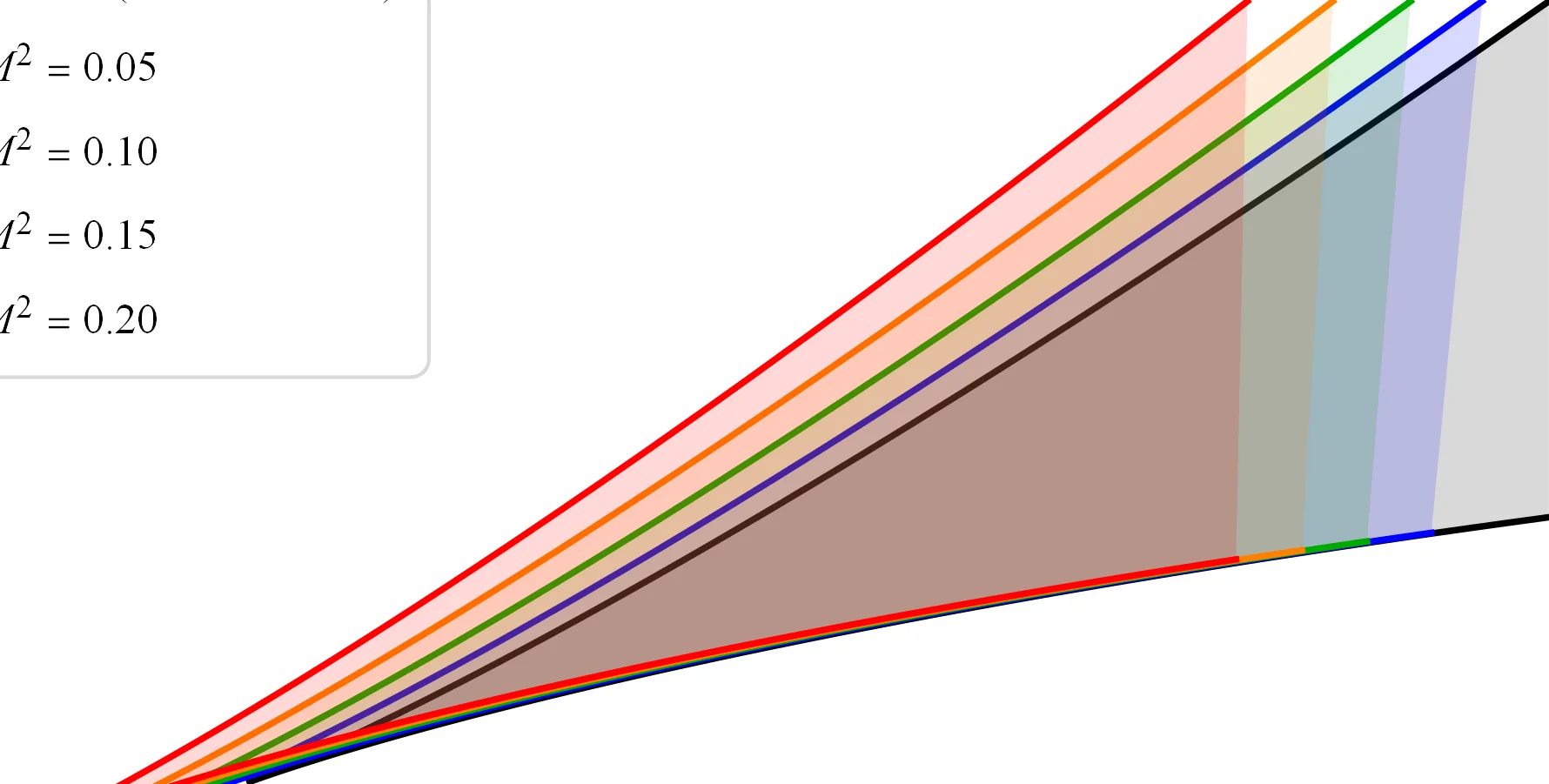
The authors took a model in which gravity's strength changes at the smallest distances, as if a spring scale became softer under strong compression. A single dimensionless parameter, α/M², governs the whole picture. As it increases, the tightest stable orbits, those where a star can still circle without falling in, shift closer to the center. The allowed region for motion shrinks, like a figure-skating rink narrowed toward the middle.
The researchers then calculated the gravitational waves — the trembling of space emitted by a small star falling into a large hole. It turned out the quantum correction shifts the wave left on the graph: crests arrive earlier because the orbit has become shorter. The amplitude grows a bit — the star dives deeper into the strong field, making the burst brighter. This is especially noticeable for orbits with many loops near the horizon: they linger longer in dangerous proximity and reveal the hole's unusual nature more strongly.
This approach turns a black hole into a musical instrument: its quantum 'heart' sets the tone, and the falling star plays the melody. If detectors catch a phase shift and stronger peaks, we'll hear the voice of quantum gravity for the first time — not in equations, but in the real cosmos.
The parameter α/M² can be thought of as the 'softness' of the hole's center: at zero it becomes ordinary with a singularity, and at large values its core swells like a balloon, preventing anything from falling into a point.
In M. John Harrison's novel 'Light', black holes turn out to be gateways to other universes — a regular hole with a swelling core echoes that idea, only instead of a portal there's a smooth quantum bubble.