Spin, Mirror, Spin: A Shortcut to Fusion Energy express
The race for fusion energy is like trying to bottle a lightning bolt. For decades, physicists have struggled to recreate on Earth the processes that power the Sun. The main challenge is getting light nuclei to fuse despite their mutual repulsion, while extracting more energy than was spent heating and confining the plasma.
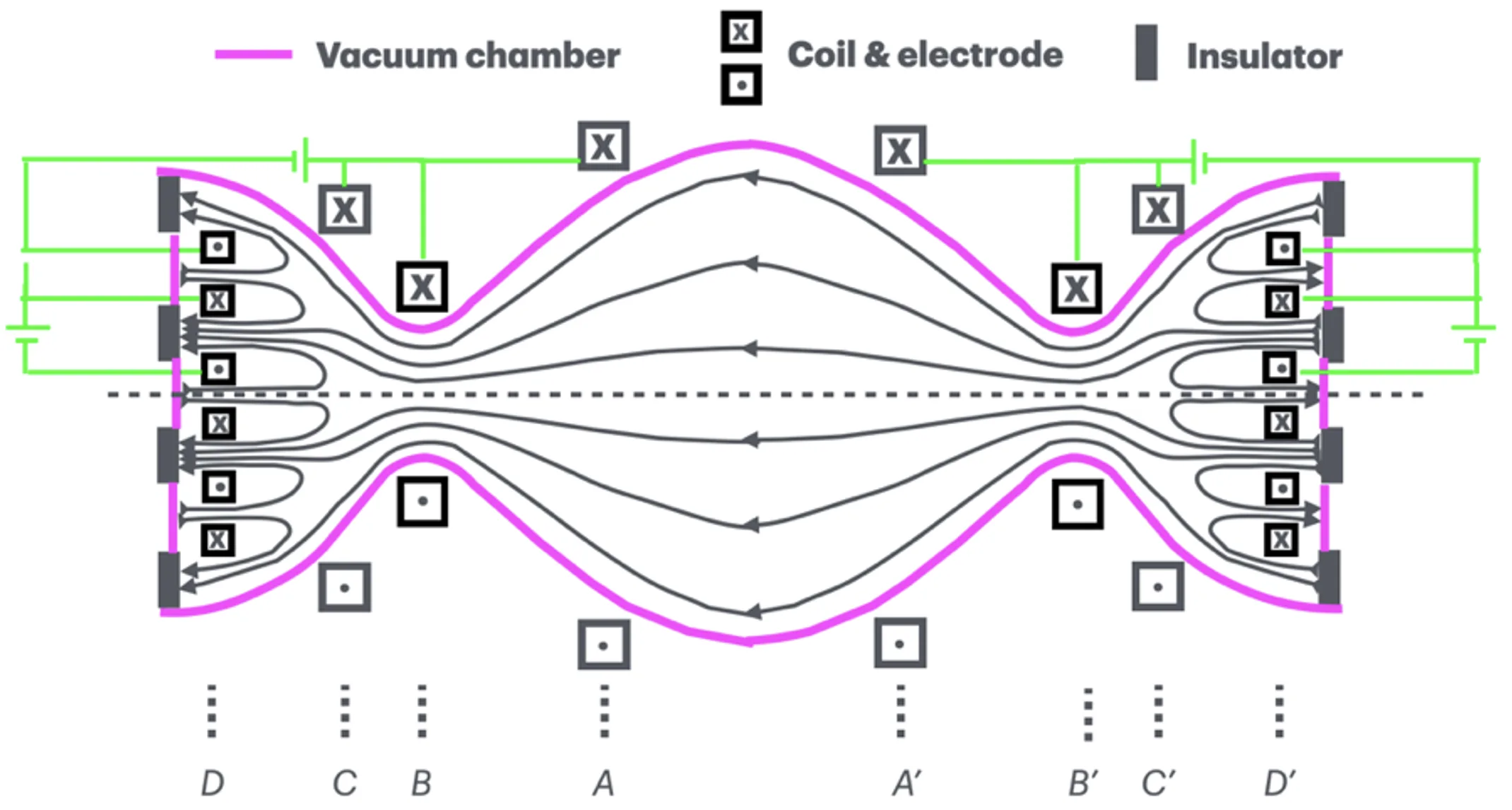
This new work offers a surprisingly elegant solution. The device from the University of Texas at Austin works like a carousel that doesn't just spin the seats but also squeezes them from all sides. First, the plasma (a superheated gas of charged particles) is slowly warmed in this rotating magnetic mirror, like soup on a stove. Then comes a rapid compression from every direction at once: from the sides, top, and bottom. This double whammy sharply boosts density and temperature at the center, triggering an avalanche of fusion reactions.
The authors build on already completed experiments and patents. Their calculations show the method can get very close to the Lawson criterion — the coveted milestone after which a fusion reaction starts to pay for itself. A carousel that squeezes plasma might just be the shortcut to clean energy that humanity has been seeking since the mid-20th century.
Original abstract
as written by the authors arXiv:2607.27024
Controlling nuclear fusion is so challenging that for decades, people have been asking: Are we closer to infinite clean energy? Upon the philosophy of beauty and simplicity, the current work points out that there can be a shortcut: the rotating mirror with detached electrodes and all-directional pinch compressions. This is based on the provisional patents filed recently by the University of Texas at Austin. The device combines the steady-state and fast processes in the two main streams of controlled nuclear fusion research: magnetic confinement fusion and inertial confinement fusion. The fuel plasma is preheated in a steady-state process in a rotating mirror with detached electrodes and then the pinch compressions in both radial and longitudinal directions are applied as the fast process. Preheating and longitudinal compression, in addition to the radial compression, significantly boost the nuclear fusion rate. Fast compression after the preheating limits the time for thermalization between ions and electrons and, therefore, minimizes the impact of electron bremsstrahlung radiation loss on ions. Based on the existing experimental results, the current method can be extrapolated to have the potential to reach or exceed the Lawson criterion for the first demonstration of the feasibility of peaceful usage of nuclear fusion energy.
The Lawson criterion is the product of plasma density, temperature, and energy confinement time. For a deuterium-tritium mixture, you need about $10^{20}$ particles per cubic meter multiplied by seconds, at temperatures of hundreds of millions of degrees.
In Liu Cixin's novel "The Three-Body Problem," the alien Trisolarans use a similar principle: they compress matter to monstrous densities to trigger fusion reactions in their miniature "stars."