Rotationalenergy is the kinetic energy stored in an object's spinning motion. For a rigid body, it depends on the moment of inertia and the square of the angular velocity. In astrophysics, rotational energy is a major reservoir of power: a rapidly spinning neutron star, for example, can hold enormous rotational energy that, when tapped, drives phenomena like pulsar winds and gamma-ray bursts. The concept also applies to fluid systems, where rotating flows carry energy that can be converted into other forms.
History
The formula for rotationalkinetic energy was established in the 18th century by Leonhard Euler, who formalized the mechanics of rotating bodies. The idea that stellar rotation could power explosions gained traction in the 20th century with the discovery of pulsars and gamma-ray bursts.
How it works
For a solid object, rotationalenergy is calculated as (1/2) I ω², where I is the moment of inertia and ω is the angular velocity. When an object slows down, this energy is released — often as radiation, particles, or heat. In astrophysical contexts, a spinning black hole or neutron star can lose rotational energy through magnetic fields or gravitational waves, powering some of the most energetic explosions in the universe. The mechanism is analogous to a flywheel: spin it up, and it stores energy; brake it, and the energy comes out.
In practice
Rotationalenergy is harnessed in flywheel energy storage systems, which store electricity as spinning kinetic energy and release it on demand, and in gyroscopes used for navigation and stabilization.
Fun fact
A neutron star the size of a city can spin hundreds of times per second, storing more rotationalenergy than the Sun emits in its entire lifetime.
Units by system: SI: joule · CGS: erg · Planck: planck energy · natural: electronvolt
Water in a tank spins at nearly four revolutions per second, and, as if by magic, a column the size of a dinner table emerges. The vortex lives for dozens of rotations, even though everything around it churns and trembles. Where does such stability come from?
The secret is that the vortex is not isolated.
A laser beam is like a swift vortex that briefly captures a passing electron. As the particle moves through the pulse, its spin (the intrinsic rotation, like a tiny top) experiences a weak kick. After leaving the beam, the top no longer points in the same direction; it has turned a little.
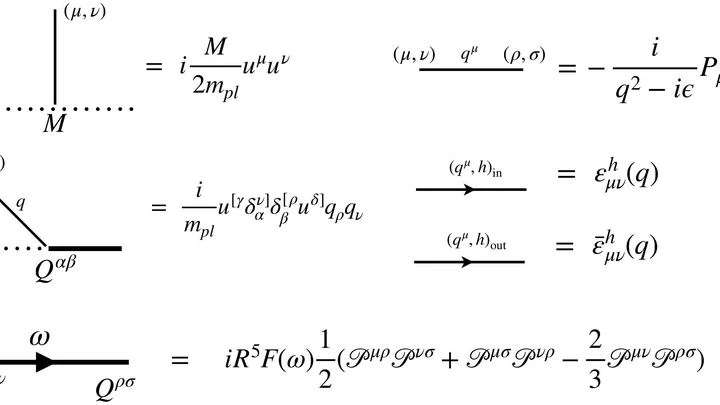
Two stars circle each other, gradually drawing closer. Their dance loses energy, and that energy escapes into space — in the form of gravitational waves, and sometimes other fields.
The early Universe was like a tightly coiled spring. In the first moments, it expanded at an unimaginable rate — a phase called inflation. Usually, this is attributed to a special field, but there's another idea: spacetime itself twists like a spring, and this twisting (in physics, torsion) becomes the engine of expansion.
The race for fusion energy is like trying to bottle a lightning bolt. For decades, physicists have struggled to recreate on Earth the processes that power the Sun. The main challenge is getting light nuclei to fuse despite their mutual repulsion, while extracting more energy than was spent heating and confining the plasma.
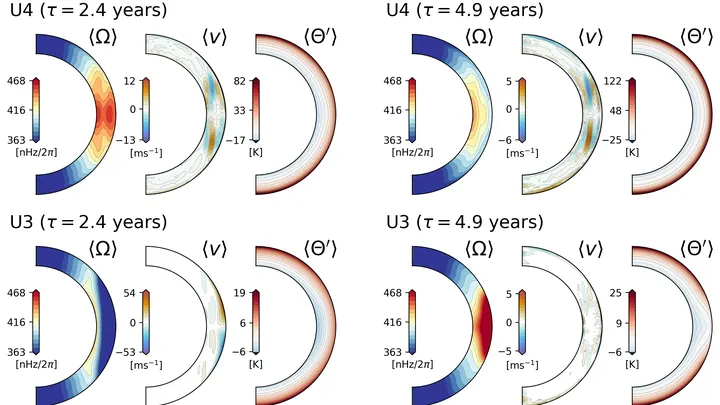
27 days at the equator, 32 at the poles. Five days' difference, and over a year, the equator gains almost a week. A gas ball 1,4 million kilometers in diameter spins like a layered top: each layer moves at its own speed.
Inside planets and stars, in rotating oceans of plasma, turbulent flows, Coriolis forces, and magnetic tension collide. The central question is how the energy of this chaos crystallizes into a stable magnetic framework that can last billions of years.
When two superdense stars circle in a tight dance, the space around them shudders. This shudder, gravitational waves, is caught by giant detectors on Earth. But deciphering the signal is tricky: you need to figure out what exactly you're dealing with — a pair of black holes or neutron stars.
A neutron star is the leftover core of an exploded giant, compressed to the size of a city. A teaspoon of its matter weighs a billion tons. Inside such a star, particles are packed so tightly that quantum effects start to show. One of them is the intrinsic rotation of particles, or spin.
Toss a handful of coins on a table: each one lands heads or tails on its own. Now imagine the coins start flipping over, nudging each other. That's roughly how neutrinos behave in a very dense environment.
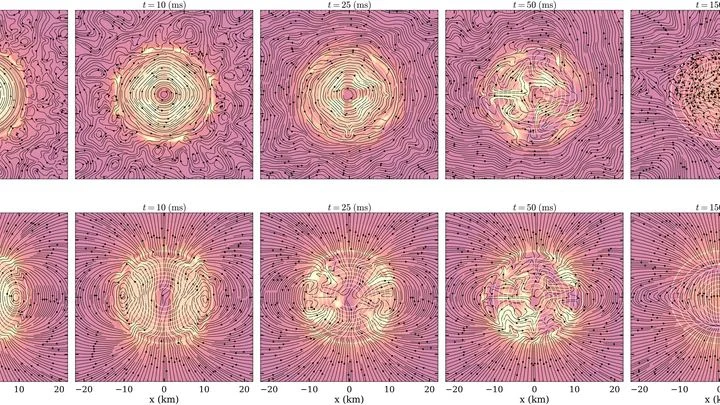
A neutron star is a sphere the size of a city but with the mass of an entire Sun. Its magnetic field can tear atoms apart from thousands of kilometers away. Yet until now, it was a mystery how this field is arranged inside: whether it is twisted into tight ropes or more like neat lines radiating from the poles.
A tiny magnet levitates in a magnetic trap, like a weightless needle. Its magnetized axis is like a stubborn compass needle that is prevented from turning. An invisible wall rises before it. But in the quantum world, particles can seep through barriers — this trick is called tunneling.
Sugar dissolves in tea, and then with a single motion gathers back into the spoon. In an ordinary kitchen, you won't see that — viscosity and disorder get in the way. But in the world of ultra-slow motions, where inertia vanishes, such tricks become reality.
A flock of birds or a school of fish sometimes swirls into a vortex, even though no individual commands 'spin.' Such collective rotation helps the group stay together and mix better. It is usually explained by the individuals being asymmetric, like a screw, or pushing each other with a twist. But a new study finds another route.
In superfluid helium, a vortex is like a tornado in a bottle, but instead of water, it's a quantum liquid that flows without friction. Such a vortex doesn't dissipate on its own, so the question of where its energy goes has long remained open.
Neutron stars are the compressed cores of dead stars — city-sized objects with staggering density. Some of these stars become pulsars, cosmic lighthouses emitting strictly periodic radiation pulses.
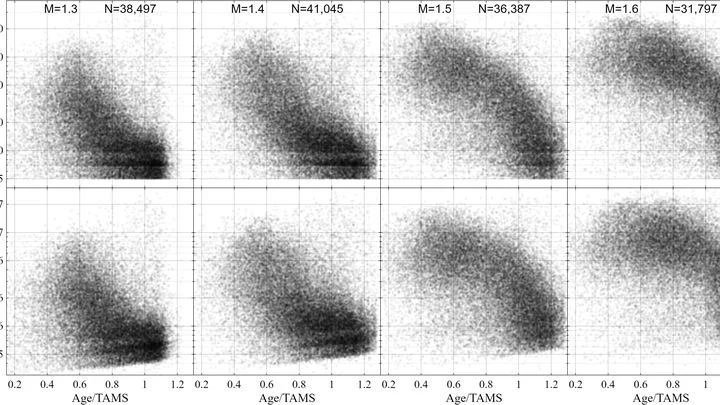
The Gaia space telescope has measured how fast more than a hundred thousand stars spin. It turns out that a star's rotation speed depends on its temperature. For stars cooler than 6500 degrees, the surface moves at 10–20 kilometers per second.
Short gamma-ray bursts are colossal explosions that release, in a fraction of a second, energy comparable to what our Sun will emit over billions of years.