Superconductor Pushed to 190 Kelvin express
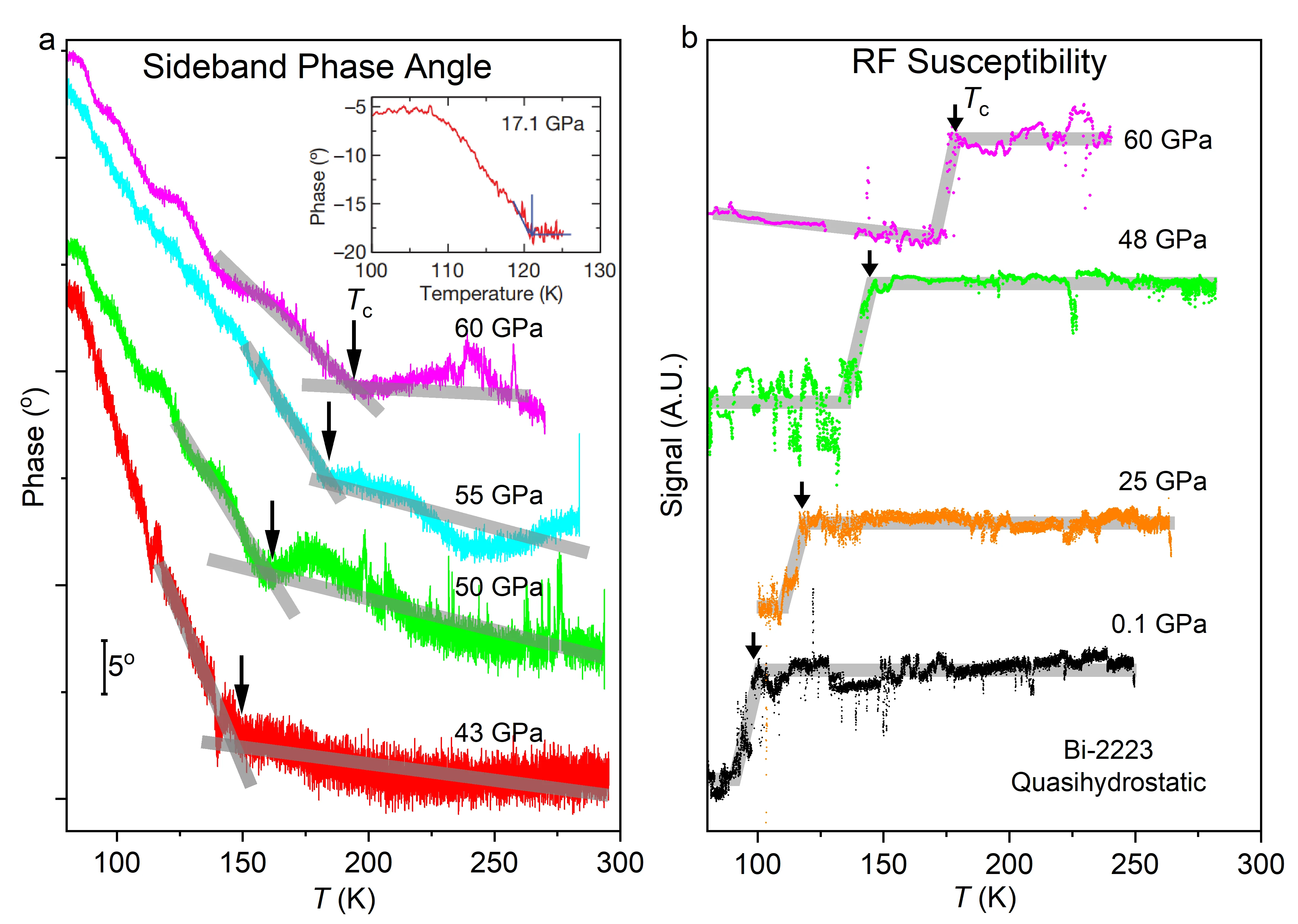
Many materials behave like finicky ice: at one pressure they melt, at another they turn harder. Superconductors in the cuprate family are no exception. Their ability to carry current without loss depends on how tightly the crystal lattice is squeezed. In a new study, physicists traced this dependence for the compound Bi-2223. Samples were placed in high-pressure cells, and the onset of the Meissner effect — the telltale sign of superconductivity when magnetic fields are expelled from the sample — was measured.
When compressed up to 25 GPa (roughly 250,000 times atmospheric pressure), the critical temperature of the superconductor behaved unexpectedly: it first dropped, then began to rise. This is like a car that slows on an incline but then shifts to a lower gear and confidently climbs the hill. Beyond 25 GPa, the rise became continuous, and by 60 GPa the temperature reached 190 K — that's minus 83 degrees Celsius. Colder than the harshest Antarctic night, but far warmer than most known superconductors.
Such a curve hints at a second region of superconductivity at high doping levels (adding impurities to tweak properties). Possibly the material rearranges its electronic structure, opening a new channel for lossless current. This isn't just a record for its own sake — understanding the second regime could help create superconductors that work at more convenient temperatures.
A temperature of 190 K (-83 °C) is lower than the lowest natural temperature ever recorded on Earth (-89.2 °C at Vostok Station in Antarctica), but it still requires cooling.