High pressure refers to conditions where the pressure is significantly greater than Earth's atmospheric pressure at sea level (about 101 kPa). In planetary science, high pressure is a defining characteristic of planetary interiors, where pressures can reach millions of atmospheres. For example, at the center of Earth, the pressure is about 360 GPa (3.6 million atmospheres). These extreme conditions fundamentally alter the behavior of matter: gases become supercritical fluids, solids undergo phase transitions to denser crystal structures, and chemical reactions that are impossible at ambient pressure become favorable. High pressure is crucial for understanding the formation and evolution of planets, from the magma oceans of young rocky worlds to the metallichydrogen cores of gas giants. It also plays a role in the synthesis of new materials and in biological research, where pressure can be used to preserve cells or alter biochemical processes.
History
The systematic study of high-pressure phenomena began in the 19th century with the work of physicists like Percy Bridgman, who developed techniques for generating pressures up to 100,000 atmospheres and won the Nobel Prize in Physics in 1946 for his contributions. In planetary science, high-pressure experiments became essential in the mid-20th century as researchers sought to understand the Earth's deep interior.
How it works
At high pressure, the volume of a system is reduced, bringing atoms and molecules closer together. This increases the frequency of collisions and lowers the activation energy barriers for certain reactions, allowing chemical pathways that are kinetically hindered at low pressure to proceed. For instance, in a planetary magma ocean, high pressure can force hydrogen gas to dissolve into molten rock, where it can react with metal oxides to form water and other volatiles. The pressure also stabilizes denser phases, such as high-pressure polymorphs of minerals, which can sequester elements and affect the planet's thermal evolution. In the laboratory, high pressure is achieved using diamond anvil cells, which can generate pressures exceeding 500 GPa, or dynamic compression methods like shock waves.
In practice
High-pressure research is used to synthesize superhard materials like synthetic diamonds and cubic boron nitride, which are essential for cutting tools and abrasives, and to study the behavior of materials under extreme conditions relevant to planetary modeling and inertial confinement fusion.
Fun fact
At the high pressures found in the deep oceans, some organisms, such as the hadal snailfish, have adapted to live at depths of 8,000 meters, where the pressure is about 80 MPa, yet their cells function normally due to the presence of piezolytes—small molecules that counteract the effects of pressure.
In the depths of sub-Neptunes, the most common type of planet in the Galaxy, though not one you could stand on, silicate magma and hydrogen mix into a single supercritical cocktail. Previously, it was thought that beneath the dense hydrogen atmosphere lay a sharp boundary with molten silicate, like oil on water.
Many materials behave like finicky ice: at one pressure they melt, at another they turn harder. Superconductors in the cuprate family are no exception. Their ability to carry current without loss depends on how tightly the crystal lattice is squeezed. In a new study, physicists traced this dependence for the compound Bi-2223.
Every civilization is born with a gravitational debt. The home planet's mass determines the loan amount, and the Tsiolkovsky equation is the interest rate applied to each kilogram of payload. To send a probe to the stars, you have to pay with fuel, and the debt grows exponentially.
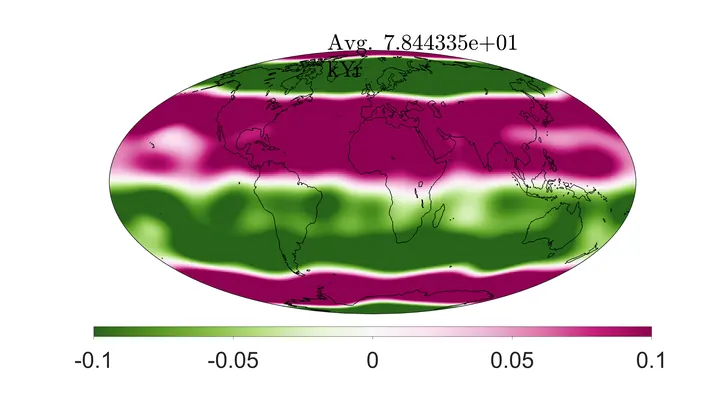
Earth's magnetic field is like an invisible shield that protects us from cosmic radiation. But if you look closely at its long-term averaged pattern, you'll notice that this shield isn't perfectly smooth: it has its own "seams" and "patches." New research using computer simulations of the geodynamo shows that…
Deep beneath our feet, in the scorching mantle, iron leads a double life. It can be divalent or trivalent, like a coin that lands heads or tails. Which side dominates determines how much oxygen stays in the planet's rocky shell and how much sinks into the core.
A copper crystal is squeezed in diamond anvil cells. As pressure mounts, a battle unfolds inside the material between two states: one prepares electrons for superconductivity, the other hinders their pairing. Scientists tracked this struggle using ultrashort laser pulses.
Today's Martian surface is a cold, nearly airless home. Many dream of a full renovation: warming the planet, filling it with air from carbon dioxide and nitrogen.
Planet HIP 67522 b is quite young: it's only 17 million years old, compared to Earth's 4.5 billion. It's a hot Jupiter — a gas giant that orbits very close to its star, so its atmosphere is heated and puffed up.
Cometary ice slams into the young Earth. The pressure at the impact point is like stacking six aircraft carriers on your thumbnail. In the lab, such conditions are reproduced by squeezing a tiny sample between two rotating anvils.
This time, adenosine monophosphate — one of the letters of future RNA — was placed under the anvils.
Just as in a crowded room each new person sharply increases the pressure on the walls, in a neutron star increasing density leads to a rise in internal resistance. But even this resistance has an absolute ceiling.
The most common type of planet in our Galaxy — rocky worlds around other stars, or exoplanets, shrouded in the simplest gas hydrogen. Their innards remained a mystery until scientists recreated the conditions of the interior in the lab.
In diamond, you can embed a “spy.” Simply replace a carbon atom with nitrogen: you get a defect that responds to magnetic fields and sends a light signal.