Catching the Moment a Protein Breaks express
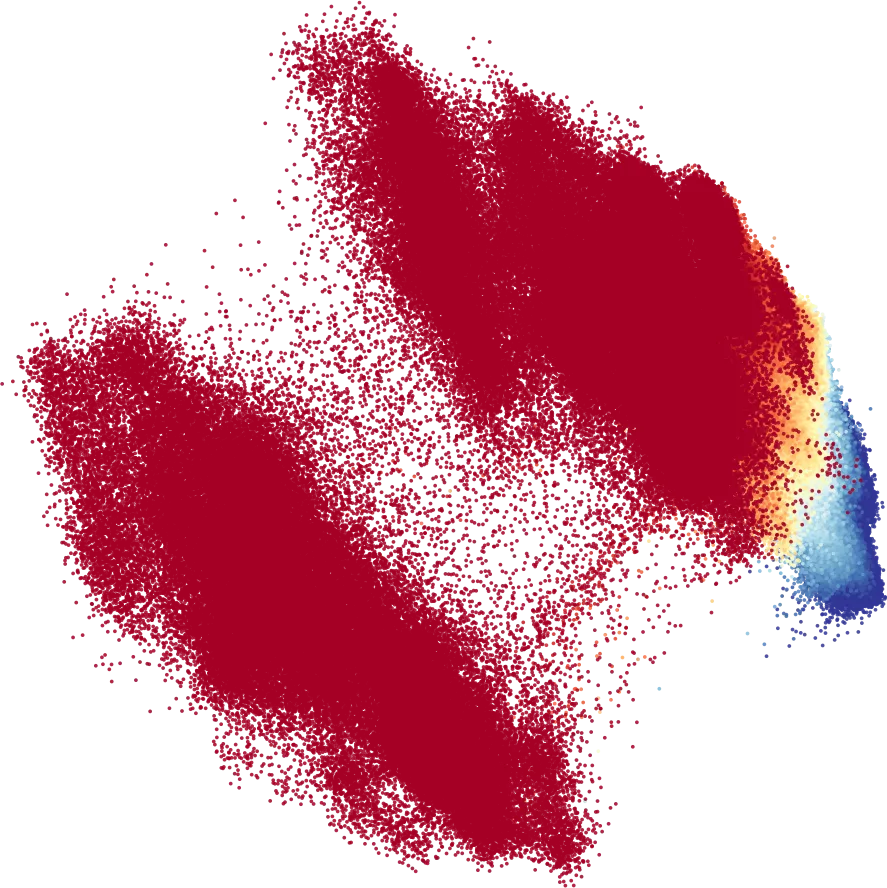
A mountain pass connects two valleys. In one, the protein is folded; in the other, it is unfolded. To get from one to the other, you must cross the saddle — the highest point on the path. In protein science, this point is called the transition state, and the coordinate that shows the distance to it is the committor. But a real protein has thousands of dimensions, the rotation angles of atoms, and finding that saddle is nearly impossible.
The authors rewrote an old variational principle so that you no longer need to impose rigid boundary conditions. Instead, they introduced a single normalization — the so-called "fidelity." Now you can use any trial function, even one that doesn't vanish at the start and equal one at the finish. This is like working with a rough sketch of the pass instead of a precise map — the key is that the scale is right.
The method was tested on three proteins: AIB9, villin HP-35, and chignolin. For the first two, they obtained committors in the full space of angles, and for chignolin, folding and unfolding rates using only data from umbrella sampling. Everything computes quickly, via a closed-form formula. This opens the way to studying rare events in large systems — from protein folding to crystal formation.
The mountain pass no longer needs to be stormed blindly. A simple elevation map is enough.
Villin HP-35 folds in just a few microseconds — one of the fastest known folding processes.