A quantum particle like an electron cannot just 'slightly' jump to another level — the transition either happened or it didn't. Fermi's golden rule gives the probability of such an event per second. It's like predicting how often a ball exits a maze through many exits if it is constantly nudged by weak pushes.
History
Paul Dirac in 1927 derived the expression for the transition probability into the continuum, laying the foundations of time-dependent perturbation theory. Enrico Fermi in the 1940s actively used this formula for neutron reaction calculations and named it 'golden rule No. 2' because it proved indispensable. Subsequently, John von Neumann and other mathematicians refined the applicability conditions, linking the rule to the spectral function theorem.
How it works
Fermi's rule underlies the calculation of particle decay widths, nuclear reaction rates, photoelectric effect cross section, and tunneling in solids. It is adequate for weak, short-range perturbations and a sufficiently dense spectrum of final states. For strong fields or long duration, non-perturbative methods are needed.
Fun fact
Thanks to this rule, we know why LEDs glow a specific color: electrons and holes meet at a pre-calculated rate.
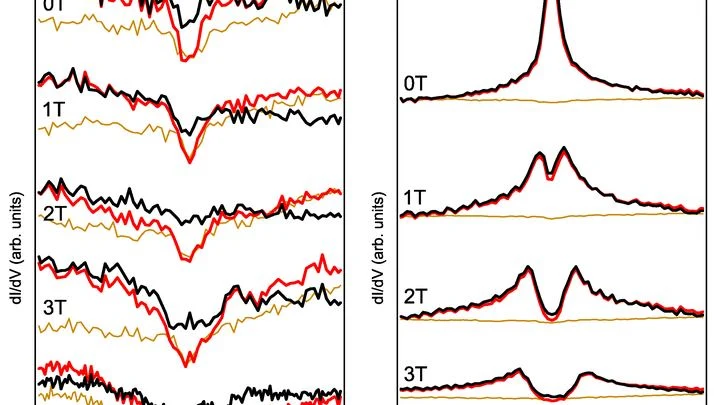
Electrons in an ultra-clean gallium arsenide film behave like a crowd at a crossroads, where the tilt of the magnetic field sets the direction. At zero tilt, they form a compressible liquid of composite fermions, particles made of an electron and a pair of vortices.
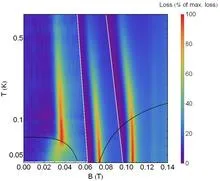
Tuning a radio receiver to a station that changes frequency as you cross a phase boundary: that is how you might picture the challenge facing the researchers. In the metal YbRh2Si2, electrons behave as "heavy" particles: their effective mass is hundreds of times that of a free electron.
Imagine a soundproof room where you tune a tuning fork: the faintest rustle throws off the tuning. In the world of ultra-precise atomic measurements, that rustle is the magnetic field. It imperceptibly shifts transition frequencies, and to get a reliable standard, physicists had to carefully calibrate the field.
In the quantum world, particles sometimes behave like acrobats on invisible tightropes. An instanton field is a brief vortex that appears and vanishes in an instant. When a fermion (a particle like an electron) enters such a vortex, its energy does not stay put. Instead, it smoothly slides from one level to another, like a ball rolling down a hill.
Light escaping a massive body loses steam. Its frequency dips slightly, and its color shifts toward red. Physicists call this gravitational redshift. In classical theory, it's all clear, but the moment you bring quanta into the picture, trouble starts.
Previously, this shift was modeled as a kind of mode mixer — a device that entangles different states of light.
The wind carries pollen, and each grain moves as if on its own. But once the air swirls into a vortex, the pollen trajectories can no longer be separated: they are tangled. This is roughly how electrons behave in a strange metal: their motion is so strongly coupled to soft fluctuations of the medium that the usual particle carriers disappear.
A mountain pass connects two valleys. In one, the protein is folded; in the other, it is unfolded. To get from one to the other, you must cross the saddle — the highest point on the path. In protein science, this point is called the transition state, and the coordinate that shows the distance to it is the committor.
An optical trap holds an atom almost motionless, like a ball on a soft spring. But as soon as acceleration appears, say gravity, the equilibrium shifts. The atom moves within the standing light wave, and this changes the rate at which it exchanges energy with the field. The frequency of this exchange becomes a direct indicator of acceleration.
Water from a faucet boils quickly, but in the last moment before the boiling point, everything seems to freeze — bubbles hesitate, the temperature stalls. So it is in quantum systems: when a material approaches a critical point, its internal clock stretches to infinity.
In a world locked in a crystal lattice and cooled nearly to absolute zero, matter knows how to hide its deepest secrets. A quantum spin liquid is a state where electron spins never freeze, even at zero temperature, remaining in an eternally flickering superposition.
The Mpemba effect is a mystery where hot вода sometimes freezes faster than warm water. Usually this is attributed to how вода loses heat and энтропию (a measure of disorder). But in a glass of water, chaos prevents a precise model.
Physicists built a quantum model: a particle in a well with two depressions separated by a barrier.
The classical Mpemba paradox — hot water freezes faster than cold — has teased scientists for centuries. Only recently has nonequilibrium statistical mechanics explained it: it’s all about boundary conditions; the system seems to seek an excuse to “hit the wall” and speed up cooling.
A glass of hot tea sometimes cools faster than a glass of warm tea. This paradox, known as the Mpemba effect, was long considered a curiosity from the world of liquids. But physicists have found it where no one expected: in the faint glow of organic films placed in a magnetic field.
A pebble falls into a pond, and ripples spread across the water. In the quantum world, the pond is not made of water but of many identical particles, and the pebble is also a particle, just a foreign one. Such a foreign particle is called a Fermi polaron.
In the mountains, there is a saddle — a point where the trail from one valley crosses over into another. Standing exactly on it, you take a step and are already descending the new slope. In chemistry, such a place is called the transition state: a brief moment when atoms are frozen on the threshold of transformation.
Electrons in a conductor are like a chaotic crowd: colliding, they lose energy, and resistance arises. In a superconductor, however, they move in unison, like partners in a well-coordinated dance, without touching each other. This state has reduced энтропией — meaning disorder.
Such behavior is rare for gold and copper.
You're pouring water into a glass, but you want exactly one million drops — not approximately, but exactly. An ordinary faucet pours a stream where the number of drops always varies. In the quantum world, photons have the same problem: a laser emits light where the number of particles fluctuates like a crowd in a square.
A long chain of atoms, each a tiny magnet. They talk to each other and to a common field, like musicians in an orchestra who hear both the conductor and their neighbors. When the external field changes, the orchestra either plays out of sync or all instruments come in together: that's a quantum phase transition.
A busy intersection without traffic lights. Cars drive, brake, and change lanes, and from the outside, it looks like complete chaos. But if you watch for a while, you can notice a rhythm: the flow thickens and thins. In physics, this rhythm of disorder is called entropy: it shows how far a system is from calm equilibrium, like water in a boiling kettle.
If you carry a cup of coffee slowly and steadily around a room and then return to the same spot, nothing happens to the drink. But in the quantum world, things are different: a particle that makes such a loop comes back not quite the same. It picks up an elusive 'extra'—the geometric phase, which physicists call the Berry phase.
In the quantum world, light and matter constantly exchange energy. Previously, they were described statically, like frozen poses. The new approach follows the dance itself: the transitions between states, like a continuous sequence of movements.
Before assembling a huge puzzle, you need to stamp out the pieces — otherwise the picture won't come together. In fusion-based quantum computers, the role of such pieces is played by tiny clumps of light — photonic resource states. They are collided and measured to gradually grow the computational fabric.
If you squeeze a handful of sand in your fist, it first compacts, but then starts to resist — the grains have nowhere left to go. In the depths of a neutron star, something similar happens, except instead of sand grains, you have elementary particles, and instead of your hand, you have monstrous gravity.
Quantum computers promise to solve problems that regular computers can't. But where is the line? The authors of a new study stumbled upon a surprising case: electrons paired up behave like a well-behaved orchestra. Even if you add a bit of "magic"—a special quantum resource: their behavior remains predictable.
When you flip a switch, the light doesn't come on immediately — electrons in the wires need time to 'get going' and move together. In ordinary metals and semiconductors, current builds up gradually, like water in a hose when you first open the tap.
A handful of coins drops onto a table. While they spin, each can land heads or tails: that's quantum uncertainty. But once they settle, the picture becomes definite, classical. That's roughly how noise destroys quantum order, turning it into ordinary disorder.
A typical recipe explains how to cook a dish: step by step, from the initial ingredients to the finished result. The new approach flips the logic: imagine that the future pie itself dictates how much flour to add now. In the quantum world, researchers suggest, a particle receives signals from the future measurement outcome.
A tiny magnet, made from just two molecules, was placed on a metal surface, and it behaved like a temperamental conductor. Normally, electrons in a metal move in a coordinated way, like a crowd on an escalator. But when cooled significantly, this order breaks down, and the motion becomes unpredictable.
In a pot of boiling water, bubbles of steam are born and pop, but the water itself remains a liquid. Something similar happens in an ultracold atomic gas: atoms constantly form pairs and then fly apart again, even though superfluidity has not yet set in.
Physicists trapped a cloud of lithium atoms between mirrors. Light bounces inside, like in an echo chamber, forcing the atoms to emit synchronously — resulting in superradiance, akin to a choir where voices merge into a single thunder. Like a stadium chanting in unison: each whisper turns into a deafening rhythm. The secret is density.
Inside a tiny accelerometer, gas behaves nothing like the air in a room. There are so few molecules that they rarely collide with one another, and the familiar laws of viscosity and thermal conductivity stop working.
A quantum bit, or qubit, is like a coin spinning on a table, able to be both heads and tails at once. For the computer to know what came up, you have to stop the coin and look. Previously, this stopping was done with a delay: data was read out, taken to a regular computer for processing, and only then was the result known.
Picture a chef flicking water onto a sizzling skillet. The droplets instantly hiss and evaporate, giving immediate feedback on the temperature — far quicker than any thermometer. This intuitive idea underpins a new approach in quantum thermometry.
Quantum computers use GKP states, dreamed up by Alexei Kitaev, John Preskill, and Daniel Gottesman. Their hallmark is built-in stabilizer checks that catch errors. For a long time, it was believed that a successful check guaranteed a nearly perfect state. Alas, it's an illusion.
Electrons — tiny particles in molecules — constantly maneuver, avoiding collisions like passengers during rush hour. To calculate their behavior, scientists set a personal distance rule: a mathematical function that indicates how close one electron can get to its neighbor.
The law discovered by Wolfgang Pauli forbids identical particles from occupying the same spot. Hence, in cold matter, a Fermi sea is born: particles, like water, fill energy levels from bottom to top. The shape of the sea's surface — including 'islands' of emptiness — dictates the properties of the whole system.