How an insulator grows a metallic skin express
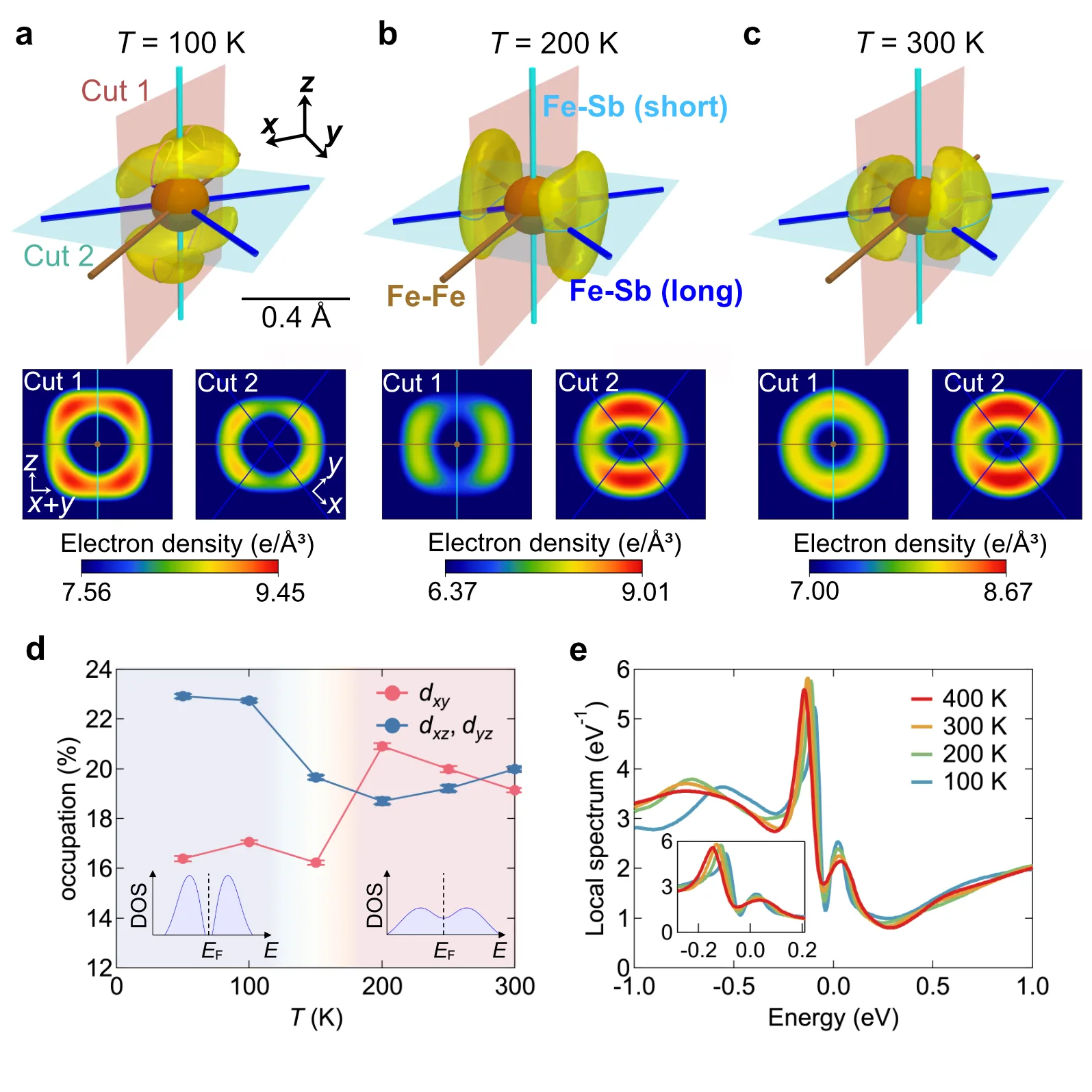
A house with cork walls suddenly gets covered in copper sheets, but only when frost sets in. That's roughly how FeSb₂ behaves when made into a film just a few atomic layers thick. Under normal conditions, it's a narrow-gap insulator: electrons sit tightly in place like spectators in an overcrowded hall. But physicists discovered that when cooled below a certain temperature (around –200 °C), a layer appears on the film's surface that conducts current beautifully, while the interior stays a dielectric — no current flows through it.
This behavior stems from a rare alliance of two effects: strong electron interactions in the bulk and a special kind of polarization called topological polarization. Usually, getting topological surface states requires heavy atoms and spin-orbit coupling. Here, things work differently: the polarization arises from how chemical bonds are arranged, with no spin involvement. It's as if the wallpaper pattern itself created a conductive path once the room cooled down.
This work opens a new route to materials where topology and strong correlations don't hinder each other but help. In the long run, it could lead to energy-efficient electronics that use lossless surface currents. And then houses with cork walls might not just get copper-clad in the cold: they could control that cladding, switching it on and off at will.
The FeSb₂ film in the experiment was about 20 nanometers thick — a thousand times thinner than a human hair, yet enough to show a striking surface effect.
In Arthur C. Clarke's novel The City and the Stars, buildings are covered with a material that changes its properties on command — much like FeSb₂'s surface, switchable between conducting and magnetic states.