Starquakes of Newborn Stars express
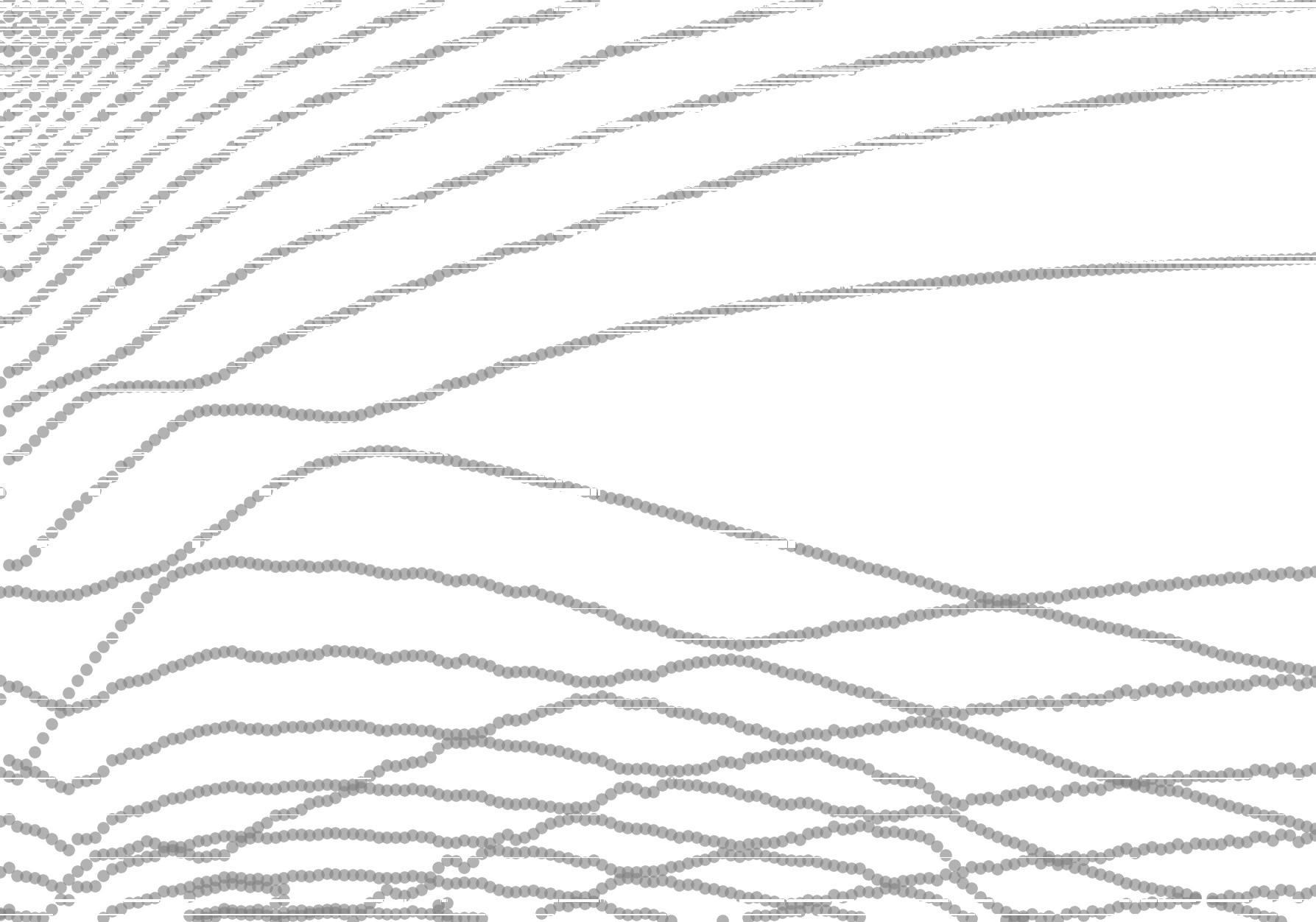
After a supernova explosion, a dense ball the size of a city remains at the center — a newborn neutron star. It is hot, compressed, and rings like a bell after being struck. These tremors, the star's oscillations, emit gravitational ripples that sensitive detectors on Earth can catch.
But how do we know what exactly is trembling inside the star? The authors broke the oscillations down into families, like a musician breaking a chord into notes. It turned out that some oscillations live in the star's core, others near its surface, and still others in the shock wave around it. The dominant high pitch is the surface oscillation, where the density drops sharply.
This breakdown will help future gravitational wave detectors: from the heard pitch, one can determine the mass and size of the newborn star, even without seeing it through a telescope.
Original abstract
as written by the authors arXiv:2608.10264v1
Newborn proto-neutron stars (PNS) are potential targets of gravitational wave asteroseismology, the study of the (inner) structure of stars via their oscillation modes. To prepare for the eventual detection of such modes by current and future gravitational wave observatories, theoretical studies have obtained the possible spectrum of oscillations. However, there has been disagreement when it comes to identifying and classifying specific modes according to the physical mechanism that excites them. In this paper, we present a novel scheme to classify the oscillation modes of a newly born PNS surrounded by a stalled accretion shock in core-collapse supernovae (CCSNe). Our classification is physically motivated, as it is based on the energy of the restoring forces of the mode. We investigate the nature of the modes by considering the different regions of the CCSN that they stem from. We apply this scheme to a set of 28 non-rotating 1D, 2D and 3D CCSN simulations performed with two different numerical codes and using different progenitors and equations of state. In that way, we find that there are different families of f-, p- and g-modes in the system, living in different areas. More specifically, we identify two families of f- and p-modes associated with the PNS and the shock, respectively, and two families of g-modes originating from the two convectively stable regions, one in the PNS core and one near its surface. We also find that the dominant high-frequency emission mode is the f-mode of the PNS, associated with the strong density gradient at its surface. Our classification procedure is automatic, performs consistently for all the models considered, and paves the way to systematic studies of the dependence of the mode frequencies on the PNS properties, with direct application to parameter estimation from future observations of gravitational wave signals.
A newborn neutron star vibrates at frequencies of thousands of hertz — higher than the highest note on a piano.
In the movie "Interstellar," gravitational waves helped the heroes, but there they were created by black holes, whereas here they come from trembling newborn stars.