Gravitational wave frequency is the rate at which the ripples in spacetime oscillate as they pass a detector. These waves are produced by accelerating massive objects, such as merging black holes or neutron stars, and their frequency is directly tied to the motion of the source. For example, a binary system of two compact objects spiraling together emits waves whose frequency increases as the orbit shrinks, eventually sweeping upward in a characteristic 'chirp' before the merger.
History
The concept was central to predictions made by Albert Einstein in 1916, but the first direct detection of gravitational waves with a measurable frequency occurred in 2015 by the LIGO collaboration.
How it works
The frequency of a gravitational wave is set by the orbital or rotational period of the emitting system. For a binary, the wave frequency is twice the orbital frequency, and it evolves as the system loses energy through radiation. Detectors like LIGO measure the stretching and squeezing of space, and by tracking how the frequency changes over time, physicists can infer the masses, spins, and distance of the sources.
In practice
Gravitational wave frequency analysis is used to identify and characterize astrophysical events, enabling multi-messenger astronomy and tests of general relativity.
Fun fact
The frequency of gravitational waves from the first detected merger, GW150914, swept from about 35 Hz to 250 Hz in less than a second, corresponding to a pitch audible to humans if converted to sound.
Units by system: SI: hertz · CGS: hertz · Planck: planck frequency · natural: electronvolt
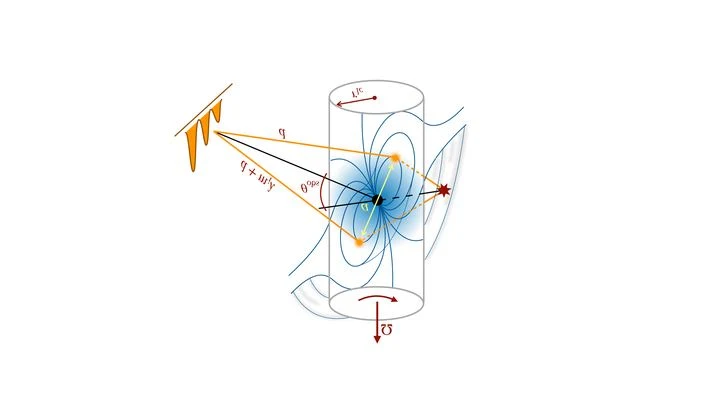
The mirror races along at nearly forty thousand kilometers per second. Light that strikes it bounces back, but changed, like a ball volleyed by a racket in mid-swing. That's exactly the kind of mirror scientists have built inside an ultra-thin glass thread filled with hydrogen.
First, a powerful laser pulse is sent down the fiber.
Imagine a string stretched between two tuning pegs. The slightest touch makes it vibrate, and from the pitch you can guess exactly how it was plucked. Physicists at the University of Arizona have stretched a similar string — not on a musical instrument, but on a silicon membrane just a hundred nanometers thick.
After a supernova explosion, a dense ball the size of a city remains at the center — a newborn neutron star. It is hot, compressed, and rings like a bell after being struck. These tremors, the star's oscillations, emit gravitational ripples that sensitive detectors on Earth can catch.
The very first moment of the universe's existence is like a taut string suddenly struck. It vibrated, and those oscillations froze into galaxies and voids. But physicists suspect there were other vibrations — fast, local, almost like a drumroll against a slow melody.
295 000 meters per second. Not even particles in solar coronal ejecta move that fast. But at the center of the galaxy cluster H1821+643, hot gas does exactly that. The quasar at its heart takes a breath, and its breath stirs everything around for 60 thousand light-years.
In the first 10⁻³⁵ seconds after the big bang, the most rapid part unfolded. Space expanded faster than light — that's expansion of the universe (inflation). Almost the entire score was performed by a single field, the inflaton, conducting the tempo and key.
An optical trap holds an atom almost motionless, like a ball on a soft spring. But as soon as acceleration appears, say gravity, the equilibrium shifts. The atom moves within the standing light wave, and this changes the rate at which it exchanges energy with the field. The frequency of this exchange becomes a direct indicator of acceleration.
In the first moments after the Big Bang, the Universe hummed like a bell. Inflation, the epoch of rapid expansion confirmed by measurements of the cosmic microwave background, ended, and the inflaton field began oscillating around the minimum of its potential.
When two black holes merge far away, we receive a tremor of space — gravitational waves. Usually, they are described by Einstein's equations, but what if gravity works differently at the tiniest distances? The authors took one such hypothesis — Hořava–Lifshitz gravity.
In the centers of distant galaxies, X-ray 'beacons' sometimes light up. They don't flash randomly but on a strict schedule: every few hours or days. These bursts are called quasi-periodic eruptions (repeating at nearly regular intervals).
A blob of cold helium swoops dangerously close to a black hole. But this isn't just a blob: it's a dead star the size of Earth, yet with a mass comparable to the Sun's.
Two heavy spheres of dark emptiness hurtle toward each other and collide dead-on. This is not billiards: it's the collision of two equal black holes. The impact sends a tremor through space itself — gravitational waves.
Most of this tremor is a low hum that physicists call bremsstrahlung.
In the usual picture, a black hole is a featureless pit in spacetime. But if a shell of matter vibrates around it, the gap between the edge of the abyss and this shell becomes a resonant cavity.
A stone falls into a well, and a second later, a splash. A star falls into a black hole, and disappears beyond the horizon, leaving only a ripple in space. But what if the bottom of the well is not a dead end but a passage? In the usual picture, matter compresses into a point of infinite density — a singularity.
A distant lighthouse flashes for an instant brighter than an entire galaxy. This is a fast radio burst — a mysterious signal from deep space. Some repeat, and astronomers have noticed a peculiarity: these bursts show rapid changes in polarization — a property indicating how the radio wave is twisted in space.
A tuning fork, once struck, makes neighboring strings vibrate. Much the same happens with a cloud of ultralight particles (also called axions) around a rapidly spinning black hole. The hole, like a motor, spins up the particles, and they begin to emit gravitational waves — a trembling of space itself.
When two supermassive black holes circle each other before merging, they shake spacetime itself, like a speedboat racing across a lake leaves waves in its wake. These waves are called gravitational waves. They travel through the Universe and pass through everything, even the Earth.
A sunspot, a dark island on the scorching surface, breathes. Every three minutes, a wave spreads from it, runs along an invisible magnetic arch, and makes the plasma above a neighboring spot flare with a radio signal. Radio telescopes caught seven such flares in a row on February 14, 2024.
Two neutron stars collide, and the space around them ripples like the surface of a pond after a stone is thrown. Huge gravitational wave detectors catch these ripples. If the collision also launches a narrow beam of gamma rays, space telescopes see it as a short gamma-ray burst.
You can squeeze light between two mirrors like a spring in a vise. It bounces back and forth, growing denser: that's how you get ultra-bright beams. But there's a limit: at too high a brightness, the mirrors start to shake. The light rocks them the way wind rocks a swing, and some energy leaks into that jitter.
A radio telescope picks up a signal from the Crab Nebula, and instead of a smooth line, the screen shows bright and dark bands, like on a zebra's hide. This is the emission from the pulsar, a rapidly spinning neutron star left over from a supernova explosion.
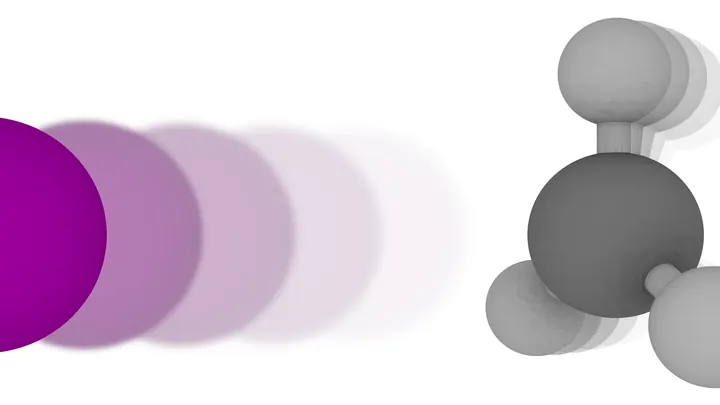
A chemical bond is like a stretched spring between atoms. When it's snapped, the molecular fragments fly apart, but they don't freeze: they keep vibrating, like a plucked string. That's exactly the vibration a team of researchers caught when they broke a methyl iodide molecule with an ultraviolet laser.
Every hour, when the hands of a clock align at twelve, something happens in Earth's magnetosphere. It's as if an invisible conductor raises a baton, and waves race along magnetic field lines toward the surface. They're called pearls: on recordings, they look like a string of beads strung along time.
Gamma-ray bursts are the most powerful explosions in the Universe: a dying star collapses into a black hole, ejecting streams of energy. Often this happens after a supernova flare. But astronomers caught a strange rhythm — in the emission of 34 such bursts, clear pulsations appeared, like beats of a cosmic heart.
A radio telescope catches a signal lasting a few milliseconds, and in that instant, energy comparable to what the Sun emits over days is released. This is a fast radio burst, a millisecond radio pulse from a distant galaxy. Since their discovery in 2007, astrophysicists have debated what causes them.