Why Perovskite Solar Cells Age express
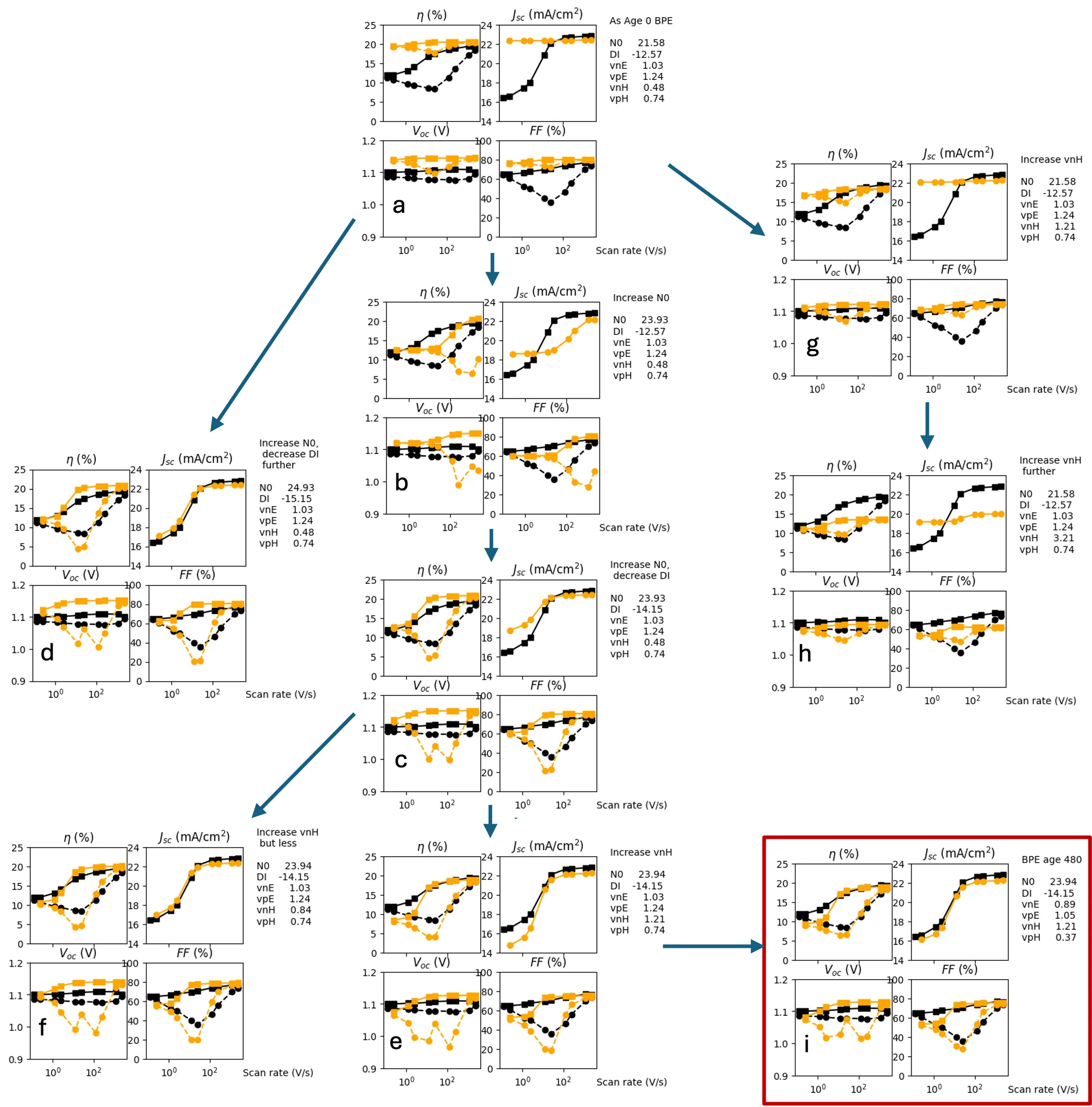
A perovskite solar cell is like a young athlete: it performs brilliantly at first, but tires with age. Over eight hours, its performance drops noticeably, with no visible cause like cracks or dust. Scientists took one cell and recorded its performance at 0, 90, 280, and 480 minutes of its life. Then they applied machine learning to reconstruct from these external data what was happening inside.
Inside the perovskite, mobile ions, charged particles, start to move under the influence of light and voltage. Their concentration and speed of movement (diffusion coefficient) change over time, not independently but in a coordinated way. When ions become numerous, additional losses arise at the boundaries between crystal grains: there charges recombine, that is, they disappear without producing current. It's like having extra players on a team who get in each other's way at the goal.
This approach, combining simulations and machine learning, allows a glimpse into hidden processes without dismantling the device. Previously, one would have had to destroy the cell and look under a microscope to see what changed. Now aging can be monitored in real time, and perhaps we can learn to slow it down.
Aging of perovskite cells is the main barrier to their market entry. If we understand which ions are to blame, we can choose additives or change the composition to slow their movement. Then cheap and flexible solar panels could last not hours but years.
Perovskite solar cells have increased their efficiency from 3% to over 25% in just ten years — faster than any other type of photovoltaic cell in history.
In Kim Stanley Robinson's novel 'The Ministry for the Future,' perovskite solar panels cover deserts and rooftops, but their degradation remains a problem, just as in reality.