Signal loss in optics is the decrease in optical power as light travels through a medium or device. It is the fundamental performance metric for any system that uses light to carry information or energy, from fiber-optic communication networks to sensors and imaging systems. The concept is central to engineering decisions: how far a signal can travel before it needs amplification, how sensitive a detector must be, and how much power a source must emit. In the context of the provided articles, signal loss appears in practical scenarios like transmitting signals from a freezer (where temperature affects components), suppressing instabilities in gravitational wave detectors (where even tiny losses degrade sensitivity), and designing MRI systems that use optical fibers to carry signals from the scanner to the processing unit.
History
The systematic study of signal loss in optical fibers began in the 1960s, with Charles Kao's pioneering work in 1966 that identified impurities in glass as the main cause of excessive loss and proposed that purer glass could make fiber communication practical. This work earned him the Nobel Prize in Physics in 2009.
How it works
Signal loss arises from several physical mechanisms. Absorption occurs when photonstransfer their energy to the material's atoms or molecules, often converting it to heat. Scattering happens when light is deflected by microscopic inhomogeneities, such as density fluctuations in glass or imperfections at interfaces. Additionally, in waveguides like optical fibers, light can leak out if the fiber is bent too sharply or if the core-cladding boundary is not perfectly reflective. Engineers quantify loss in decibels per kilometer (dB/km) for fibers, or as a percentage for individual components, allowing them to budget the total loss across a system and design accordingly.
In practice
Signal loss is the key parameter in designing fiber-optic networks, determining the spacing of amplifiers and repeaters, and in optimizing components like connectors, splitters, and switches for minimal attenuation.
Fun fact
Modern optical fibers have losses as low as 0.14 dB/km, meaning a signal can travel about 30 kilometers before losing half its power, a feat achieved by using ultra-pure silica glass with impurity levels measured in parts per billion.
Electricians working with high voltage are like divers: they need to see what's happening deep underwater without going down themselves. What's needed is a sensor that stays away from the dangerous current and relays information to the surface. Usually, light is used: a beam passes through a transparent crystal, and the electric field slightly rotates it.
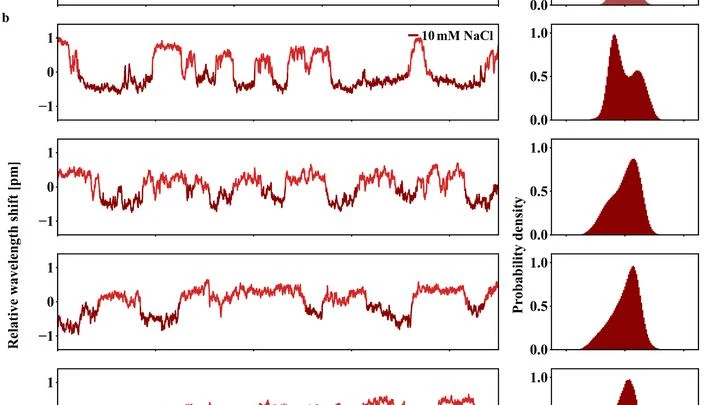
A perovskite solar cell is like a young athlete: it performs brilliantly at first, but tires with age. Over eight hours, its performance drops noticeably, with no visible cause like cracks or dust. Scientists took one cell and recorded its performance at 0, 90, 280, and 480 minutes of its life.
A light field, like a neat waffle iron, presses a regular pattern of bright and dark regions into space. Atoms get stuck in the brightest spots as if in tiny dimples: that's an optical lattice. It's a favorite tool for physicists who want to study quantum behavior of matter in its pure form.
A protein in a cell is not a frozen sculpture but a restless mechanism. Its parts are constantly vibrating, and these movements determine how it grabs molecules, transmits signals, or builds the cellular scaffold. But filming the life of a single protein was hampered by two nuisances at once. First, the movements last millionths of a second — ordinary cameras simply cannot catch them.
Next-generation radars handle both communication and object tracking. Their constant vigilance quickly drains batteries. Engineers took a cue from astronomy: hunting for exoplanets via the transit method only needs a telescope when a planet crosses its star's disk.
A clamp antenna system resembles a garden hose with punctures. In the waveguide cable, emission points are created where radio waves burst out, like water from a hole. Obstacles in the path block direct communication, but reflected signals can bypass the barrier.
Imagine a smart antenna panel, a phased array, that steers radio waves traveling at the speed of light. It works like an orchestra: hundreds of tiny emitters, like musical instruments, shift their phase (the moment they 'join' the overall sound) on command via a variable voltage.
Imagine an experienced chef during rush hour: suddenly a stove fails or a key ingredient runs out. Instead of panicking, he instantly reworks the recipes — speeding up some dishes, slowing down others, reallocating resources on the fly. This principle of dynamic adaptation underpins a new generation of ultra-reliable networks.
The Universe is a giant concert hall, where instead of walls and balconies, invisible clouds of dark matter float. This architectural ensemble is not static: it refracts and scatters the 'music' rushing through it — gravitational waves from merging black holes.
Dozens of copper coils in an MRI scanner pick up the faint response from tissues, like microphones trying to catch a whisper in a noisy hall. Each microphone drags a thick bundle of wires behind it. The wires press on each other, create electrical interference, heat up, and add risk for the patient.
In pursuit of gravitational waves, ripples in spacetime left by black holes and neutron stars, detectors like LIGO pump their arms with light of dazzling intensity.
Gravitational wave detectors are microphones listening to the trembling of space. But their own noise drowns out weak signals. To hear more, physicists add special "squeezed" light to the instrument: it reduces quantum noise, like noise cancellation in headphones.
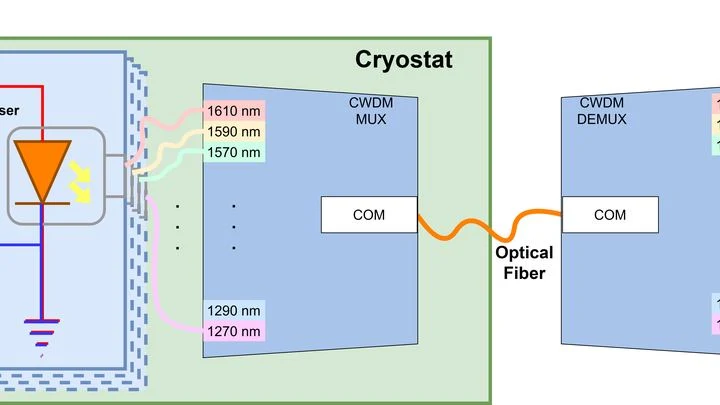
A thermos of liquid xenon cooled to minus 100 degrees Celsius. Inside are sensitive sensors that catch rare signals from dark matter particles. To bring these signals out, copper cables are usually used. But over the long haul, the signal weakens, and adjacent cables start 'cross-talking' — that's called crosstalk.