Battery spectroscopy refers to a suite of non-destructive techniques that probe the inner workings of batteries while they operate or after they have aged. Instead of taking a battery apart, these methods use light, X-rays, or electrical signals to infer the chemical state of electrodes, the distribution of ions, and the formation of degradation products. This is crucial because batteries fail not through a single dramatic event, but through subtle, cumulative changes in their materials—cracks, phase transitions, and the growth of resistive layers—that are invisible from the outside.
History
The application of spectroscopic methods to batteries grew in the 1990s with the rise of lithium-ion technology, when researchers began using X-ray diffraction and Raman spectroscopy to study electrode materials in situ. The field expanded rapidly with the development of synchrotron light sources, which allowed high-resolution, time-resolved measurements of working batteries.
How it works
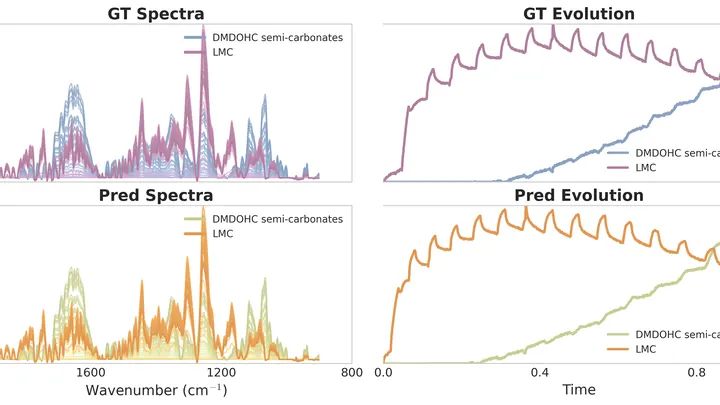
Most battery spectroscopy methods work by sending a probe (photons, electrons, or an electrical perturbation) into the cell and analyzing the response. For example, X-ray absorption spectroscopy reveals the oxidation state of transition metals in cathodes, while Raman or infrared spectroscopy identifies molecular vibrations of electrolyte decomposition products. Electrochemical impedance spectroscopy applies a small AC voltage and measures the current response across a range of frequencies, separating fast processes (charge transfer) from slow ones (ion diffusion). These signals are compared to reference spectra or models to map out the internal state of the battery without opening it.
In practice
Battery spectroscopy is used in quality control, failure analysis, and the development of next-generation batteries, such as solid-state and sodium-ion cells. It helps researchers identify why a battery loses capacity and guides the design of longer-lasting materials.
Fun fact
Some battery spectroscopy techniques can detect the presence of a single lithium ion moving between electrodes, a sensitivity that was once thought impossible.
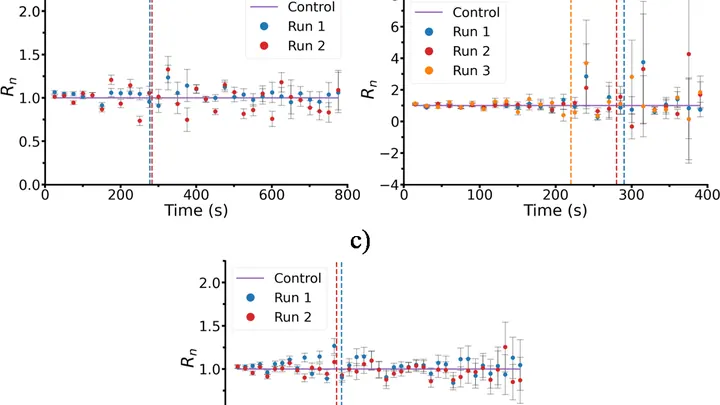
A perovskite solar cell is like a young athlete: it performs brilliantly at first, but tires with age. Over eight hours, its performance drops noticeably, with no visible cause like cracks or dust. Scientists took one cell and recorded its performance at 0, 90, 280, and 480 minutes of its life.
Battery aging is like metal fatigue: a crack grows inside long before the part breaks. Usually, you only learn about the problem when capacity drops below 80%—but by then, the damage is irreversible.
Ever since Paul Dirac theoretically predicted antimatter, physicists have been hunting for the tiniest differences between particles and their antiparticles.
For decades, the search for extraterrestrial intelligence has waited for quiet, coherent signals from space — a kind of 'whistle' in the radio silence. However, our own technosphere has created a continuous radio background — the hum of a vast metropolis, emitted by all communications, radars, and broadcasting stations.
Infrared light is invisible to the eye, but it's everywhere: from TV remotes to the heat of the human body. Catching it requires special materials. Conventional detectors are bulky, rigid, and not easily tuned to specific wavelengths.
A solar cell is like a heart: if you force it to beat out of rhythm, it tires quickly. Usually, cells are tested by applying reverse voltage, but in real life, a shadow from a leaf or a bird forces neighboring cells to pass foreign current through themselves.
To align particle spins in one direction, physicists usually cool a substance to near absolute zero and place it in a strong magnetic field. That is expensive and bulky.
A new method resembles tuning many spinning tops with a gentle touch: mediator molecules temporarily bind to target atoms and pass on their order.
Batteries usually have two terminals — an anode and a cathode. Engineers are trying to remove the anode from solid-state batteries (with solid electrolytes) to make them lighter and more capacious. During charging, metal should deposit itself as a layer on the contact, and then vanish completely during discharge. But after a few cycles, capacity drops.
A quantum dot is a box so small that an electron inside cannot have just any energy, but only strictly defined values, like the steps of a staircase. Each step can accommodate several electrons, but exactly how many is the question. If a step is double, two electrons can stand on it; if single, only one.
An X-ray image of a battery looks like a photo taken through frosted glass: fine details blur into a gray smudge. The culprit is the detector itself, which cannot distinguish features smaller than its pixel size. Engineers proposed getting around this barrier by illuminating the sample not with a uniform beam but with a striped pattern.
The battery in your phone or electric car is a tiny chemical factory. Inside, lithium ions shuttle between two electrodes, and at the boundary with the liquid electrolyte, a thin film forms: it determines how long the battery will last. This film is called the solid-electrolyte interphase.
Open systems exchange energy with their surroundings, like a guitar string fading into the air. Scientists built such a system out of light, twisting the beams into corkscrews and forming an artificial lattice — a maze where losses can be controlled at every step. Light in this maze always moves at the maximum possible speed, but its energy can fade or grow.