A Thermal Thermometer for the Sun express
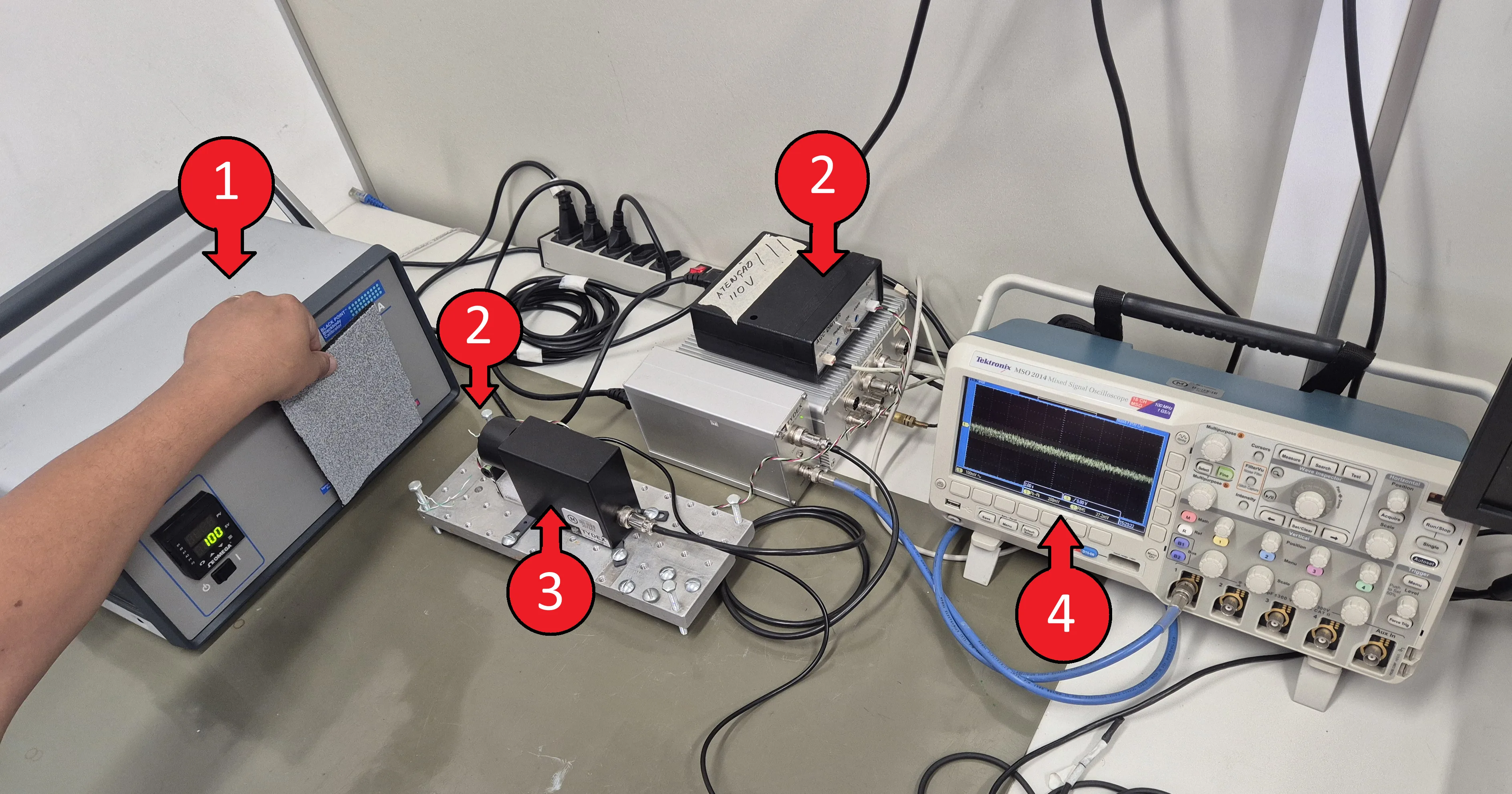
In the kitchen, when a pan heats up, your hand feels the heat before you even touch it. A solar telescope picks up similar invisible heat — only from a star, not a stove. The instrument, called HATS, captures radiation in the terahertz range, which was previously little studied due to technical difficulties. Its heart is a Golay cell, a tiny chamber filled with gas that expands with heat and moves a tiny mirror.
To extract the weak signal from noise, a rotating disk with slits is placed in front of the detector: it interrupts the beam 20 times per second. The signal becomes a flicker, which is then processed mathematically. The authors compared two approaches: sine wave fitting and fast Fourier transform with six different "windows"—filters that smooth the signal edges in different ways. The Hamming window worked best: the error was only 15.48, and the calibration coefficient was 10.32 millivolts per kelvin.
Calibration accuracy matters not only for the Sun. The same modulation and filtering principle is useful in factories where you need to measure the temperature of molten metal without contact, or in instruments monitoring water vapor in the atmosphere. In medicine, terahertz rays promise a safe way to look under the skin without X-rays. So a small thermometer for a star helps build big tools for Earth.
Original abstract
as written by the authors arXiv:2608.12137v1
The THz range has been under-explored for solar astronomy, mainly due to technological limitations. Only recently, a few new telescopes, such as the High Altitude Terahertz Solar (HATS) photometer, have been monitoring the solar activity in this range of the spectrum. This paper presents the experimental characterization and voltage-to-temperature calibration of the HATS acquisition system. HATS uses a Golay cell for capturing the incoming radiation, modulated by a 20 Hz fork chopper. The amplitude of the signal is then obtained at predetermined time intervals by applying a windowing function and an FFT to the signal. To characterize this acquisition system, a blackbody calibrator, with temperatures varying from 100 to 500 C (373.15 K to 648.15 K), was used as a THz source, and two signal recovery methodologies were compared: sinusoidal curve fitting and FFT combined with six windowing functions (rectangular, Hamming, Hann, Barlett, Blackman, and Flat Top). Our quantitative results demonstrate high linearity in the system's response over the input source's temperature range, with the Hamming window achieving the highest precision, yielding a Root Mean Square Error (RMSE) of 15.48 and a calibration temperature-to-voltage factor of 10.32 +- 0.13 mV/K. In contrast, the Bartlett window presented the highest error (RMSE 16.02). The choice of windowing function had only a minor effect on the calibration factors, which ranged from 10.32 to 10.43 mV/K, all within the experimental uncertainties. Beyond solar photometry, the signal modulation and windowing concepts established here are highly applicable to other fields requiring high-sensitivity thermal detection, such as industrial pyrometry for high-temperature manufacturing, environmental monitoring of atmospheric water vapor, and the development of medical imaging systems based on Terahertz radiation for non-invasive tissue analysis.
The Golay cell was invented in 1947 for military thermal imaging and is still used in terahertz detectors due to its simplicity and sensitivity.
In the series "Star Trek," the medical tricorder scans the body without contact — terahertz sensors like the one calibrated here bring such devices closer to reality.