A Ship in a Bottle ✛
A ship in a bottle doesn't rock on the waves: the glass holds it steady. Chemists did much the same with a molecule that stores quantum information. Outside, its spin was jostled by every collision with the environment and lost information within a few microseconds. Inside the gap between crystal layers, the molecule got stuck, vibrations died down, and the information survived a hundred times longer.
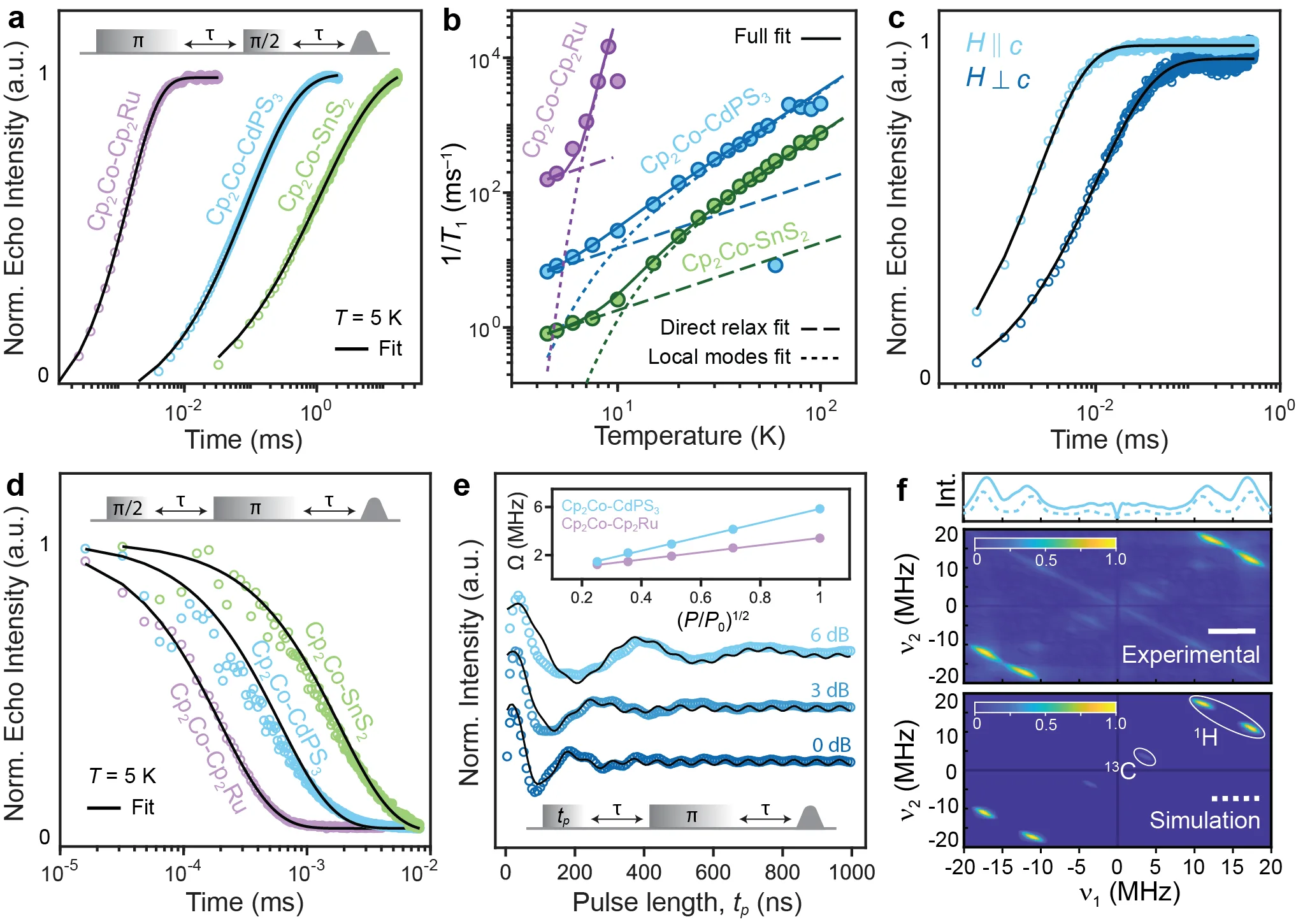
The trick is that the crystal doesn't just lock the molecule in; it also gives it a gentle squeeze. The molecule is like a sandwich: a cobalt atom held between two flat rings. The squeezing changes the shape of the rings, making it hard for the spin to flip. Previously it flipped in 5 microseconds; inside the crystal, it takes a full millisecond. That's like a spinning top that used to stop in a second now twirling for a minute and a half.
This trick works because the bottle isn't just isolating the ship; it becomes part of the ship's structure. Inside the gap, the molecule stands upright like a toy soldier in a box, and all the molecules line up in a neat lattice. That allows you to assemble whole fleets of quantum "ships" in a single crystal. Already today, this technique can be used to create ordered arrays of quantum cells, and in the future, for ultra-sensitive magnetic field sensors.
Cobaltocene is the very 'sandwich' of two cyclopentadienyl rings around a cobalt atom, for whose structure Ernst Otto Fischer and Geoffrey Wilkinson won the 1973 Nobel Prize in Chemistry. In this work, it plays the canary in the coal mine: its spin is so sensitive to the environment that the spectrum reveals the symmetry of the cage it is placed in.
The idea of trapping a single molecule in a nanoscale cavity and making it work as a qubit echoes the 'atom trap' from Greg Egan's novel Quarantine: there, quantum states are isolated from the environment to be used for computation. In Egan, the isolation is nearly perfect, but here confinement does not isolate; it reshapes the coupling to the environment, and that is exactly what brings the gain.