A Ship in a Bottle: How to Trap a Quantum Spin in a Layered Crystal ✛
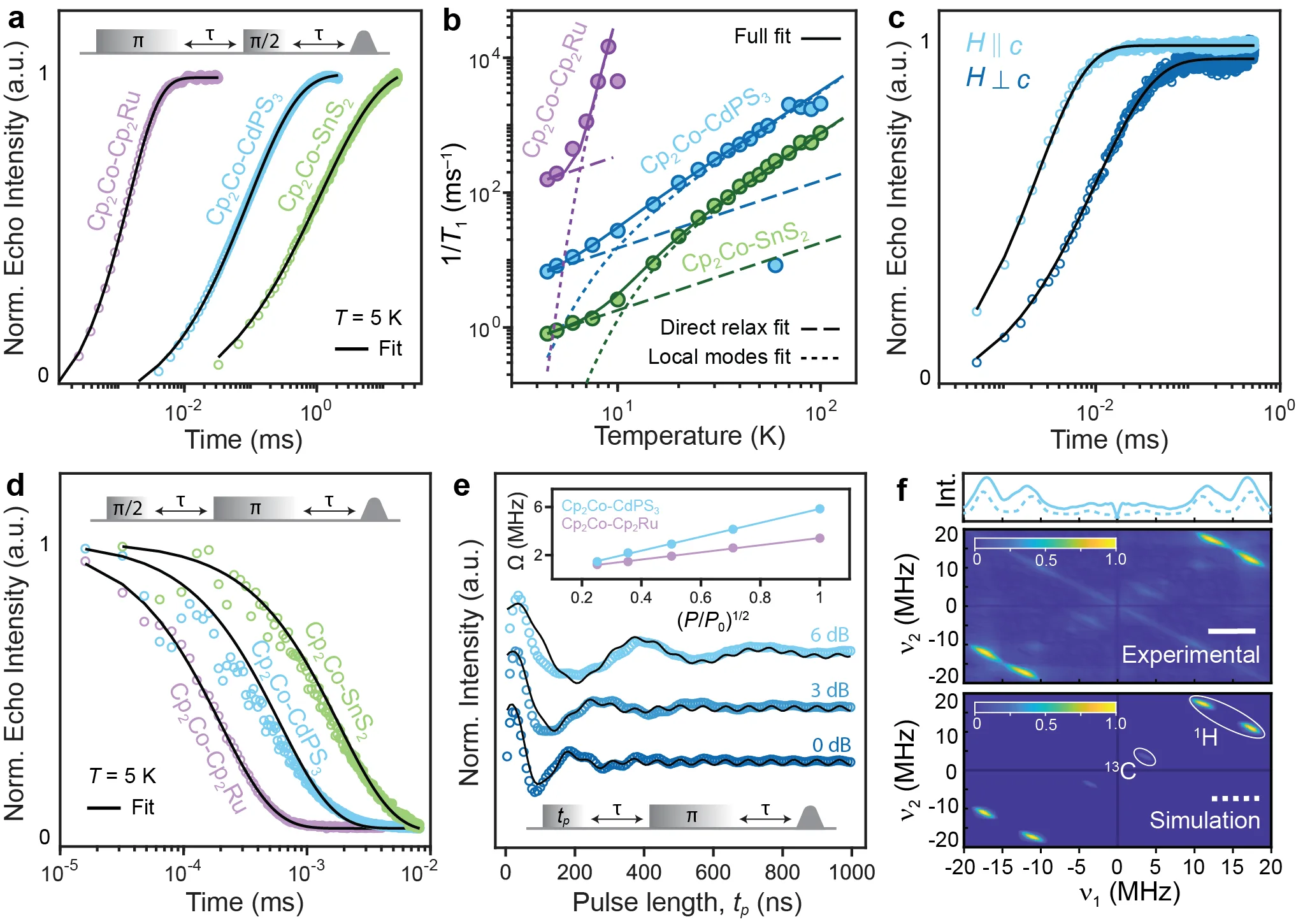
A ship in a bottle is assembled from the inside, not the outside: masts and sails are pulled through the narrow neck, and once inside the glass they settle into the right pose on their own. Chemists have done something similar with a single cobaltocene molecule, which they pulled into the gap between layers of a two-dimensional crystal. A free molecule behaves like a ship on the open water: its spin, which carries quantum information, rocks with every collision with the environment and loses coherence within microseconds. Inside the gap, everything changes: the molecule gets stuck in one pose, its vibrations die down, and the quantum state lives a hundred times longer.
The key to success is not isolation but restructuring. The cobaltocene molecule resembles a sandwich: a cobalt atom is squeezed between two flat rings. In the free state, its electrons have a significant orbital moment, which serves as a channel for rapid coherence loss. Inside the gap, the crystal slightly compresses the rings, distorting the molecule, and this channel closes. The electronic structure changes so that the spin becomes hard to flip, meaning the quantum state lives longer. The researchers saw this in electron paramagnetic resonance spectra, where the signal from the trapped molecule persisted up to 100 K, whereas the free molecule stopped responding already at 10 K.
The layered crystal acts like a careful bottle: it not only holds the molecule but also dictates its only possible pose. At 5 K, cobaltocene stands upright, and when heated above 156 K, it lies flat. This ordering is visible in a superstructure with a doubled period: the molecules arrange into a triangular lattice within the gap. This is no longer a collection of scattered ships but a whole fleet, ready for coordinated work.
This approach solves a long-standing problem: previously, it was thought that a substrate in a solid inevitably destroys quantum states, so qubits had to be isolated. Here, the substrate does not hinder but helps: it fixes orientation, dampens vibrations, and rearranges the hierarchy of energy scales. The ship in a bottle is not just protected from the waves; the bottle itself has become part of its structure. Already today, this technique can be used to create ordered arrays of molecular qubits in layered materials, and in the future, for hybrid magnetic field sensors at the nanometer scale.
Cobaltocene is the very 'sandwich' of two cyclopentadienyl rings around a cobalt atom, for whose structure Ernst Otto Fischer and Geoffrey Wilkinson won the 1973 Nobel Prize in Chemistry. In this work, it plays the canary in the coal mine: its spin is so sensitive to the environment that the spectrum reveals the symmetry of the cage it is placed in.
The idea of trapping a single molecule in a nanoscale cavity and making it work as a qubit echoes the 'atom trap' from Greg Egan's novel Quarantine: there, quantum states are isolated from the environment to be used for computation. In Egan, the isolation is nearly perfect, but here confinement does not isolate; it reshapes the coupling to the environment, and that is exactly what brings the gain.