Quark confinement is the fundamental principle of the strong force that quarks, the elementary particles that make up protons and neutrons, can never exist in isolation. They are permanently bound together inside composite particles called hadrons, such as protons and neutrons. This phenomenon explains why we never observe a free quark in nature, no matter how much energy we use to try to separate them.
History
The concept was developed in the 1970s, with key contributions from theorists like David Gross, David Politzer, and Frank Wilczek, who discovered asymptotic freedom, and from Kenneth Wilson, who formulated lattice QCD that demonstrated confinement.
How it works
The strong force between quarks behaves unlike gravity or electromagnetism. Instead of weakening with distance, the force between two quarks remains constant as they are pulled apart, like a rubber band. When enough energy is put into separating them, that energy converts into new quark-antiquark pairs, creating new hadrons rather than freeing a single quark. This process is called hadronization.
In practice
Understanding confinement is essential for interpreting particle accelerator experiments, where jets of hadrons are observed instead of free quarks, and for modeling the interior of neutron stars.
Fun fact
If you try to pull a quark out of a proton, the energy you invest creates new quarks, so you end up with two hadrons instead of one free quark.
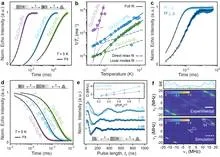
A layered cake of molybdenum disulfide MoS2 sits on the lab bench. It is prepared in the usual way: adhesive tape peels off the top layers to obtain a thin sample. But beneath the tape remains an invisible cavity where the atomic floors are no longer pressed together. It is there that electrons begin to behave differently than in the crystal bulk.
A ship in a bottle is assembled from the inside, not the outside: masts and sails are pulled through the narrow neck, and once inside the glass they settle into the right pose on their own. Chemists have done something similar with a single cobaltocene molecule, which they pulled into the gap between layers of a two-dimensional crystal.
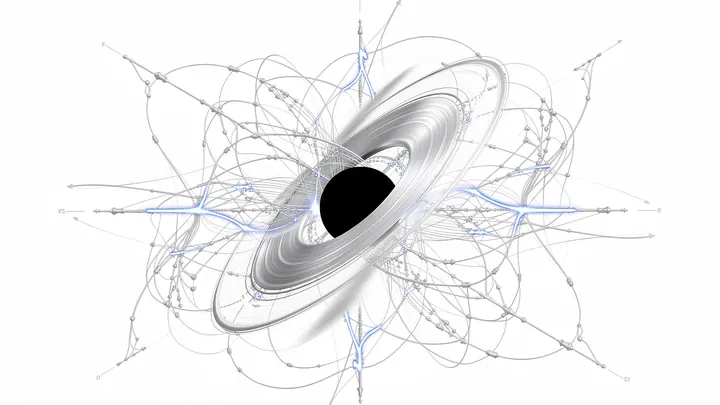
The proton is not a solid ball but a tiny prison. Inside it, three quarks are locked up, and the gluon field keeps them from escaping — something like invisible threads that only grow stronger if the quarks try to move apart.
A massive aluminum cylinder weighing a ton hangs in a vacuum. A gravitational wave, a ripple in spacetime, passes through it, and the bar begins to tremble almost imperceptibly. That trembling can be heard as sound: gravitational waves turn into a phonon — a quantum of sound vibrations.
A single graviton, a quantum of spacetime, is incredibly weak. For detectors like LIGO, built by Rainer Weiss and colleagues, quantum effects are suppressed by a factor of 10⁻³⁸: it's like trying to hear a grain of sand changing the wind's direction in a hurricane.
At first glance, the atomic nucleus is a cramped communal apartment where protons and neutrons (together called nucleons) live by strict rules. Each occupies its own orbit, like electrons in an atom, and on average everything looks orderly.
Sometimes an unwelcome guest sneaks into the equations, like a creaky floorboard that unsettles the whole house. In gravity theories, if you add curvature-squared terms to the equations (which you need to describe very strong fields), a ghost particle appears — heavy but with negative energy.
If you try to break a proton apart and pull out a quark, you're in for a surprise. Ordinary forces, like the electric force, weaken as particles fly apart. Here, it's the opposite. The farther a quark gets from its neighbors, the harder it's pulled back.
Gravity is like a stretched trampoline: massive bodies press into it, making other bodies roll toward them. This shared curvature of space, gravity, affects everyone, but it doesn't convey secret messages.
Somewhere above our heads, every second, a proton accelerated to energies millions of times greater than those at the Large Hadron Collider slams into the atmosphere. It strikes an air molecule, and a cascade is born — a wide atmospheric shower of thousands of particles.
An ordinary magnet makes a compass needle turn, but it doesn't stop the needle from moving forward. But if you twist a magnetic field into a knot, it can trap a particle in place, like a snare. This phenomenon is called an 'Aharonov–Bohm cage': the particle's waves cancel each other out at some points and reinforce at others, leaving only tiny 'islands' where it can exist.
In a thick metal, electrons are like a discordant orchestra: each instrument plays on its own, the overall sound is noise. But roll the metal into a film just a couple of atoms thick, and electrons suddenly begin to "play" in harmony, conducting current without dissonance. Even John Bardeen explained that in superconductors, electrons form pairs — duets that move unimpeded.