Molecular spin qubits in a van der Waals bottle ✛
Context
This work sits at the fringe even among its arXiv neighbors: nearby studies explore entanglement in flat crystals, molecules bridging spin and light, and icy labyrinths of three-dimensional quantum spin liquids. All of them, in one way or another, tackle a common problem: how to preserve fragile quantum states in a solid. What sets this paper apart is that it does not hunt for a new material or a new qubit type; instead, it offers a universal trick: use the empty space between layers of a two-dimensional crystal as a ready-made nanocage. Here cobaltocene is not the goal but a sensitive probe: its spin depends strongly on the environment, so any symmetry change shows up immediately in electron paramagnetic resonance spectra.
Methods
Crystals of SnS2 and CdPS3 were immersed in an acetonitrile solution of cobaltocene. A redox reaction transferred an electron from the molecule to the host layers, and the resulting cation [Cp2Co]+ along with a small fraction of neutral molecules intercalated into the interlayer space. Composition and structure were verified by X-ray diffraction, Mössbauer spectroscopy on tin-119 nuclei, transmission electron microscopy, and scanning tunneling spectroscopy. Coherence was measured by pulsed electron paramagnetic resonance: an inversion-recovery sequence gave T1, and a two-pulse Hahn echo gave the phase memory time Tm. Molecular orientation was determined from the angular dependence of the spectra and from the temperature evolution of the A1g Raman mode.
Results
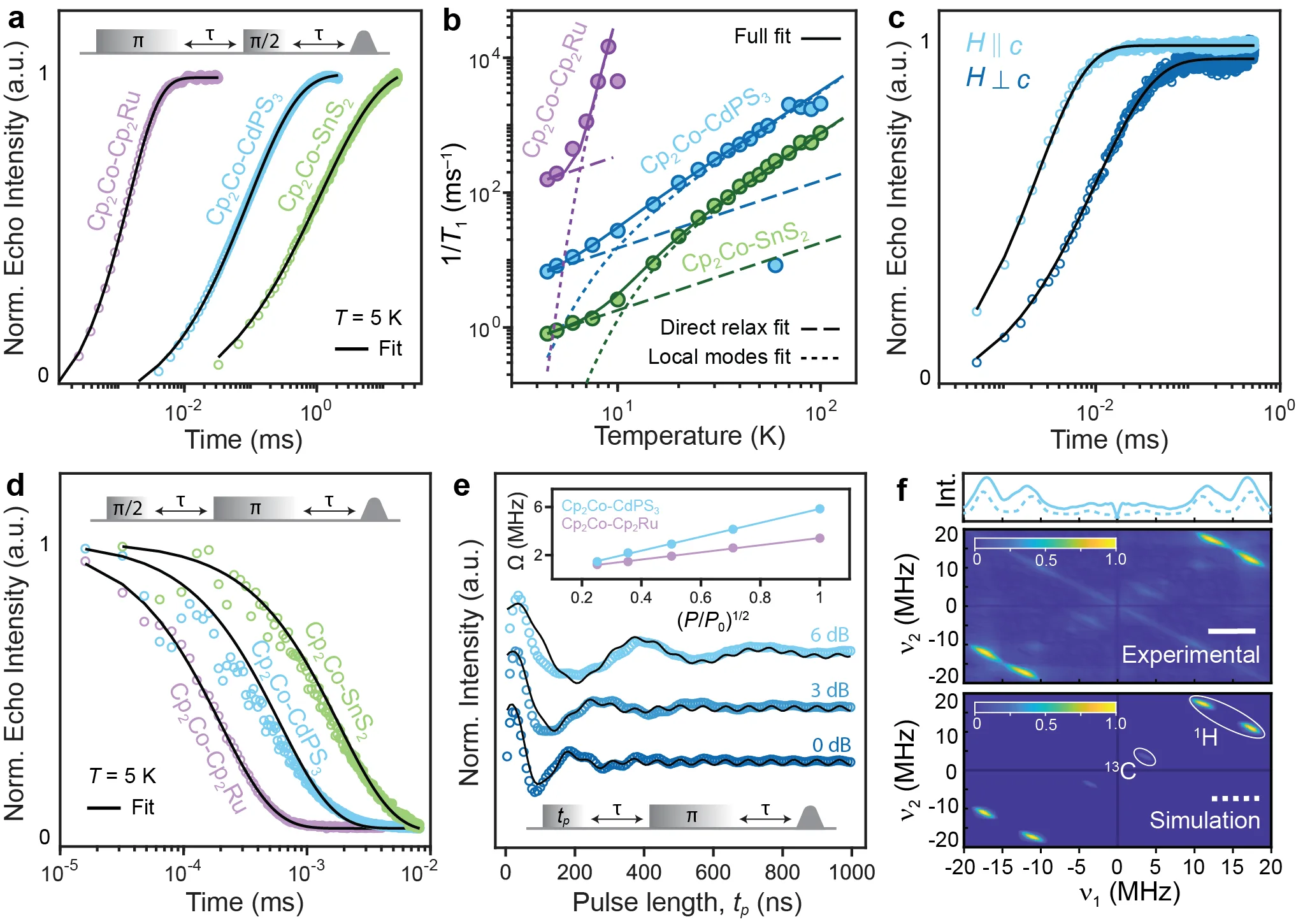
vdW confinement increased T1 by more than two orders of magnitude: from 5.2 μs for unconfined cobaltocene (5 mol% in Cp2Ru) to 1.1 ms in SnS2 and 0.09 ms in CdPS3 at 5 K. The echo signal for confined molecules persisted up to 100 K, whereas free cobaltocene stopped giving an echo already at 10 K. The phase memory time Tm was 1.8 μs (SnS2) and 0.6 μs (CdPS3), about a thousand times shorter than T1 and limited by the proton bath of the ligands. Electron diffraction revealed a 2a × 2a superstructure, meaning the molecules self-organize into a triangular lattice with a doubled host period. At 5 K the molecules stand upright (the C5 axis parallel to the crystal c axis), and above 156 K they lie flat. A single-ion Hamiltonian model explained the T1 increase: confinement strengthens the Jahn-Teller distortion relative to spin-orbit coupling, quenches the orbital moment, and removes the spin-flip channel needed for fast relaxation.
Implications
The key difference from neighboring work is not a new material or a new coherence record, but the demonstration that the geometry of the vdW gap itself can be a tool for engineering quantum states. Neighboring studies look at entanglement in flat crystals or molecules on surfaces, where the substrate often harms coherence. Here the substrate does not hinder but helps: it sets the orientation, suppresses vibrational modes, and rearranges the hierarchy of energy scales. This is the first experimental realization of vdW confinement of molecular spin qubits, and it can be transferred to other molecule–two-dimensional material pairs.
Future development
The nearest reserve is deuteration of the cyclopentadienyl rings to remove the proton bath and raise Tm. Beyond that, one can vary the host: change the band gap, introduce magnetic ions into the layers, or create heterostructures from different vdW materials. Since the crystals easily exfoliate down to monolayers, a path opens to hybrid devices where a molecular qubit sits next to photonic or superconducting circuits. The 'bottle' concept also applies to other metallocenes and to more robust rare-earth ion complexes.
Impact
The result will influence quantum sensing, which needs spin labels with nanometer resolution, and the architecture of hybrid quantum devices based on two-dimensional materials. The chemical tunability of the vdW gap could also prove useful in spintronics, where molecular arrays act as ordered magnetic lattices.
Next steps
Synthesize deuterated cobaltocene and measure Tm in the same hosts. Test the transferability of the approach to complexes with longer relaxation times, such as vanadyl porphyrins or rare-earth single-ion magnets.
Key open problems
For the chemistry of molecular qubits, the central unsolved problem is maintaining coherence when integrating into a device. This work shows that vdW confinement solves it by controlling symmetry and the vibrational spectrum, rather than by isolating the molecule. An open question remains how universal this trick is for complexes with large spin and strong spin-orbit coupling.
The knowledge machine's view
This section is addressed to the author of the paper and their colleagues. Neighbouring works were found by meaning-based search across our archive, not by word overlap. We do not review: we show the field around the work.
What the work does
The study shows that the van der Waals interlayer gap of SnS2 and CdPS3 acts as a protective nanocage for the molecular spin qubit cobaltocene: confinement fixes the molecular orientation, enhances the Jahn–Teller distortion, and suppresses the orbital moment, which increases T1 from 5.2 μs to 1.1 ms at 5 K and preserves the echo up to 100 K.
Where its strength is
The strength lies in the authors' transformation of the vdW gap geometry from a passive environment into an active tool for quantum state engineering, demonstrating a versatile approach applicable to various layered hosts.
Where it could go next
- It might be interesting to see how quantum entanglement in flat crystals, as studied in the work on the courier-archivist tandem, could combine with molecular qubits embedded in the vdW gap to create multi-node quantum registers.based on: Courier and Archivist in Tandem: Entanglement in a Flat Crystal arXiv:2509.23170
- Nearby lies the work on record quantum memory using two atoms; perhaps transferring the decoherence protection methods used there (e.g., dynamical decoupling) to cobaltocene in SnS2 could help extend the short Tm.based on: Two Atoms Against Chaos: A Quantum Memory Record arXiv:2603.19631
- Our archive includes a study on quantum squeezing of molecules to improve sensor precision; it would be interesting to test whether vdW confinement provides similar squeezing of spin states and whether it could be used for quantum metrology.based on: Quantum Squeezing of Molecules Improves Sensor Accuracy Threefold arXiv:2606.02500
Worth trying
- Try applying dynamical decoupling sequences to cobaltocene in SnS2 to extend Tm and bring it closer to T1.
- Investigate the possibility of optical readout of the spin state via the interface with excitons in the layered host, as in the work on the semiconductor whisper.
- Test whether cobaltocene in the vdW gap can serve as a sensitive probe of local magnetic fields or temperature.
Why this may matter
If the approach scales to other molecules and layered materials, it could become a platform for building scalable quantum devices where molecular qubits are shielded from the environment without complex chemical engineering.
Nearby works in our archive
- Flip-Flop Molecules: Turning Polar Particles into Quantum Chess Playerssimilarity 0.49
- Courier and Archivist in Tandem: Entanglement in a Flat Crystalsimilarity 0.47
- Two Atoms Against Chaos: A Quantum Memory Recordsimilarity 0.47
- Quantum Squeezing of Molecules Improves Sensor Accuracy Threefoldsimilarity 0.46
- How to Make a Waterfall and a Wave Get Alongsimilarity 0.46
- A Semiconductor's Whisper Beneath a Superconductor's Humsimilarity 0.46
The archive is sparse around this work: the closest review is only 0.49, against a usual 0.64. It looks like few have drilled nearby.
Cobaltocene is the very 'sandwich' of two cyclopentadienyl rings around a cobalt atom, for whose structure Ernst Otto Fischer and Geoffrey Wilkinson won the 1973 Nobel Prize in Chemistry. In this work, it plays the canary in the coal mine: its spin is so sensitive to the environment that the spectrum reveals the symmetry of the cage it is placed in.
The idea of trapping a single molecule in a nanoscale cavity and making it work as a qubit echoes the 'atom trap' from Greg Egan's novel Quarantine: there, quantum states are isolated from the environment to be used for computation. In Egan, the isolation is nearly perfect, but here confinement does not isolate; it reshapes the coupling to the environment, and that is exactly what brings the gain.
Key numbers
- T1 increase: more than 100-fold
- T1 in SnS2 at 5 K: 1.1 ms
- T1 of free cobaltocene at 5 K: 5.2 μs
- orientation transition: 156 K
- interlayer spacing expansion: 0.55 nm