Why Galaxies Fade from the Outside In: Neural Network Lifts the Veil from Distant Images ✛
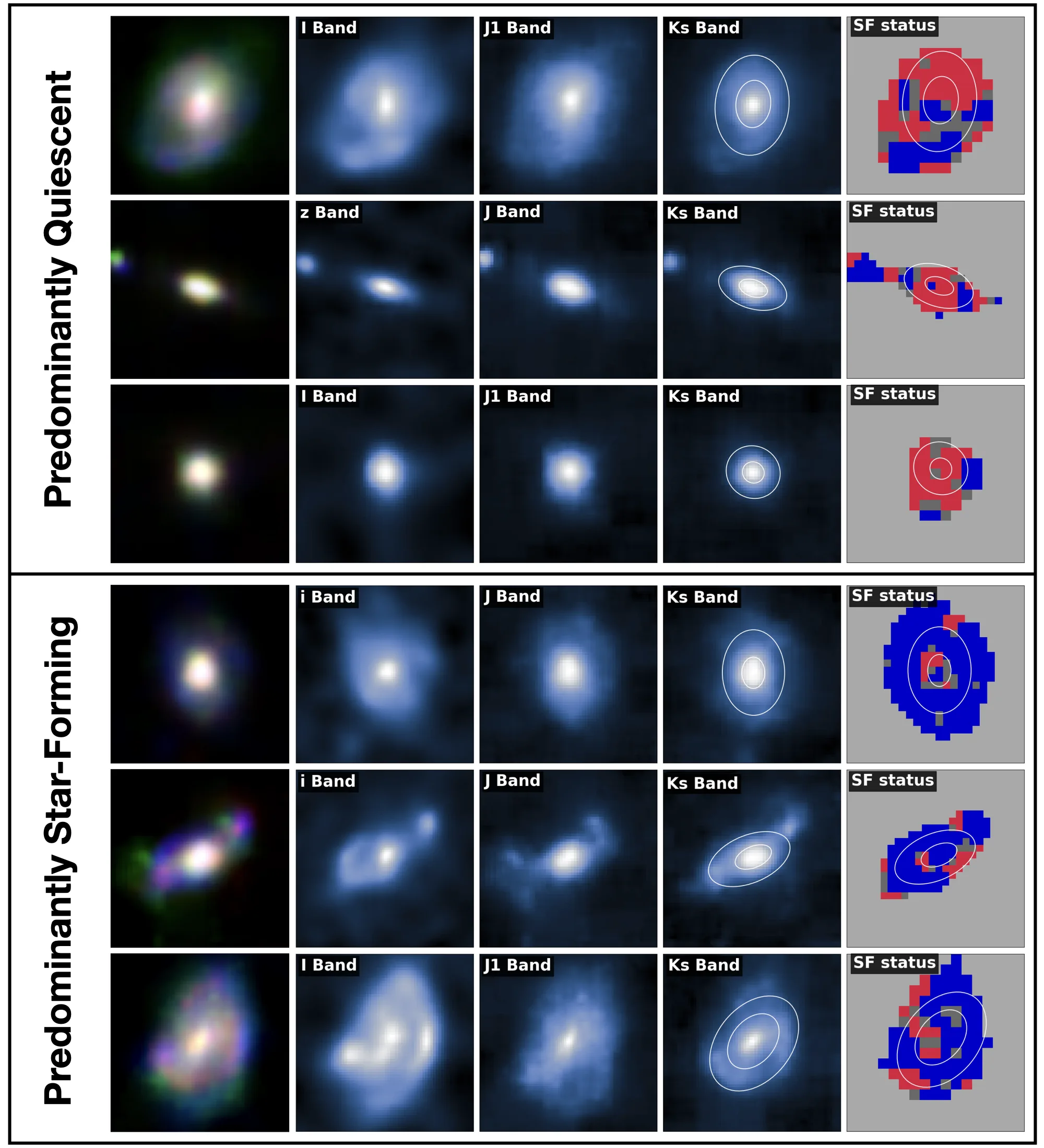
A photo of a distant galaxy taken from Earth looks like a view through frosted glass: the atmosphere smears the details, so we cannot see where exactly stars are being born in the galaxy. A neural network has learned to lift this veil, restoring sharpness using space-based images as a reference.
The researchers selected nine galaxy clusters, seen as they were when the universe was about 5 billion years old. After processing, each galaxy was split into an inner and an outer region, and the colors were used to check whether stars were forming there. It turned out that among galaxies previously classified as fully quenched, 21% still harbor star formation in their centers and 3% on their outskirts. In clusters, the fraction of quenched galaxies is higher than in the field, but this excess does not depend on mass, contradicting earlier findings.
This means that galaxies often fade from the outside in, especially small ones. Previously, it was thought that the quenching efficiency depends strongly on mass, but now it is clear that the integrated color was misleading. The method can be applied to existing ground-based surveys to extract information about millions of galaxies without new observations. Lifting the frosted glass from distant galaxies has only just begun.
Deconvolution achieved a resolution of about 0.2 arcseconds, comparable to that of the Hubble Space Telescope, even though the original ground-based images had a blur of 0.5–0.8 arcseconds. It is like reading fine print through frosted glass and then suddenly seeing the letters clearly.
The idea of recovering hidden structure from blurry data echoes the 'image enhancement' technology of science fiction, for example in 'Star Trek' or the movie 'Blade Runner', where a computer fills in details from bits of information. Here, the neural network does the same, but strictly based on a training set of real space images.