Lifting the Veil from Galaxies: How AI Deconvolution Reveals Outside-In Quenching of Star Formation ✛
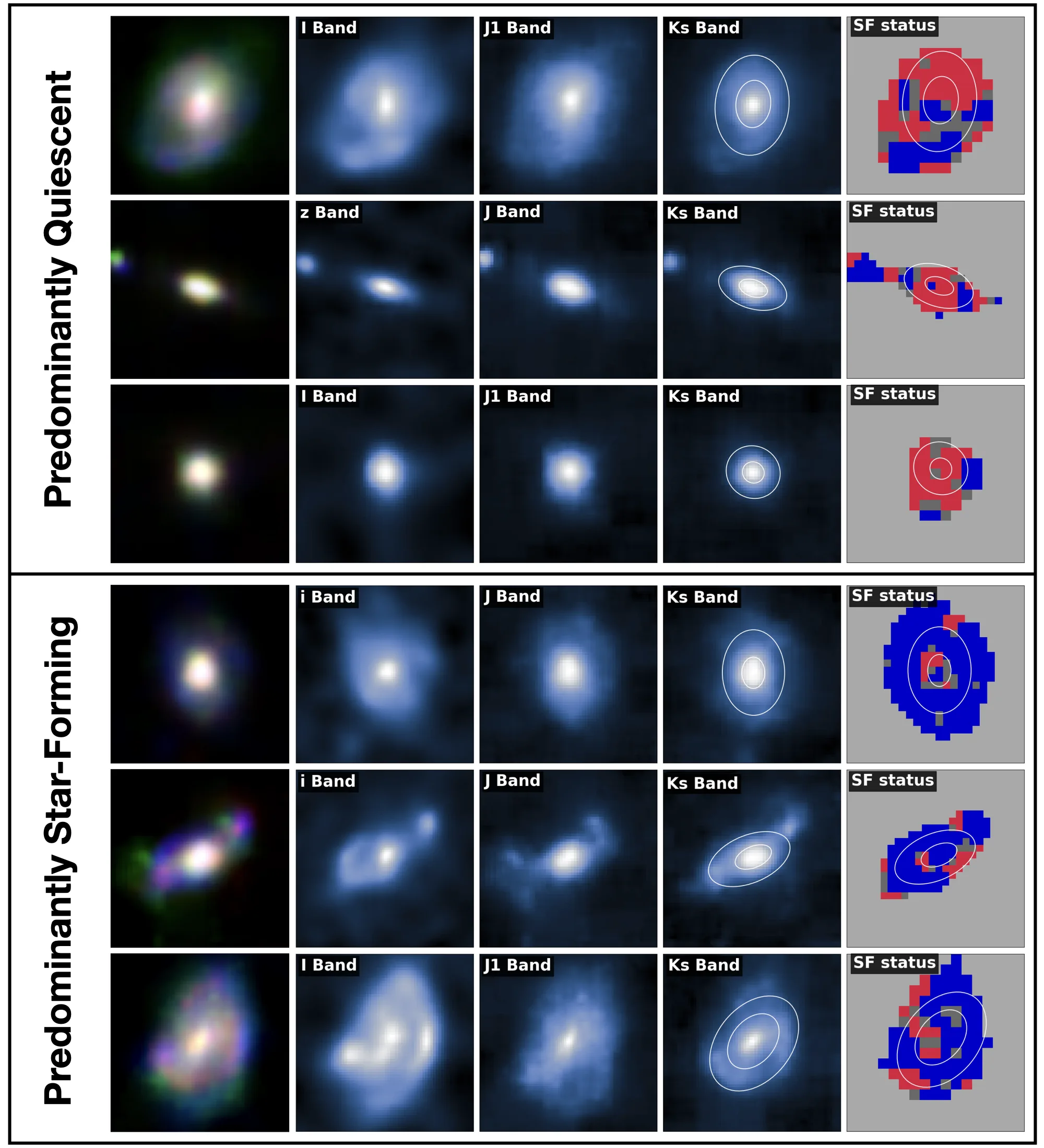
A ground-based image of a distant galaxy looks like a view through frosted glass: the atmosphere smears details, hiding the internal structure. Astronomers have long wanted to know where exactly star formation shuts off in galaxies, but ground-based telescopes could not resolve the subtle color gradients. Now a neural network has learned to lift this veil, restoring sharpness using cosmic images as templates.
For this study, nine galaxy clusters at redshifts from 1 to 1.4 were selected, meaning we see them as they were when the universe was about 5 billion years old. Each image was processed with deconvolution: first, the blur was removed mathematically, then a neural network suppressed noise. Training used pairs of "blurred ground-based image and sharp space-based image from Hubble and James Webb." As a result, a resolution of about 0.2 arcseconds was achieved, comparable to Hubble, even though the original blur was 0.5–0.8 arcseconds.
After restoring sharpness, each galaxy was divided into an inner region containing half the light and an outer region containing 90%. The colors of these regions indicated whether stars are forming there. It turned out that among galaxies considered fully quenched by integrated color, 21% still have star formation in the center and 3% in the outskirts. In clusters, the fraction of predominantly quenched galaxies is 48.5±1.7%, compared to 35.7±2.9% in the field. The excess of quenched galaxies in clusters is 19.9±4.5% and does not depend on stellar mass, contradicting previous results where this excess increased with mass.
These results change our picture of how galaxies lose their ability to form stars. Previously, it was thought that quenching efficiency strongly depends on mass, but now it is clear that integrated colors systematically overestimate the fraction of fully quenched galaxies, especially massive ones. Spatially resolved data show that quenching often proceeds from the outside in, pointing to the importance of such data for correct interpretation.
The deconvolution method can be scaled to huge samples of galaxies from ground-based surveys like Rubin/LSST, where atmospheric blur limits resolution. Training on Euclid and Roman images will allow recovering spatial structure for billions of objects. In the near future, the authors plan to study the phase space of galaxies with different quenching pathways to distinguish mechanisms: ram-pressure stripping, starvation, or tidal interaction. Lifting the frosted glass from distant galaxies has only just begun.
Deconvolution achieved a resolution of about 0.2 arcseconds, comparable to that of the Hubble Space Telescope, even though the original ground-based images had a blur of 0.5–0.8 arcseconds. It is like reading fine print through frosted glass and then suddenly seeing the letters clearly.
The idea of recovering hidden structure from blurry data echoes the 'image enhancement' technology of science fiction, for example in 'Star Trek' or the movie 'Blade Runner', where a computer fills in details from bits of information. Here, the neural network does the same, but strictly based on a training set of real space images.