Lifting the Veil from Galaxies: How AI Deconvolution Reveals Outside-In Quenching of Star Formation ✛
Context
This work sits alongside studies that use machine learning to process astronomical images and investigate galaxy evolution in dense environments. Neighboring works have already shown that neural networks can recover the equation of state of neutron stars from gravitational waves, and that color maps of galaxy outskirts help solve the mystery of 'impossible' early galaxies. In the same vein, this paper applies deep deconvolution to ground-based images to examine for the first time in detail where exactly inside galaxies star formation quenches under environmental influence at high redshifts.
Methods
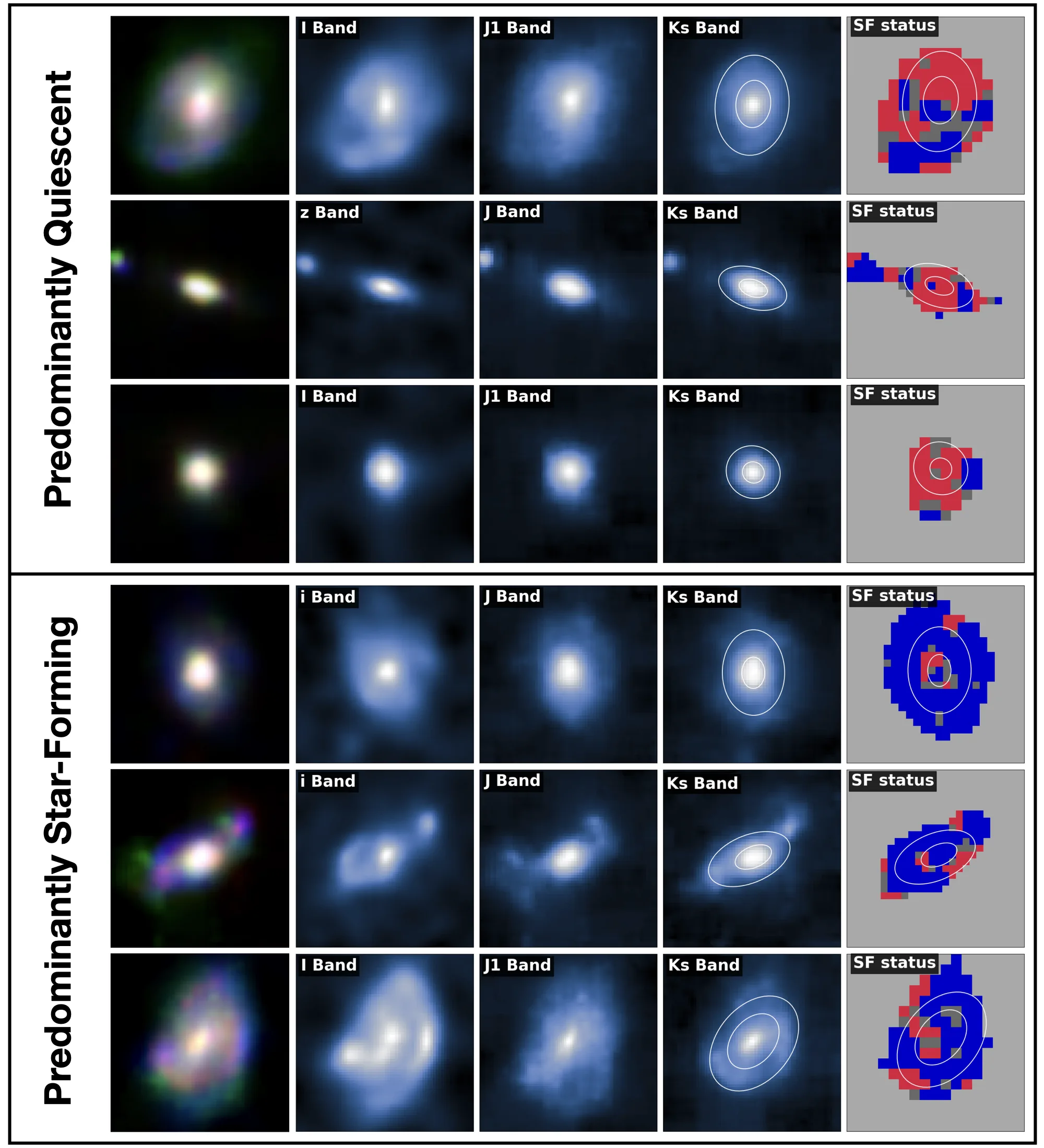
The researchers took images of nine galaxy clusters from the GOGREEN survey, obtained with the ground-based VLT, Subaru, Magellan, and CFHT telescopes in the optical and near-infrared. For each image, they built a model of the point spread function (PSF) describing atmospheric blur. They then applied the neural network method SUNet, which first performs linear Tikhonov deconvolution and then removes noise using multi-level wavelet-like convolutions. The model was trained on pairs of 'blurred ground-based image - sharp space-based image' from the Hubble and James Webb telescopes. For the near-infrared, three new models were trained based on JWST/NIRCam data from the COSMOS-Web survey. After deconvolution, for each galaxy they measured fluxes in two elliptical apertures: an inner one containing 50% of the light in the Ks band, and an outer one containing 90%. Based on normalized I−J and J−K colors, calibrated against integrated U−V and V−J colors, each region was classified as star-forming or quenched. Galaxies were divided into four classes: predominantly star-forming, predominantly quenched, quenched inside, and quenched outside.
Results
Deconvolution succeeded for 94.8% of galaxies, with failures almost always due to low signal-to-noise ratio rather than galaxy size. Among galaxies classified as quenched by integrated colors, 21% retain star formation in their centers and 3% in their outskirts. In clusters, the fraction of predominantly quenched galaxies is 48.5±1.7% versus 35.7±2.9% in the field. The excess of quenched galaxies in clusters (QFE) is 19.9±4.5% and does not depend on stellar mass, contradicting earlier GOGREEN results where QFE increased with mass. Among galaxies with residual star formation in clusters, 38.6±2.1% are quenched outside and only 5.4±1.1% inside. At low masses (log M*/M⊙ from 10.2 to 10.6), the excess of galaxies with quenched outskirts in clusters is 22.8±5.8% (significance 3.9σ). At high masses, no significant excess is found.
Implications
Unlike neighboring works that either recovered global galaxy parameters from integrated light or studied morphology without linking to color, this study is the first to apply deep deconvolution to ground-based data for spatially resolved classification of star formation quenching in distant clusters. This allowed directly seeing that integrated colors systematically overestimate the fraction of fully quenched galaxies, especially massive ones. Thus, the work calls into question previous conclusions about a strong mass dependence of quenching efficiency and highlights the importance of resolved data for correct interpretation.
Future development
The method can be scaled to enormous galaxy samples from ground-based surveys such as Rubin/LSST, where atmospheric blur limits resolution. Training on Euclid and Roman images will allow recovering spatial structure for billions of objects. In the near term, the authors plan to study the phase space of galaxies with different quenching paths to distinguish mechanisms: ram-pressure stripping, strangulation, or tidal interaction.
Impact
The results will affect the interpretation of data from large galaxy cluster surveys and models of galaxy formation and evolution in dense environments. The deconvolution method is applicable to any ground-based images, expanding the capabilities of existing telescopes without new observations.
Next steps
Study the distribution of galaxies of different classes in cluster phase space (velocity and distance from the center) to link quenching type to orbital history. Obtain spectra or multi-band photometry to estimate the ages of stellar populations in quenched outskirts and thereby constrain quenching timescales.
Key open problems
The work directly addresses the long-standing problem of which mechanism is responsible for quenching star formation in dense environments: slow strangulation, rapid ram-pressure stripping, or tidal harassment. Spatially resolved data showing that quenching proceeds from the outside in and is more pronounced in low-mass galaxies narrow down the candidates but do not allow a final choice of one mechanism without information on timescales.
The knowledge machine's view
This section is addressed to the author of the paper and their colleagues. Neighbouring works were found by meaning-based search across our archive, not by word overlap. We do not review: we show the field around the work.
What the work does
You applied deep deconvolution to ground-based images of nine clusters from GOGREEN, recovered the structure of about 1200 galaxies at z~1–1.4, and classified them by the spatial distribution of star formation. You found that a quarter of the galaxies considered quiescent by integrated colors are still forming stars, and that clusters contain an excess of galaxies with quenched outskirts, independent of mass.
Where its strength is
The strength of the work lies in moving from integrated colors to a spatially resolved classification, which revealed hidden star formation and identified the quenching pattern (outside-in) in dense environments.
Where it could go next
- It might be interesting to compare the reconstructed star formation maps with dust maps: in our archive there is an analysis where dust is modeled as discrete clumps rather than a uniform fog, which could alter the interpretation of colors and quenching.based on: Dust in Galaxies: Clumps Instead of Haze arXiv:2608.14023v1
- Nearby, there is experience applying generative neural networks to recover physical quantities from noisy data, in that case neutron star equations of state from gravitational waves; perhaps similar approaches could help extract star formation maps directly, bypassing the two-step deconvolution and classification.based on: Generative AI Reconstructs Neutron Star Matter arXiv:2608.17457v1
- Another adjacent approach is automatic structure detection in galaxy images using computer vision; it could be adapted to search for compact star-forming regions in reconstructed galaxies and compare their properties in clusters and the field.based on: Contour Map of Stellar Nurseries: Computer Vision Finds Clusters in the Fireworks Galaxy arXiv:2607.26330v1
Worth trying
- Test whether the fraction of galaxies with quenched outskirts changes when using clumpy dust maps instead of uniform extinction.
- Train a generative model on pairs of ground-based image and star formation map, and compare its predictions with color-based classification.
- Apply a cluster detector to the reconstructed images to identify compact star-forming regions and study their connection to the environment.
Why this may matter
Spatially resolved quenching at z>1 provides direct observational constraints on the mechanisms that halt star formation in galaxies falling into clusters, and could become a key test for galaxy evolution models.
Nearby works in our archive
- Dust in Galaxies: Clumps Instead of Hazesimilarity 0.54
- Dark Galaxies: The Invisible Neighbors of the Milky Waysimilarity 0.54
- Stellar Streams in Reversesimilarity 0.52
- Generative AI Reconstructs Neutron Star Mattersimilarity 0.52
- Contour Map of Stellar Nurseries: Computer Vision Finds Clusters in the Fireworks Galaxysimilarity 0.52
The archive is sparse around this work: the closest review is only 0.54, against a usual 0.64. It looks like few have drilled nearby.
Deconvolution achieved a resolution of about 0.2 arcseconds, comparable to that of the Hubble Space Telescope, even though the original ground-based images had a blur of 0.5–0.8 arcseconds. It is like reading fine print through frosted glass and then suddenly seeing the letters clearly.
The idea of recovering hidden structure from blurry data echoes the 'image enhancement' technology of science fiction, for example in 'Star Trek' or the movie 'Blade Runner', where a computer fills in details from bits of information. Here, the neural network does the same, but strictly based on a training set of real space images.
Key numbers
- Fraction of galaxies with quenched outskirts in clusters at low masses: 22.8±5.8%
- Quenched fraction excess in clusters (QFE): 19.9±4.5%
- Deconvolution success rate: 94.8%
- Fraction of galaxies misclassified as quenched by integrated colors: 24%
- Redshift of studied clusters: 1.0–1.4