How to Hear the Eternal Current in a Superconductor ✛
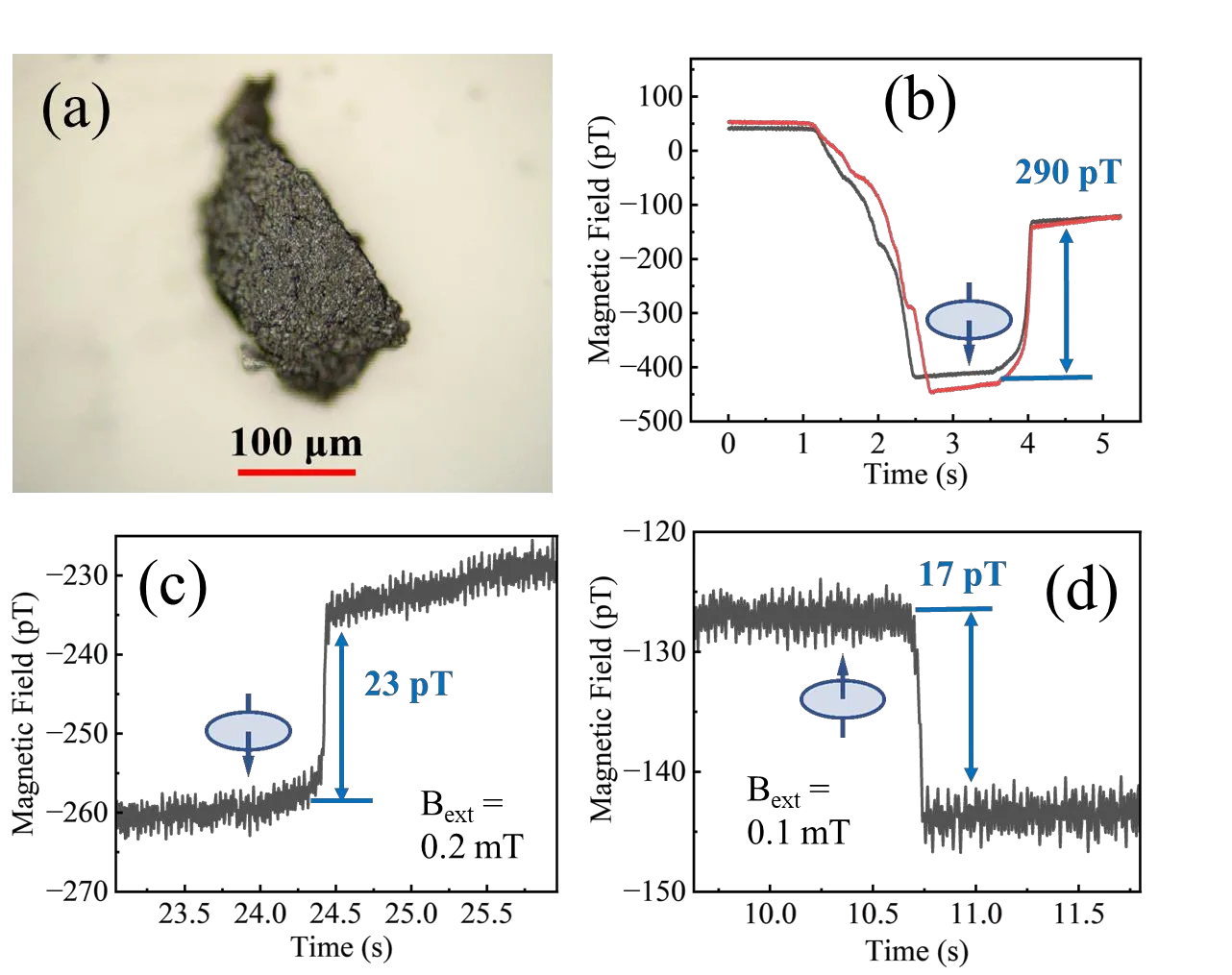
A superconductor is like a perpetual electromagnet: if you cool it in a magnetic field, a current gets trapped inside, flowing endlessly and generating its own magnetic field. That field is extremely weak, about a billion times weaker than a refrigerator magnet. But the new device, like a sensitive ear, picks it up from a couple of centimeters away, without touching the sample.
Previously, to test superconductivity, you had to solder wires to a tiny crystal and cool everything to very low temperatures. This destroyed fragile samples, especially those squeezed in diamond anvils under enormous pressure. Now, the sample is simply mounted on a wooden stick, cooled in liquid nitrogen, and brought near the magnetometer. When the sample warms above the critical temperature, the supercurrent disappears, and the magnetic field drops sharply. That jump is the signature of superconductivity.
This testing method works with samples smaller than 100 micrometers, which is thinner than a human hair. It is already ready for use in laboratories searching for new superconductors that could operate at room temperature.
Earth's magnetic field alone induced a remnant current in the REBCO superconducting tape, which created a field of 20 picotesla. That is a billion times weaker than the field of a typical refrigerator magnet.
In Arthur C. Clarke's novel 'Childhood's End,' aliens use superconductors for levitation, and here a supercurrent induced by Earth's magnetic field turns a tiny sample into a permanent electromagnet that can be sensed from centimeters away.