Superconductivity Without Wires: How to Catch a Persistent Current ✛
A tiny black hole flies through a hydrogen cloud and stretches atoms like taffy. That is what a superconductor looks like when it traps a persistent current: a material in which electricity flows without losses turns into a miniature permanent magnet. But how do you hear that whisper of a field when a sample the size of a grain of sand is squeezed between diamonds under millions of atmospheres of pressure? Until now, scientists relied on bulky setups with cryogenic sensors and electrical contacts that destroyed fragile crystals.
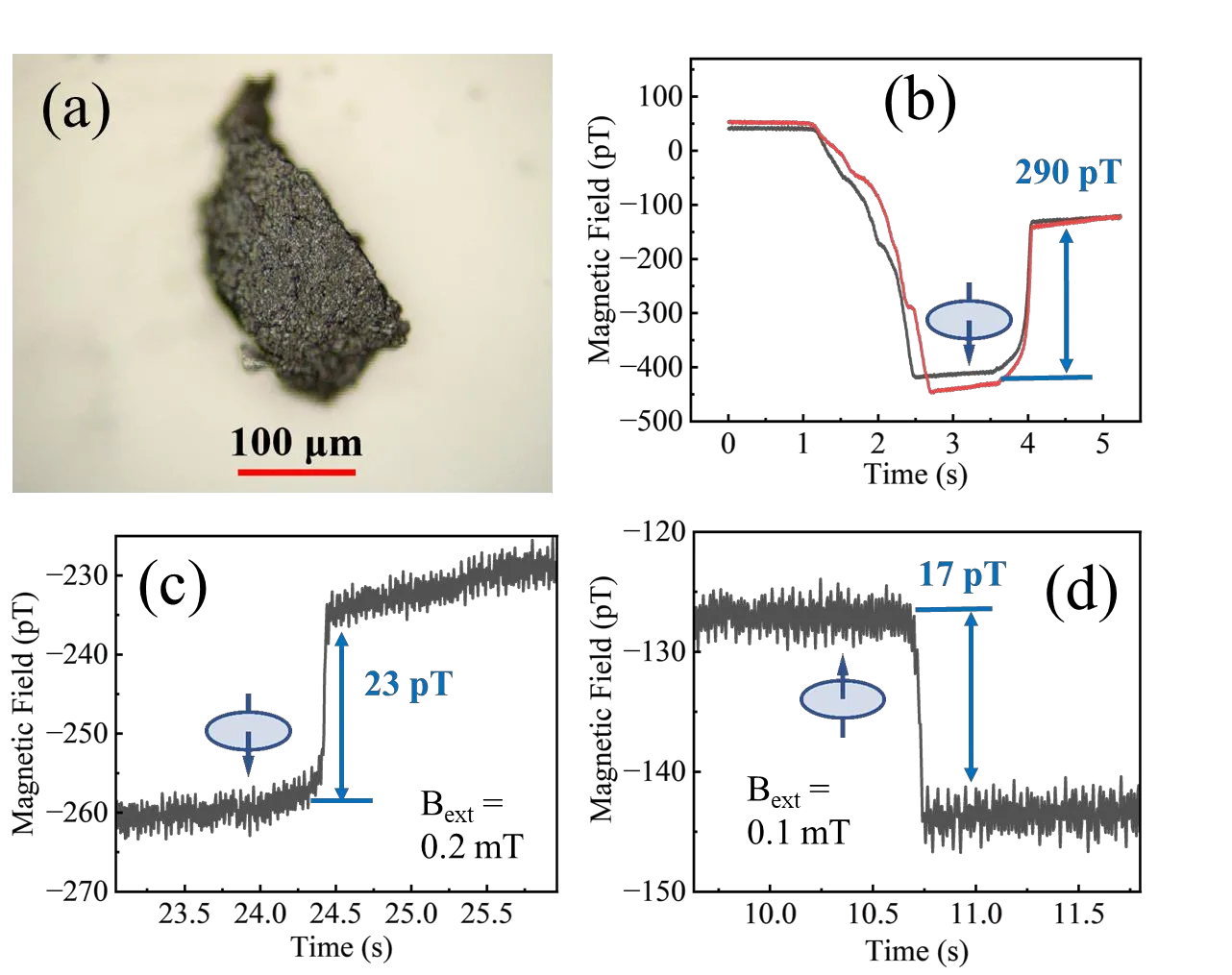
The new method, dubbed DSV (Direct Superconductivity Validation), acts like a keen ear pressed to a door. An atomic magnetometer based on rubidium vapor, operating at room temperature, picks up the magnetic field created by the supercurrent induced in the sample when it is cooled in liquid nitrogen. The sample is mounted on the tip of a wooden stick, quickly transferred into a shielded chamber, and allowed to warm up. The moment the temperature exceeds the critical value, the supercurrent vanishes and the field drops sharply; that jump is the signature of superconductivity.
On a YBCO microcrystal smaller than 100 micrometers, after cooling in a field of 3.4 millitesla, a field of about 290 picotesla was recorded; that is a billion times weaker than a refrigerator magnet. As the magnetizing field was systematically increased, the residual current grew linearly and then saturated, as expected for type-II superconductors. A commercial REBCO tape gave an even more surprising result: even without an external magnet, just from Earth's magnetic field, a supercurrent arose that produced a field of 20 picotesla.
To reach samples in diamond anvil cells, where the distance to the sensor is about two centimeters, a ferrite rod 15 millimeters long is placed between them. It collects magnetic flux like a funnel and directs it into the magnetometer. Thanks to this, the signal from a distance of 21 millimeters is recovered to 630 picotesla, enough to confidently distinguish a superconductor from a normal metal.
So the tiny black hole stretching atoms like taffy finds its voice: a supercurrent induced even by terrestrial magnetism can be heard from centimeters away. The method is already ready for mass screening of candidates predicted by artificial intelligence and promises to accelerate the search for room-temperature superconductivity.
Earth's magnetic field alone induced a remnant current in the REBCO superconducting tape, which created a field of 20 picotesla. That is a billion times weaker than the field of a typical refrigerator magnet.
In Arthur C. Clarke's novel 'Childhood's End,' aliens use superconductors for levitation, and here a supercurrent induced by Earth's magnetic field turns a tiny sample into a permanent electromagnet that can be sensed from centimeters away.