Superconductivity Without Wires: How to Catch a Perpetual Current ✛
Context
The search for high-temperature and room-temperature superconductors is accelerating thanks to artificial intelligence and automated synthesis, but experimental validation remains a bottleneck. Traditional signatures of superconductivity, namely zero resistance and the Meissner effect, are difficult to establish in microscopic samples, especially in hydrides within diamond anvil cells, where dimensions are tens of micrometers. Related works on the arXiv are moving in the same direction: some use superconducting quantum interference devices (SQUIDs) to detect trapped flux, others investigate nickelates and hydrides, and still others develop laser control of superconductivity. All face limitations: SQUIDs require cryogenic temperatures, are expensive, and are sensitive to mechanical noise, while contact methods damage fragile samples. Against this backdrop, this work stands apart: it offers not an improvement of existing schemes but a fundamentally different approach that moves detection to room temperature and completely eliminates contact with the sample.
Methods
The DSV platform uses a commercial atomic magnetometer, the QZFM Gen-3 from QuSpin, which operates at room temperature on rubidium vapor. The superconductor sample is attached to the tip of a wooden stick and cooled in liquid nitrogen within the magnetic field of a neodymium magnet to induce a remnant supercurrent. The sample is then quickly transferred to a magnetically shielded chamber, where the magnetometer measures the absolute magnetic field. As residual liquid nitrogen evaporates, the temperature rises, and when it exceeds the critical temperature Tc, the supercurrent disappears and the field drops abruptly. This jump serves as a direct signature of superconductivity. To check reproducibility, the direction of the magnetizing field was reversed, expecting a sign change in the measured field. The magnetometer sensitivity was 2–3 picotesla, and a test coil carrying a current of 10 microamperes produced a field of 122 picotesla, matching the calculation within uncertainty. For remote measurements, a ferrite rod 15 mm long was placed between the sample and the sensor to collect and channel the magnetic flux.
Results
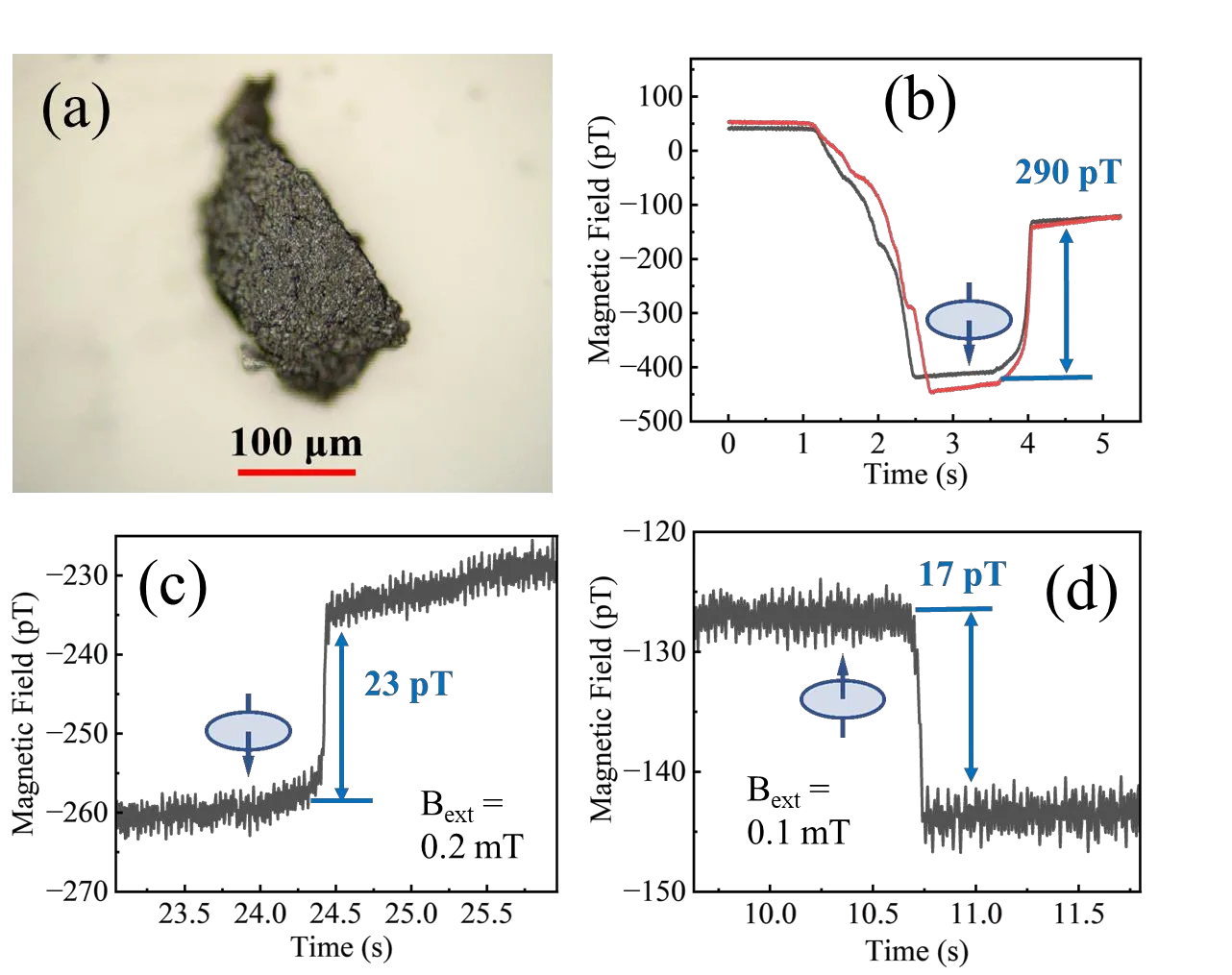
On a YBCO microcrystal smaller than 100 micrometers, after cooling in a field of 3.4 millitesla, a field of about 290 picotesla was recorded, which disappeared abruptly upon heating above Tc. Flipping the magnetizing field changed the sign of the signal, ruling out ferromagnetic contamination. When the field was systematically varied from 3.4 to 530 millitesla, the remnant current grew linearly at low fields and saturated after 20 millitesla, as expected for type-II superconductors. A commercial REBCO tape measuring 1.3×1.3 mm produced a field of 5.5 nanotesla after cooling in a 4 millitesla field, and when cooled without any external magnet, a signal of 20 picotesla was recorded, caused solely by Earth's magnetic field. This is the first observation of a supercurrent induced by the ambient geomagnetic field. The ferrite concentrator restored the signal from 90 to 630 picotesla when the distance increased from 6 to 21 millimeters, confirming the method's suitability for diamond anvil cells, where the distance to the sample is about 1.8 centimeters.
Implications
This work differs from related approaches in that it is the first to move detection of remnant supercurrents to room temperature and make it fully contactless. SQUID magnetometry, used in related studies on hydrides, requires cryogenic cooling and complex setup, whereas here a commercial atomic magnetometer and a wooden stick suffice. Furthermore, DSV measures the absolute field rather than flux changes, simplifying quantitative assessment of the supercurrent. The scale is also different: the method works with samples smaller than 100 micrometers, directly compatible with diamond anvil cells, whereas many related studies focus on larger crystals or theoretical calculations. This makes DSV the first practical platform for mass screening of candidates predicted by artificial intelligence.
Future development
The method can be extended to type-I superconductors by creating a microscopic hole or a non-superconducting region in the sample via laser micromachining to form a current loop. For superconductors with low Tc, the sample or diamond anvil cell can be mounted on a cryogenic stage with temperature control, enabling studies of supercurrent relaxation dynamics. Magnetic shielding can be easily enlarged to accommodate a standard diamond anvil cell, and ferrite concentrators can be lengthened for even greater distances. The platform is also applicable to other quantum materials: two-dimensional magnets, antiferromagnets, ferrimagnets, and topological magnetic systems, by measuring their stray fields.
Impact
The method will accelerate the validation of superconductors synthesized under high pressure and simplify mass screening of materials predicted by machine learning algorithms. The contactless configuration will preserve space around the sample in the diamond anvil cell for simultaneous laser spectroscopy or X-ray diffraction.
Next steps
Adapt the platform to a standard diamond anvil cell with an integrated ferrite concentrator and test it on a known hydride superconductor. Develop an automated sample positioning system for high-throughput screening.
Key open problems
For the physics of superconductivity, the mechanism of high-temperature superconductivity in cuprates and hydrides remains unresolved, as does the possibility of room-temperature superconductivity at ambient pressure. Direct detection of remnant supercurrents provides an independent way to verify controversial claims, for example for LK-99 or hydrides, where conventional measurements yield contradictory results due to impurity phases and microscopic sizes.
The knowledge machine's view
This section is addressed to the author of the paper and their colleagues. Neighbouring works were found by meaning-based search across our archive, not by word overlap. We do not review: we show the field around the work.
What the work does
The authors present the DSV platform for contactless verification of superconductivity in microscopic samples using an optically pumped atomic magnetometer. The method measures the magnetic field from remnant supercurrents induced by cooling in a magnetic field and detects the abrupt disappearance of the field upon crossing Tc. Operation is demonstrated on YBCO microcrystals and REBCO tape with picotesla sensitivity and the capability for remote measurements through a ferrite flux concentrator.
Where its strength is
The strength of this work lies in bringing superconductivity detection to room temperature and completely eliminating contact with the sample, which is especially valuable for fragile microsamples in diamond anvil cells. The use of a commercial magnetometer and a simple scheme with a ferrite concentrator make the approach scalable for rapid screening.
Where it could go next
- It might be interesting to explore integration with methods that use superconducting quantum interference devices to detect trapped flux, comparing sensitivity and applicability to even smaller samples.
- Closely related is work on measuring magnetic fields under extreme conditions, where contactless detection is also required; their approaches to shielding and signal processing might prove useful for improving DSV stability.based on: How to See Magnetic Fields in the Hottest Depths of Earth arXiv:2606.25378
- It would be interesting to compare with sensors based on alkali metal vapor atoms, which are already used for contactless electric field measurement; combining them might yield a more complete characterization of the superconducting state.based on: Atoms Feel Electricity Without Wires arXiv:2603.23751
Worth trying
- Test DSV on hydride samples in diamond anvil cells, where size and fragility make contact methods especially difficult.
- Investigate the possibility of using a gradiometer based on two magnetometers to suppress external noise and enhance sensitivity.
- Explore how the signal depends on heating rate to optimize the procedure for rapid screening.
Why this may matter
The proposed method could significantly accelerate the screening of high-temperature superconductor candidates, particularly under high-pressure conditions where traditional measurements are challenging, thereby bringing us closer to the discovery of room-temperature superconductivity.
Nearby works in our archive
- A Needle That Listens to Superconductorssimilarity 0.58
- A Levitating Sphere Measures Invisible Forcessimilarity 0.57
- Atoms Feel Electricity Without Wiressimilarity 0.55
- A Magnetic Field Sensor That Doesn't Choke on Its Own Precisionsimilarity 0.55
- Squeezed, pressed, and peeked into the soul of a superconductorsimilarity 0.54
- How to See Magnetic Fields in the Hottest Depths of Earthsimilarity 0.54
The archive is sparse around this work: the closest review is only 0.58, against a usual 0.64. It looks like few have drilled nearby.
Earth's magnetic field alone induced a remnant current in the REBCO superconducting tape, which created a field of 20 picotesla. That is a billion times weaker than the field of a typical refrigerator magnet.
In Arthur C. Clarke's novel 'Childhood's End,' aliens use superconductors for levitation, and here a supercurrent induced by Earth's magnetic field turns a tiny sample into a permanent electromagnet that can be sensed from centimeters away.
Key numbers
- magnetometer sensitivity: 2–3 picotesla
- field from YBCO microcrystal: 290 picotesla
- field from REBCO tape: 5.5 nanotesla
- field from Earth's magnetism: 20 picotesla
- detection distance with ferrite: 21 millimeters