Electrons in an atom are like birds in a tree. Each bird occupies its own branch, at a certain height and with a certain flight direction. Quantum numbers are a precise description of the place: which branch (energy), from which side (orbital shape), in which nest (magnetic number), and which way it's facing (spin). No two addresses are the same.
History
The idea of quantum numbers originated in Bohr's atomic model (1913) with the introduction of the principal number n. Arnold Sommerfeld generalized the model in 1916, adding orbital and magnetic numbers to explain fine structure. A decisive contribution was made by Wolfgang Pauli, who proposed spin and the exclusion principle in 1925. Erwin Schrödinger created wave mechanics in 1926, where the numbers n, l, mₗ received a rigorous interpretation as eigenvalues of operators, and the Dirac equation (1928) gave spin a relativistic foundation.
How it works
The wave function of an electron is determined from the Schrödinger equation. When separating variables in a central potential, quantum conditions arise: the radial equation gives n = 1, 2, 3…, the angular one gives l = 0, …, n−1 and mₗ = −l, …, l. Spin is introduced via the Dirac equation and for the electron takes values s=1/2, mₛ = ±1/2. The Pauli principle forbids two electrons from occupying the same quantum state, which explains the sequential filling of shells and the periodicity of chemical properties. Thus, quantum numbers are a direct consequence of the Schrödinger equation and the Pauli principle.
Fun fact
The spin quantum number of an electron takes only two values: +1/2 or -1/2, like a coin that always lands heads or tails, but never on its edge. It is precisely thanks to the Pauli principle, which forbids identical sets of numbers, that atoms do not collapse and form all the variety of elements.
In a tight row of atoms, spaced closer than the wavelength of light, a remarkable state hides. The excitation is distributed among all particles so that their radiation cancels itself out. This quantum 'silence' is an ideal vault for a photon: it can be stored there hundreds of times longer than usual.
Electric charge is a slippery thing. You can measure how much there is in the entire universe or in a single particle, but try to point your finger and say, 'Right here, in this cubic centimeter, there is exactly this much charge right now,' and you hit a fundamental wall.
The issue is that total charge, which physicists denote by the letter Q, is nonlocal.
The quantum world is full of strange connections. Two particles can become “entangled”: the state of one instantly affects the other, even if they are kilometers apart. But how do you know if they are truly entangled? It's like a ball of yarn: at first glance, you can't tell whether it's a single tangled ball or just a mess of loose threads.
An atomic nucleus is not just a ball of protons and neutrons. It has a shape, and that shape can change. The tin-116 nucleus was long considered almost perfectly spherical: it has 50 protons — a 'magic' number that usually gives a nucleus spherical symmetry. But a new ultra-precise measurement showed otherwise.
The quantum many-body world is a jazz ensemble, where each electron improvises, continuously listening to all the others, and the overall wave function is born from this tense dialogue.
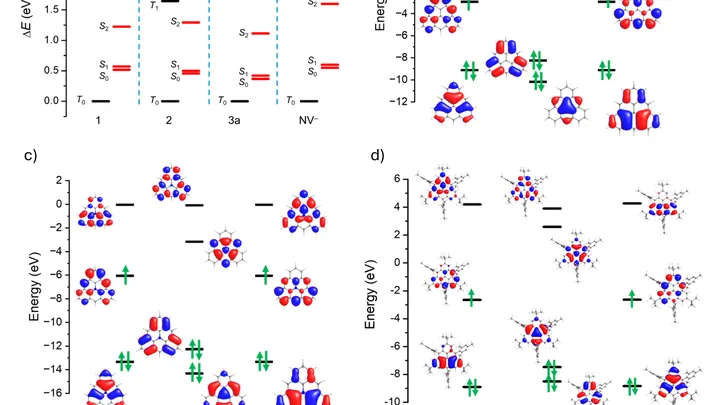
At the heart of a future quantum computer might lie a tiny organic molecule shaped like a triangle. It has two 'extra' electrons that don't pair up. Such molecules are called diradicals, and their electrons can store information in a special, quantum way.
A quantum computer is like an orchestra where every musician must play their part without missing a beat. The musicians are qubits — carriers of quantum information. For the orchestra to sound harmonious, you need qubits that are reliable, controllable, and not too sensitive to noise.
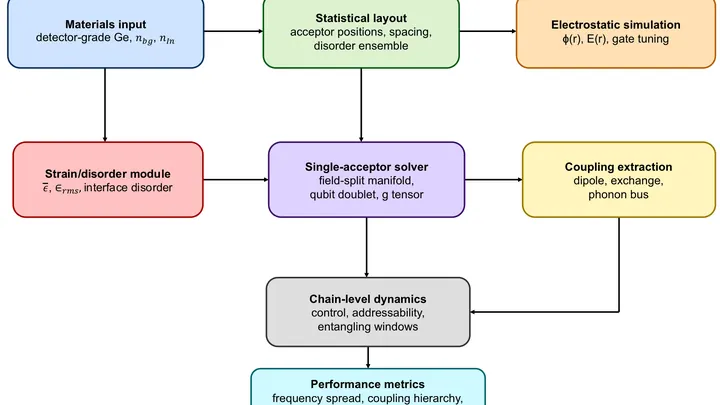
Toss a handful of phosphorus into silicon, and at a certain impurity concentration the material suddenly starts conducting electricity. This is a metal-insulator phase transition, and it happens abruptly. But what exactly changes in the electron wave functions when an insulator becomes a metal?
Textbooks divide particles into two camps: bosons love to crowd into the same state, fermions absolutely refuse. But nature allows a third option. Anyons are quasiparticles whose behavior lies somewhere in between. They can 'remember' how they were exchanged and obey a nonstandard exclusion principle.
A pot of water always boils the same way: hit 100 degrees and bubbles start. Quantum fluids are different. When a cloud of atoms is cooled to near absolute zero, it can turn into a single matter wave — a Bose–Einstein condensate. But the transition itself, it turns out, can happen in three different ways.
A quantum particle traveling around a closed ring leaves two distinct 'records' along its path. The first is like a fingerprint on a doorknob: it remains unchanged no matter how many times you turn the knob, and it only tells you about the shape and material.
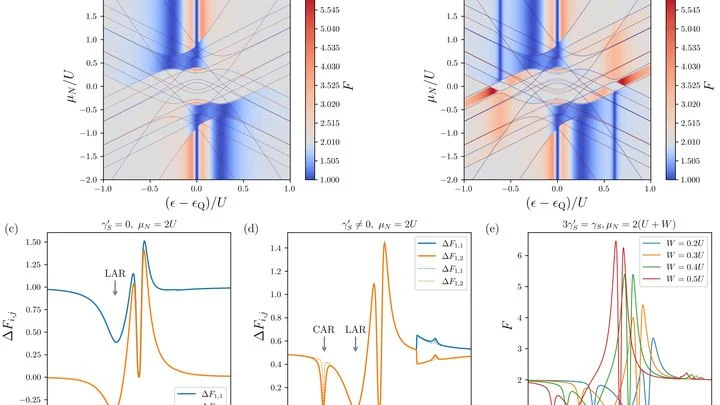
In a water supply system, water sometimes flows not as a continuous stream but in separate identical portions, as if the tap opens and closes, letting through exactly one drop each time. This is roughly how electric current behaves in superconducting contacts called Josephson junctions.
In a boron nitride crystal, the perfect atomic lattice is sometimes disrupted: an atom is missing here, or replaced by a foreign one there. Under a powerful microscope, these tiny imperfections appear as traps for electrons: they capture particles and start to emit light, and they also respond to magnetic fields.
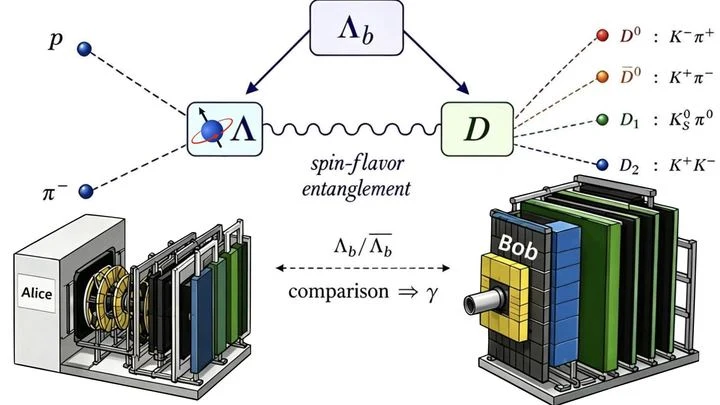
A coin tossed with the right hand always lands heads, while the left hand always lands tails. That's roughly how the lambda-b particle behaves: its intrinsic rotation (spin) is inextricably linked to which D-meson is born in its decay. This link is quantum entanglement, but not between two particles — rather between two properties of the same particle.
A pendulum swings not in a single plane but in five dimensions at once. Its motion is described by a complex mathematical model, and the pendulum itself is an electron in a graphene sheet interacting with five different "flavors" of its environment.
Quantum computers promise to solve problems that regular computers can't. But where is the line? The authors of a new study stumbled upon a surprising case: electrons paired up behave like a well-behaved orchestra. Even if you add a bit of "magic"—a special quantum resource: their behavior remains predictable.
In the world of superconductors, electrons don't like to be alone. They typically pair up into Cooper pairs and move without resistance, like figure skaters holding hands. But you can make them dance in fours. The authors of this work propose a scheme where Cooper quartets, groups of four electrons exchanging partners in a rapid rhythm, are born.
A city map: intersections are nodes, streets are connections. For an algorithm to understand the structure, each node needs a label. The classical approach — standard model — assigns simple tags, like house numbers.
A spinning top, set in motion on a perfect surface, topples from the slightest tremor. Likewise, a quantum bit, created at a defect in a diamond, has its state destroyed by magnetic disorder from impurities and external interference.
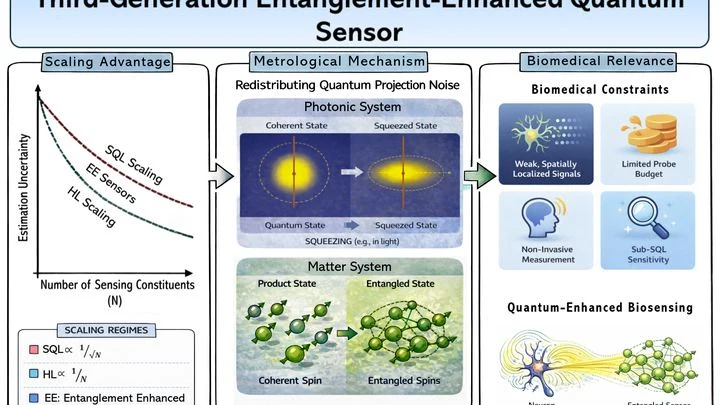
A modern hospital sensor is like a sensitive microphone in a noisy hall. It picks up a weak signal from the heart or brain, but along with it comes the hum of machines, footsteps, the breathing of neighbors. Separating the desired sound from the interference is a science in itself.
Two quantum dots are like two tiny pockets in a piece of silicon where an electron can sit, like a ball in a cup. When the pockets are far apart, each electron lives on its own, and its energy resembles the levels of a solitary atom.
An electron in an atom is like a note on a string: it has a set of allowed energies, and the physicist's task is to find these notes. Usually, the space around the nucleus is divided into small pieces and the behavior of the electron in each piece is calculated. The finer the pieces, the more accurate the answer.
A water molecule resembles a tiny dumbbell: two hydrogen atoms attach to an oxygen atom at an angle. This dumbbell doesn't stay still: it stretches, compresses, and rotates. Each such motion has its own energy, like steps on a ladder.
The quantum world doesn't like being glanced at sideways. To extract all available information from an atom or photon, you need a whole fan of 'needles'—different ways to ask a question. Physicists call such a fan a complete set of measurements. But among complete sets, there are special ones: their needles are arranged so evenly that each responds with equal strength.
A silicon chip the size of a fingernail holds billions of tiny switches. But a quantum computer needs not switches but individual electrons trapped in microscopic pits. These pits are quantum dots. And here's the catch: two neighboring pits that look identical can hold an electron differently. One is slightly deeper, the other slightly shallower.
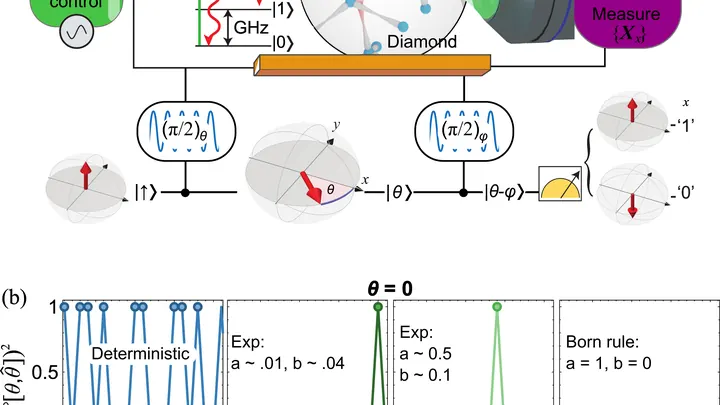
A coin toss seems random, but in reality, physics decides everything: the force of the throw, air resistance, the surface's elasticity. If you knew all the details, you could predict the outcome. True randomness lives deeper — in the quantum world.
In two mirrored rooms, set at right angles, lives a cloud of atoms. Each atom is like a singer in a choir: on its own, it may stay silent, but when neighbors start to sing, it joins in. Here, the conductor's role is played by geometry itself: one room helps the atoms emit light together, while the other gently nudges them toward that — not directly, but through a clever detour.
A quantum dot is a box so small that an electron inside cannot have just any energy, but only strictly defined values, like the steps of a staircase. Each step can accommodate several electrons, but exactly how many is the question. If a step is double, two electrons can stand on it; if single, only one.
A qubit is like a tenant in a tiny apartment: it usually takes the ground floor to avoid distractions from upstairs neighbors. In germanium quantum dots, where spin qubits live, this tenant is a hole: that is, a missing electron. The hole has a spin that acts like a tiny magnetic needle.
In a thin sandwich of gallium arsenide, electrons don't behave like individual balls but like a single quantum liquid. If the layer is made just 70 nanometers thick, this liquid separates into two nearly independent flows, like oil on water.
A quantum computer is like an orchestra where electrons and nuclei play different instruments. Usually, the conductor needs two batons: microwaves for electrons and radio waves for nuclei.
On the physicists' desk lies a plate smaller than a sheet of paper. Inside it is a crystal that can rotate a light beam like a handheld mirror. But this crystal doesn't move: it changes the beam's direction when sound is passed through it. The sound wave travels through the crystal and slightly compresses it — the beam deflects like a stream of water from a rudder.
We are used to thinking that events have causes, objects exist independently, and signals cannot outpace the speed of light. Quantum mechanics, which describes the Standard Model of particles, challenges all these assumptions at once — as if a recipe couldn't use all seven ingredients.
A regular motor burns fuel and wastes a ton of energy as heat — that's dictated by the laws of thermodynamics. A quantum engine does it differently: its fuel isn’t heat, but a perfect rhythm. Physicists call this rhythmic precision quantum coherence.
Physicists have created a quantum analogue of a musical instrument. Its “notes”—the allowed energy levels — precisely replicate the first numbers from a set that governs the distribution of primes. These numbers are the imaginary parts of the zeros of the famous Riemann zeta function, a mathematical object inextricably linked to prime numbers.
A century ago, quantum mechanics gave the world a neat picture: a particle rotating around a point can only have certain discrete amounts of angular momentum, integer multiples of Planck's constant. This rule seemed as solid as the law of gravity, and it followed from simple algebraic arguments.
A century ago, quantum mechanics gave the world a neat picture: a particle rotating around a point can only have certain discrete amounts of angular momentum, integer multiples of Planck's constant. This rule seemed as solid as the law of gravity, and it followed from simple algebraic arguments.
A quantum state under continuous measurement is not a frozen picture but a random dance. Each measurement outcome nudges the state one way or another, and to predict the future you have to track the entire trajectory.
In 1946, Felix Bloch predicted that even without an external magnetic field, a fluctuating magnetic moment exists in an ensemble of spins. It grows as the square root of the number of particles, and in small samples this noise can exceed thermal polarization.