Molecular hydrogen (H₂) is the simplest and most abundant molecule in the universe. It consists of two hydrogen atoms bound by a covalent bond. Unlike atomic hydrogen, which emits radio waves at 21 cm, H₂ has no permanent dipole moment, making it nearly invisible to direct radio observations. Instead, astronomers detect it indirectly through its effects on dust, through tracer molecules like carbon monoxide (CO), or through its ultraviolet absorption in the Lyman and Werner bands. Molecular hydrogen is the primary fuel for star formation: dense clouds of H₂ collapse under gravity to form stars, and the gas is also a key component of the interstellar medium.
History
Molecular hydrogen was first detected in space in 1970 by George Carruthers using a rocket-borne ultraviolet spectrometer, which observed absorption in the direction of the star ξ Persei. The theoretical prediction of its abundance in interstellar clouds dates back to the 1960s.
How it works
H₂ forms on the surfaces of dust grains in the interstellar medium, where two hydrogenatoms meet and combine. The molecule is fragile and can be dissociated by ultraviolet radiation, so it survives mainly in cold, dense clouds that shield it from starlight. In these clouds, H₂ acts as a coolant, radiating away heat through rotational and vibrational transitions, allowing the gas to cool and collapse further. The presence of H₂ is often inferred from observations of CO, which is excited by collisions with H₂ and emits readily detectable millimeter-wave radiation.
In practice
Understanding H₂ is crucial for modeling star formation, the evolution of galaxies, and the chemistry of the early universe. It also informs studies of exoplanet atmospheres, where H₂ is a major constituent of gas giants.
Fun fact
Although H₂ is the most abundant molecule in the universe, it is notoriously difficult to detect directly, which is why astronomers often call it 'the invisible molecule' and rely on proxies like CO.
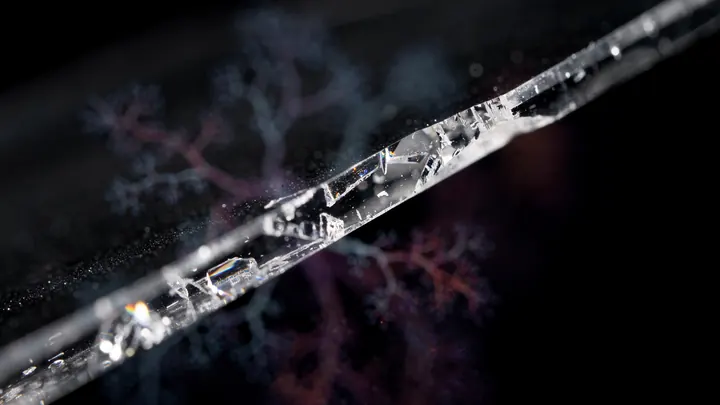
In the depths of sub-Neptunes, the most common type of planet in the Galaxy, though not one you could stand on, silicate magma and hydrogen mix into a single supercritical cocktail. Previously, it was thought that beneath the dense hydrogen atmosphere lay a sharp boundary with molten silicate, like oil on water.
In a dense molecular cloud, at the edge of glowing gas, an invisible assembly line is at work. It takes simple scraps — single atoms and light pairs — and glues them together step by step into long carbon chains and rings. The first piece of this assembly line has long eluded our eyes. Now it has been found.
In the black depths of space, on the surfaces of tiny icy dust grains, a quiet construction is underway. There, where temperatures drop to near absolute zero and harsh radiation abounds, the ordinary amino acid glycine, the simplest protein building block, links up with itself.
A disk of gas and dust spins around the young star HV Tau C, nearly edge-on to us. The James Webb Space Telescope examined its spectrum and detected the glow of hot molecular hydrogen (H₂). This revealed a wide, bipolar wind blasting from the inner regions far beyond the disk.
Seventy-two protoplanetary disks, swirling cocoons of cosmic dust and gas, came under the gaze of the MIRI instrument on JWST. Most of them shoot outflows into space: dense conical structures and narrow, high-speed jets. They blast like fountains. This process is not accidental.
For a long time, astronomers searched for the 'factories' of the most energetic cosmic rays — particles that carry the macrocosm compressed to the size of an atomic nucleus. Colossal star-forming regions like Cygnus OB2, where winds from young giants collide, were prime suspects.
The Universe at 700 million years old was a noisy construction site, just beginning to light up. Telescopes caught a signal from that distant epoch: the galaxy REBELS-25, massive and full of stellar fuel.
Imagine a packed orchestra, each musician playing their own part, while you try to pick out the quiet voice of a rare flute: its melody drowns in the sound of violins and trumpets. That's what hunting for molecules in interstellar clouds is like: telescopes pick up the 'radio voices' of countless substances, and picking out the signal you want from the noise is no easy task.
In the crowded center of the galaxy, two stars orbit so close together that one strips the outer layers off the other, like wind blowing off a coat. What remains is a hot helium core, a star without a hydrogen envelope.
Hydrogen is the most common element. Its atoms are like antennas: they emit and absorb light at very specific frequencies. Einstein predicted that spacetime can ripple: these are gravitational waves.
A galaxy is not a static picture but a bubbling cauldron where new stars are constantly born from tenuous gas. To understand how long this boiling will last, astronomers weigh the key ingredient — cold molecular hydrogen. It is invisible itself, but it is betrayed by carbon monoxide (CO), which shines in the radio range.
For nearly half a century, astronomers have been searching for glycine, the simplest amino acid and one of the fundamental building blocks of proteins, in the interstellar medium.
In the dense gaseous cocoon around a young massive star, streams of matter collide as if in a giant chemical flask. One stream moves relative to us at about 11 kilometers per second, the other at about 5. The telescope at Onsala (Sweden) caught their radio voices and resolved them into hundreds of spectral lines — molecular fingerprints.
A distant city seen through a fogged-up window: bright lights blur, details are lost. That's roughly how astronomers see gas with magnesium ions (magnesium) in our galaxy — the strongest spectral lines "peg the needle," preventing us from knowing how much material is really there.
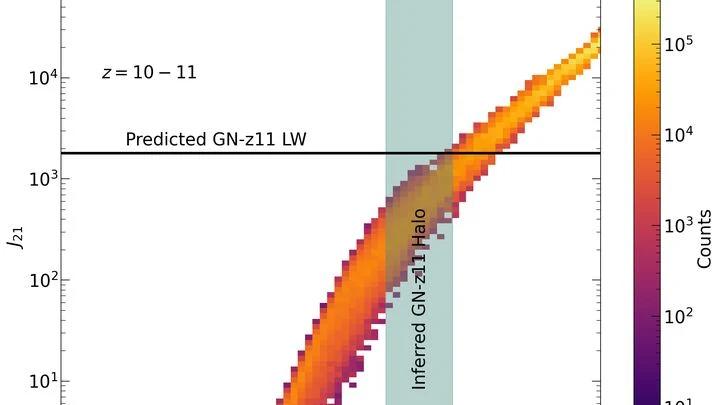
A bonfire built of pure alcohol burns hot and gives off almost no smoke. That's roughly how the first stars shone: they contained no heavy elements, only hydrogen and helium left over from the Big Bang. The James Webb Space Telescope may have caught one such "bonfire" in the galaxy GN-z11.
A sheet of paper weighs almost nothing, but stack a hundred sheets and you get a noticeable pile. That's roughly what scientists did with a material that excels at converting one color of light into another, but only when it's just one atom thick. A single layer is like a single sheet: it works beautifully, but it's too thin to produce much light.
In a dense cloud of gas and dust where giant stars are born, the ALMA telescope has spotted something familiar. Four thin gas jets shoot out from the same region, each leaving behind a chain of bright knots, like a dashed line.
Radio telescopes detected emissions from the celestial object G358.93-0.03 MM1 — a hot cocoon inside which a massive star is igniting. Within that glow, lines of glycolamide appeared, a delicate carbon molecule.
Long before a star ignites in a gas cloud, chemical life is already bustling. In cold, dense clumps of gas, called starless cores, atoms stick together to form molecules, both simple and complex. To peer into this invisible kitchen, astronomers aimed a 40-meter radio telescope in Yebes at 23 such clouds in the Orion Nebula.
Comet 3I/ATLAS was spotted when it entered the Solar System from interstellar space. The James Webb Telescope split the light from its gas cloud into a rainbow, a spectrum, and in this pattern, the lines of rare molecules with deuterium (heavy hydrogen) appeared.
A gas cloud the size of a small galaxy is falling into the Milky Way at hundreds of kilometers per second. Such clouds are called high-velocity clouds, and until now no stars had been found in them — only gas. Now, in one of them, named Complex H, astronomers have spotted a pair of young star clusters.
In a cloud where massive stars are being born, there is a hot, dense core. Like a crowded kitchen where the heat of the stove makes smells evaporate, here the warmth from young stars evaporates molecules from the surface of cosmic dust grains.
Astronomers using James Webb and spectroscopy (splitting light into colors) peered through dust into the center of galaxy IRAS 07251-0248. There they discovered benzene, acetylene, methane — the same hydrocarbons found in gasoline and plastics.
A boiling cauldron: steam rises, water churns, and the temperature varies from point to point. So it is in space: the gas clouds around young stars are not smooth spheres but a seething mixture with vortices and density fluctuations. Astronomers long treated such clouds as homogeneous, but this simplification can skew conclusions.
The night sky looks dark, but it's actually filled with a faint glow. Most of this light is born in invisible clouds of cold gas — the very stuff from which new stars emerge. This gas barely emits, making it hard to spot. But sometimes it gives itself away through radio waves emitted by carbon monoxide (CO) molecules.
Young stars are surrounded by disks of gas and dust, like construction sites for future planets. From this material, rocky worlds and gas giants will eventually assemble. So the chemical composition of the disk directly determines what the planets will be like.
In the air we breathe, invisible chemical events are constantly unfolding. One of them is the birth and instant death of a particle with the formula H₂COO. Known as an 'intermediate,' it appears for a split second when ozone molecules collide with organic compounds, then immediately shatters into simpler fragments.
In a cold gas cloud right at the center of our Galaxy, designated G+0.693-0.027, hides a true chemical laboratory. There, far from stars, on the surfaces of tiny dust grains, about the size of smoke particles, atoms stick together into molecules, like dough on a kitchen counter.
A hair dryer aimed at a block of ice strips vapor and droplets from its surface, and the ice slowly melts. The wind from the center of our Galaxy works in much the same way: it picks up cold gas clouds and carries them away, heating and shredding them along the way.
Astronomers decided to systematically search this flow for molecules, the coldest and densest form of gas, for the first time.
In the dark, cold clouds of space where stars are born, dust grains become coated with a thin layer of ice. This ice is not just frozen water but a mixture of different molecules: carbon monoxide, carbon dioxide, nitrogen, and others. For a long time, astronomers could not find nitrous oxide (N2O) in this ice — the very "laughing gas" used in medicine.
The James Webb Space Telescope is watching TRAPPIST-1—a tiny red dwarf with seven Earth-sized planets in orbit. And it sees something unusual: bright flares on this star barely reach 3500–4000 degrees. For comparison, a typical solar flare heats up to 9000–10000 degrees.