How water can accelerate to infinity, and why machines proved it ✛ ✎ ✦ OpenAI theoretical made by OpenAI AI agents (≈10,000 agents, 88 h) · checked in Lean
Picture a bathtub. Water flows, swirls, slows down through friction. The rules it follows fit in two lines, the Navier–Stokes equations: Newton's law, force equals mass times acceleration, for every drop, plus the condition that water cannot be compressed. These equations are used to design aircraft, forecast weather and model blood in vessels.
Here is the question nobody could close for ninety years. If the water flows smoothly at the start, can it, under these equations, ever accelerate to infinite speed? Real water never does, but the equations are a model. If speed becomes infinite in the model, the model breaks at that moment. Mathematicians call such a moment a singularity, and the question itself is a Millennium Prize problem, with a million dollars attached.
Now there is an answer, though not to the whole question. Let us go step by step.
The trick that started it all. Usually you solve forward: take the water, run the equations, see what happens. Ninety years of that led nowhere. Here they did the opposite. The equation can be read as a definition of the force: write down any flow, plug it into the equation, and call whatever does not balance the external force. The equation then holds automatically. Inventing a flow that accelerates to infinity is easy. The hard part is different: the force must stay smooth, calm, with no infinities. That is the entire work.
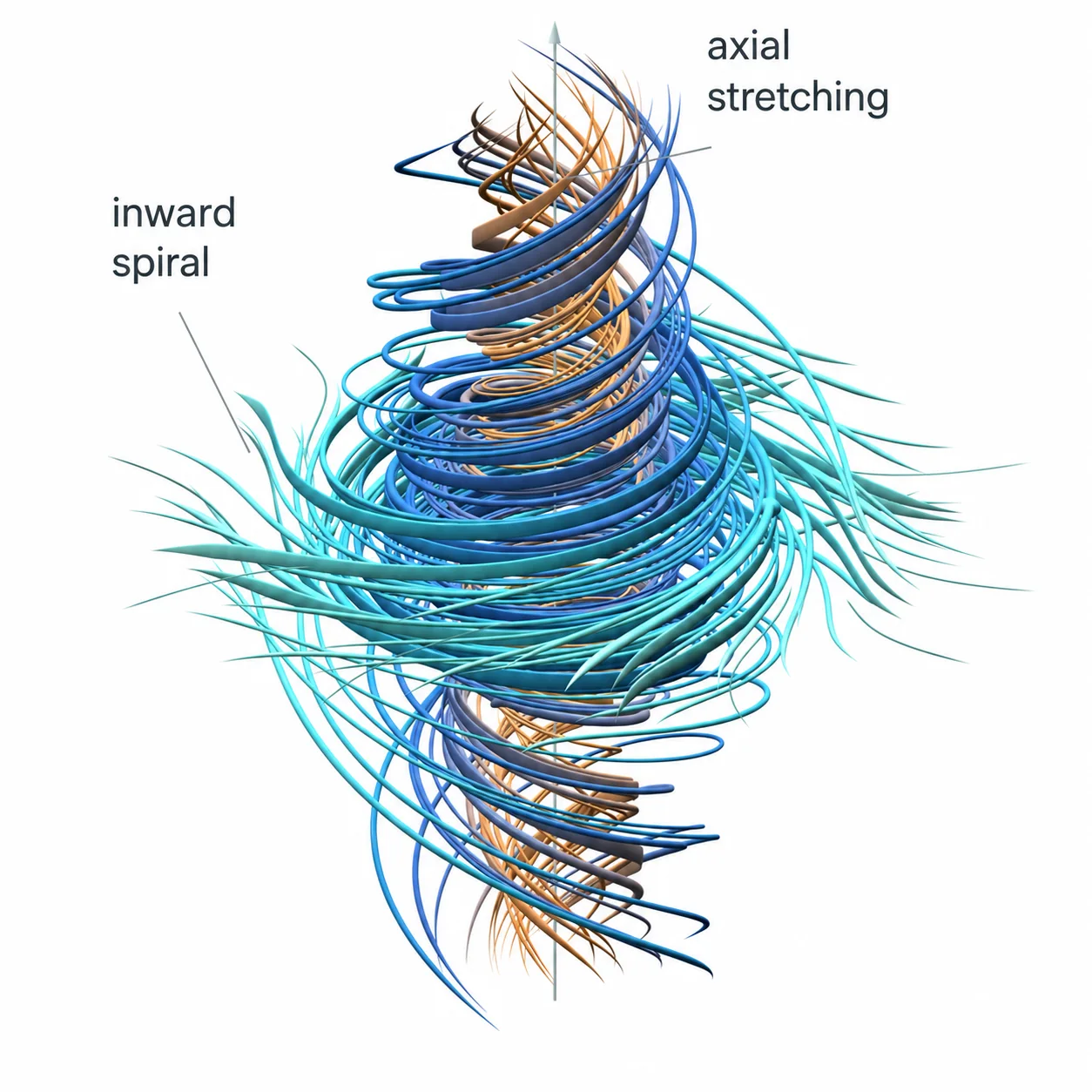
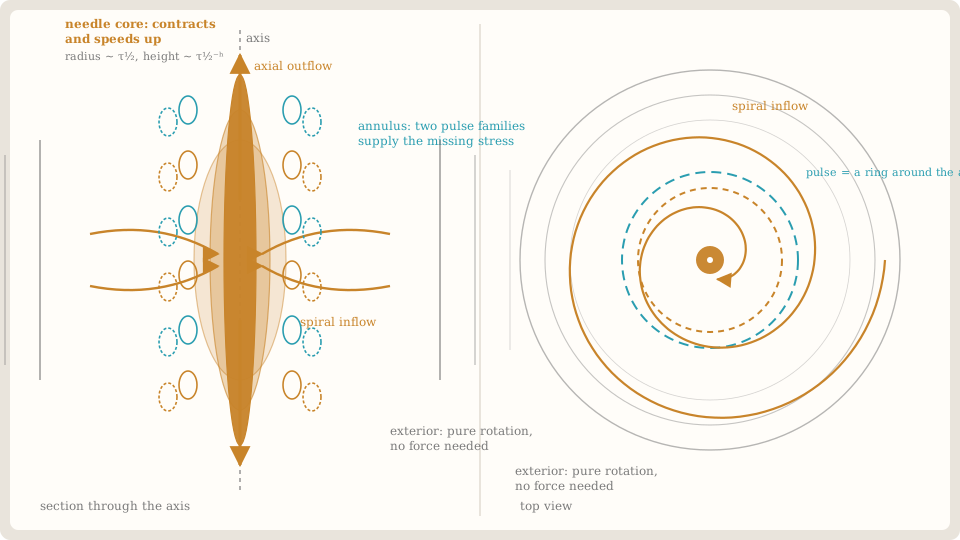
The needle whirlpool. The flow is built around a vertical axis, like water above a drain. Water spirals toward the axis and at the same time flows out along the axis, up and down. Why does it speed up? Because rotation is conserved: the closer to the axis, the faster the turn, like a skater pulling in her arms. And why does it not clog the axis and stop? Because water cannot be compressed, so the inflowing water is carried away along the axis. The inflow can continue indefinitely.
Now the surprising part. The core of the whirlpool shrinks: a fraction of a second before the blowup its radius is already tiny. But it shrinks unevenly. The radius decreases faster than the height, and the core stretches into a thin needle. And here is what happens: the speed in the needle goes to infinity while the energy of the whole needle goes to zero. No miracle: energy is speed squared times volume, and the volume of the needle falls faster than the square of the speed grows. Infinite speed lives in an ever thinner thread.
Why friction does not save the day. Viscosity, the friction inside water, smooths everything sharp. That is why many believed blowup impossible. This work does not fight friction. It builds it into the balance. In rotation the whirlpool outruns friction: the closer to the blowup, the more turns the water makes while friction slows it. In the inflow toward the axis friction stays an equal partner. Everything accelerates together and at the same rate, to the very end.
The place where it almost broke. The core is honest on its own. But it has to join the calm water outside. In the ring between the core and the outer water the equations do not balance, and the force needed there grows to infinity. That is a failure: the force is not allowed to be infinite.
The fluid supplies its own force. This is the main idea. Into the ring around the core they plant small oscillations, each a full ring around the axis, started by a tiny push. An oscillation has zero average velocity: the water jiggles back and forth. But imagine this: when it moves outward it carries a surplus of rotation, and when it moves inward, a deficit. The product of "where it goes" and "what it carries" has the same sign in both cases. So an oscillation with zero mean velocity transports rotation steadily in one direction. That transport acts on the water like a real force, and it was tuned to plug the hole in the ring exactly.
Where the oscillations get their energy and why they do not grow forever. They feed on the whirlpool itself: a drop with a surplus of rotation is pushed outward, where its surplus becomes more pronounced, and so on, as long as amplification beats friction. And they die on their own. The whirlpool turns different layers at different speeds and gradually makes the oscillation pattern finer. Friction eats fine patterns quickly. The initial size was chosen so that the oscillation grows first and then inevitably dies, leaving almost nothing behind. Each flares up and fades by itself.
Assembly. There are two families of oscillations, because two holes must be plugged: the transport of rotation and the transport of motion along the axis. Closer to the blowup they are placed ever finer and ever more often. Outside the ring the water simply circles the axis and slows down through friction exactly as the heat equation dictates, so no force is needed there at all. And the whole thing can be cut off neatly in space: the flow occupies a bounded volume, and the force acts for a bounded time.
What was proved and what was not. Proved: for any viscosity there is a smooth, bounded force under which water that was at rest reaches infinite speed in finite time while its energy stays finite. The official Millennium statement lists four alternatives: (A) and (B), smoothness always holds without an external force, and (C) and (D), breakdown happens with a smooth force. This work settles (C) and (D). The author of the statement wrote explicitly that a proof of any of the four counts, and OpenAI says it will not claim the prize. But the unforced question, the one people usually mean, stays open. And keep in mind: since the water was at rest, all the energy was put in by the external force. There is no "order out of nothing" here, only a very precise calculation of how to push.
Who did it. The proof was found by a group of roughly ten thousand AI agents in 88 hours of work; another 17 hours went into checking it in Lean, where a computer verifies every step. A week earlier, mathematicians Tristan Buckmaster and Levent Alpöge used the same forcing trick to prove a similar result for the Euler equations, where there is no friction. A priority dispute followed, but the mathematics in both works stands on its own. This may be what part of science now looks like: the tools are old and well known, and carrying the construction to the end is long, done by machine and checked by machine.
The knowledge machine's view
This section is addressed to the author of the paper and their colleagues. Neighbouring works were found by meaning-based search across our archive, not by word overlap. We do not review: we show the field around the work.
What the work does
A whirlpool was built that reaches infinite speed in finite time while its energy keeps shrinking. A smooth outside force pushes it, and the missing force is produced by the water itself, through small oscillations around the core. For us this is the first honestly built point where the ordinary description of a fluid breaks, and it can be worked with further.
Where its strength is
The mechanism is visible as a whole: the needle, the ring around it, the oscillations, calm water outside. What can be seen can be recomputed another way, repeated in another medium and tried by hand.
Where it could go next
- The link to gravity. For forty years it has been known that waves in flowing water behave as if the space around them were curved, and in a bathtub or in a cloud of cold atoms one can make real 'horizons' like those of a black hole. So the needle in this work also has its own 'curvature', and it can be computed. If it goes to infinity at the moment of the blowup, we have a laboratory model of a singularity, as in general relativity, only with finite energy. The honest caveat: this is a model of how waves behave, not Einstein's gravity itself.based on: Black Holes in a Sink of Water · Quantum Analog of a Black Hole in an Atomic Cloud · Black Holes from Light and Vortices · Hawking Radiation on a Tabletop arXiv:2604.24861 arXiv:2602.20508 arXiv:2603.01664 arXiv:2602.04593
- A point where order may be born from chaos. There is a thought: at such a special point the second law of thermodynamics may stop being strict, and disorder there may decrease rather than grow. With this work it can be checked directly: count how much disorder is produced separately in the needle, in the ring and outside. The outside force puts energy into the water, so disorder grows overall; the question is whether there is a region inside where it falls and is held by the oscillations. If there is, a 'centre of anti-entropy' becomes a number rather than words.based on: Twilight of Time: Why the Arrow Fades but Time Endures · Hourglass of Entropy: How Cold Atoms Keep Time arXiv:2508.14312 arXiv:2509.07745 arXiv:2506.01351
- A fluid without friction. In ordinary water friction damps the oscillations, and the proof is built on that. In superfluid helium and in a Bose–Einstein condensate there is no friction: vortices there are quantized, they line up into lattices by themselves, and quantum turbulence, order among chaos, is observed in the laboratory. Hence the idea: where there is nothing to damp it, a special point may not disperse but hold. This can be tested on the equation used to describe a condensate.based on: Friction Vanishes Before Your Eyes · Quantum Leapfrog: How Vortices Play in Liquid Light · Vortex Rings Without a Grid arXiv:2601.00190 arXiv:2512.07935 arXiv:2601.06942 arXiv:2512.21416
- A tabletop setup. Two wheels rotating against each other create exactly the sheared flow on which the oscillations in the paper grow. One concrete number can be measured: how the oscillations in the ring transport rotation at different wheel speeds. Agreement with the calculation would be the first point from the laboratory. Similar measurements have already been made on a whirlpool in a cup.based on: How a Whirlpool in a Cup Becomes a Black Hole Bomb arXiv:2511.05351 arXiv:2601.01258 arXiv:2501.00037
- Two paths to one door. The setup with wheels and the superfluid are described by the same mathematics: both have sheared rotation, a ring and oscillations. It is worth making a table: what in the needle corresponds to the horizon, to a quantized vortex, to the outside pumping. Then one sees which path is closer to experiment and which to theory.based on: Black Holes from Light and Vortices · Quantum Analog of a Black Hole in an Atomic Cloud arXiv:2603.01664 arXiv:2602.20508
Worth trying
- Compute the 'curvature' of the needle as for waves in water and see whether it goes to infinity at the blowup.
- Count where exactly in the construction disorder is produced and where it might decrease.
- Repeat the oscillation mechanism in a condensate model where there is no friction.
- Build a tank with two counter-rotating drives and measure the transport of rotation in the ring.
Why this may matter
If the special point in water transfers to 'curvature', ordinary and quantum fluids become a testbed for questions that cannot be checked in real gravity: how disorder behaves next to a singularity and whether order can hold where the ordinary description breaks.
Nearby works in our archive
- Black Holes in a Sink of Watersimilarity 0.00
- Quantum Analog of a Black Hole in an Atomic Cloudsimilarity 0.00
- Black Holes from Light and Vorticessimilarity 0.00
- Hawking Radiation on a Tabletopsimilarity 0.00
- How a Whirlpool in a Cup Becomes a Black Hole Bombsimilarity 0.00
- Friction Vanishes Before Your Eyessimilarity 0.00
- Quantum Leapfrog: How Vortices Play in Liquid Lightsimilarity 0.00
- Vortex Rings Without a Gridsimilarity 0.00
- Twilight of Time: Why the Arrow Fades but Time Enduressimilarity 0.00
- Hourglass of Entropy: How Cold Atoms Keep Timesimilarity 0.00
What we make of it
This work has not been peer-reviewed. What follows is our reading of it.
What works
Inverting the problem: the flow is written down, the force is defined as the residual, and the whole difficulty is honestly moved into the smoothness of the residual. The self-limiting pulses that flare up on the shear and die out by viscosity, with their mean stress fitted to the divergence of the background, form a complete, checkable mechanism rather than an upper bound.
What would make it stronger
- Give a human exposition of Sections 4–9 shorter than a hundred pages: the physics is clear in six pages, but the road from it to the estimates is open only formally.
- State explicitly what the Lean formalization covers (Theorem 1.1 in full or particular estimates) and how text and code correspond: without this 'checked in Lean' reads broader than it may be.
- A numerical illustration of the constructed flow on a finite τ horizon would show the scales and pulses visibly and give an independent check of the choice of h and wavelengths.
- Discuss which part of the construction is obstructed by the absence of a force: that is the only road from (C) to (A).
Questions for the author
- How stable is the construction under perturbations of the background and pulses: does blowup persist in an open neighbourhood of the constructed data?
- Does the self-feeding mechanism of the pulses give any hint for the unforced case, where the stress would have to arise from the initial data?
- What exactly is formalized in Lean: the full Theorem 1.1 with supports and estimates, or its nonexistence corollary?
The speed in the needle goes to infinity while its energy goes to zero: the volume shrinks faster than the square of the speed grows. Infinite speed with vanishing energy, and not a single law of physics is broken.
Take the whole work
Not published on arXiv. Here are its page, the PDF and the formalization: you can check it yourself, not only read our account.