Finite-time blowup for the three-dimensional Navier–Stokes equations with a smooth compactly supported force: anatomy of the construction ✛ ✎ ✦ OpenAI theoretical made by OpenAI AI agents (≈10,000 agents, 88 h) · checked in Lean
Context
The regularity problem asks whether a solution of the three-dimensional incompressible Navier–Stokes equations from smooth data stays smooth. Leray (1934) constructed global finite-energy weak solutions; Caffarelli, Kohn and Nirenberg (1982) showed the singular set of a suitable weak solution has zero one-dimensional parabolic Hausdorff measure, which allows isolated singularities; Escauriaza, Seregin and Šverák (2003) gave regularity under a bounded scale-invariant \(L^\infty_t L^3_x\) norm. Tao (2016) built blowup for averaged equations that keep the energy cancellation; Buckmaster and Vicol (2019) obtained nonuniqueness of weak solutions by convex integration; Albritton, Brué and Colombo (2022) built distinct Leray–Hopf solutions with zero data and one force, singular at the initial time. The direct predecessors are Córdoba and Martínez-Zoroa: blowup for forced 3D Euler (2023), for the porous medium equation with a smooth source (2024) and, with Zheng, for hypodissipative Navier–Stokes. In their constructions large-scale strain amplifies small-scale vorticity while self-interactions are suppressed. A day before OpenAI's paper, Buckmaster and Alpöge posted smooth-forcing blowup for the porous medium equation, 2D Boussinesq and 3D Euler with Lean formalizations; Tao the same day judged their approach 'likely to extend to Navier–Stokes'. Fefferman's statement explicitly accepts any of (A)–(D) as a solution; condition (5) on the force holds for every \(f\in C_c^\infty\).
Methods
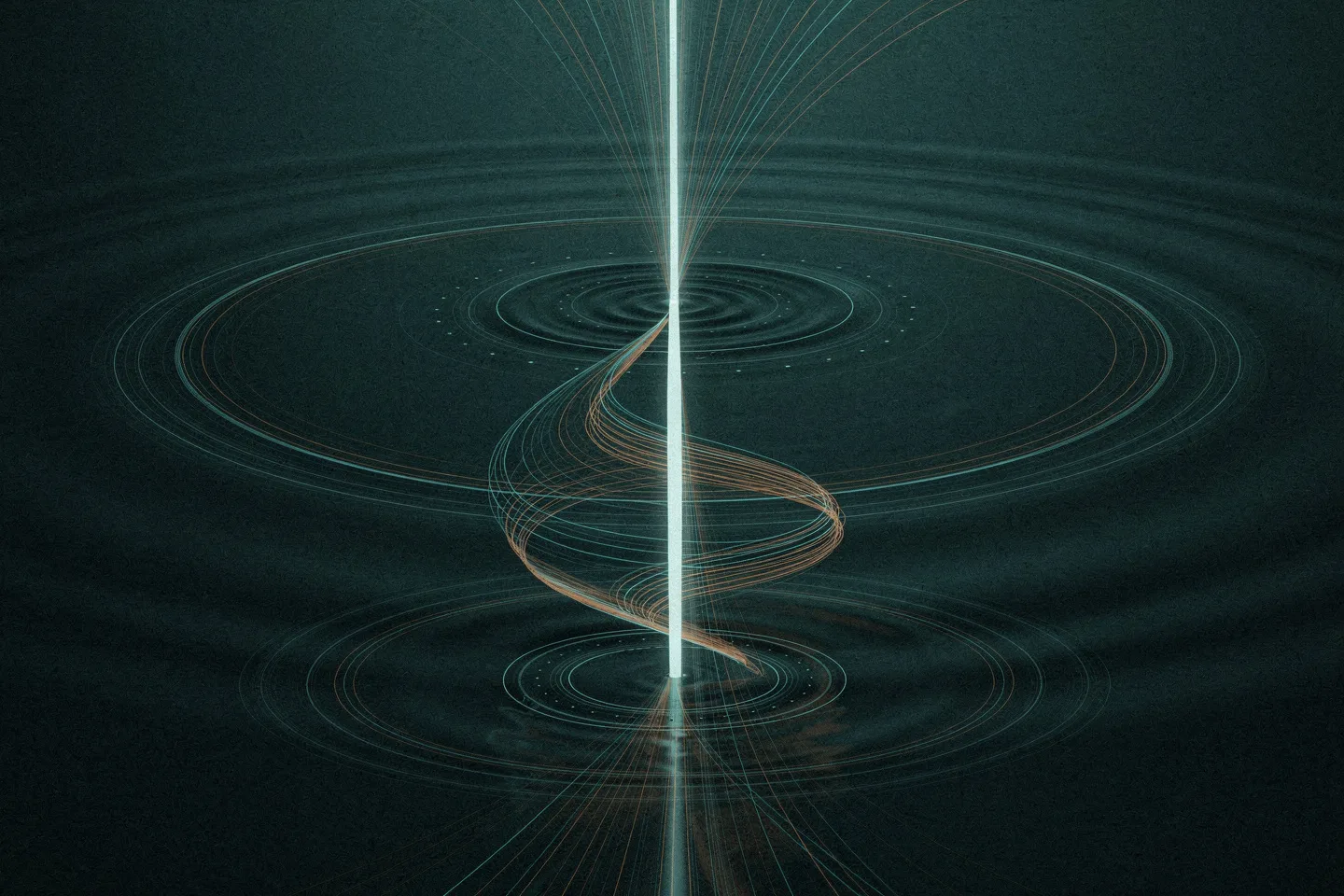
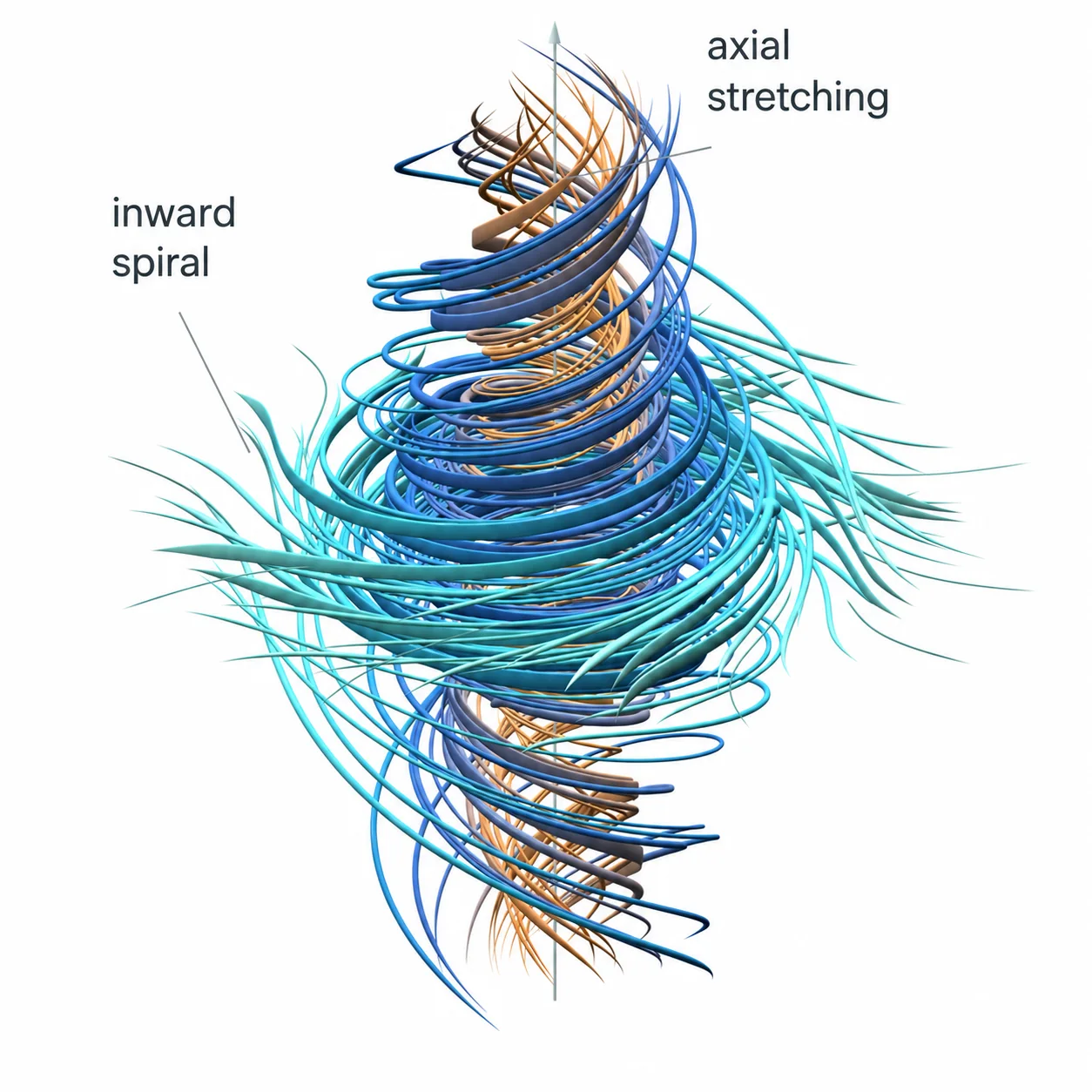
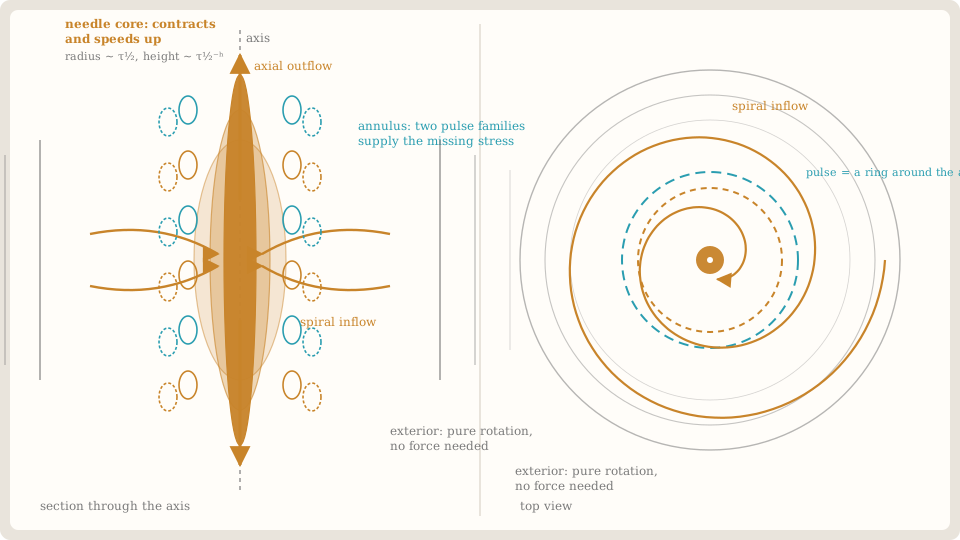
The method is inverse: the residual \(R(u,p)=\partial_t u+(u\cdot\nabla)u-\Delta u+\nabla p\) (\( u\) = 1 after rescaling) is declared to be the force, and the task becomes constructing u, p with unbounded velocity and a residual smooth up to \(t=1\) together with all space-time derivatives. The construction is layered. (1) Axisymmetric self-similar background \((u_B,p_B)\): in cylindrical coordinates a core with radial inflow, azimuthal spin-up and axial outflow on both sides of a dividing layer near \(z=0\); scales \(\ell_r\asymp\tau^{1/2},\ \ell_z\asymp\tau^{1/2-h},\ 0\lt h\lt 1/100\), speeds \(|u_\theta|,\,|u_z|\asymp\tau^{-1/2-h},\ |u_r|=O(\tau^{-1/2})\); pressure decreases toward the axis and supplies the centripetal force; viscosity transports angular momentum outward, and the growth of speed is the balance of inflow against viscous loss. The profile equations impose the leading balance in the core; matching to a smooth exterior leaves in the annulus a residual equal to minus the divergence of an annular stress up to a term vanishing to every order at the singular point (Proposition 5.5). The axial profile is deliberately slightly asymmetric, with a small upward bias and \(u_z(r,0,t)\neq0\): with exact symmetry both the axial transport of angular momentum and the radial shear of axial velocity would vanish at \(z=0\), and the pulses could not be amplified there. (2) Oscillatory pulses: sequences of spatially oscillating disturbances localized in r, z, t and closed into complete rings, two families with different ratios of radial angular-momentum flux to radial axial-momentum flux; their averaged quadratic products realize the leading stress (Proposition 7.5). The seed is an exponentially small external force; growth is on the background shear by the centrifugal mechanism (Leibovich–Stewartson, Billant–Gallaire criteria) with an axial-shear contribution; orientations are chosen so that shear shortens the radial wavelength, damping \(\propto k^2\) overtakes amplification, and the tails with all derivatives vanish as \(t\to1\). The construction leans on the exact Craik–Criminale solutions and the Singh–Sridhar viscous shearing waves, and on the Daneri–Székelyhidi technique of realizing stresses by oscillations. (3) Successive corrections improve the decay of the residual (Proposition 9.6); an auxiliary torus and separation of oscillatory supports (Section 6); compactly supported mean corrections (Section 8). (4) The exterior flow is purely azimuthal, z-independent and solves the radial heat equation exactly (the 'heat exterior'): its residual vanishes identically; at every fixed r > 0 the fields and all derivatives have smooth limits as \(t\uparrow1\), which allows a smooth spatial cutoff (Section 10); the cutoff force remains smooth. The estimates control every Cartesian derivative of the residual. The Lean 4 formalization with Mathlib (repository openai/NavierStokesAndEuler, Apache-2.0) covers the nonexistence of a global smooth solution with bounded energy on R³ and on the torus.
Results
For every \(\nu\gt 0\): a smooth compactly supported finite-energy solution from rest with \(\|u(t)\|_{L^\infty}\to\infty\) as \(t\uparrow1\), under a force \(f\in C_c^\infty(\mathbb R^3\times(0,\infty))\). Key scalings: core volume \(\asymp\tau^{3/2-h}\), core kinetic energy \(\asymp\tau^{1/2-3h}\to0\) with unbounded speed; Reynolds numbers \(\mathrm{Re}_\theta\asymp\tau^{-h}\to\infty\) and \(\mathrm{Re}_r=O(1)\); the rates \(|u_r|/\ell_r,\ |u_z|/\ell_z,\ \nu/\ell_r^2\) are all \(\asymp\tau^{-1}\), axial diffusion weaker by \(\tau^{2h}\). Corollary 10.6: transfer to T³. Alternatives (C) and (D) of Fefferman's statement are claimed. OpenAI additionally reports blowup for the unforced Euler equations (a separate paper, ~100 agents, ~50 hours). By OpenAI's account: ~10,000 coordinating agents, 88 hours to the solution, 17 hours of Lean formalization and checking, 2.7 million messages, ~130 billion output tokens on this problem.
Implications
The first example of finite-time blowup for the full three-dimensional Navier–Stokes equations with true viscosity and a smooth force, from rest and with finite energy. The mechanism is not an 'overcoming' of viscosity but its inclusion in a self-similar balance with a divergent rotational Reynolds number. It is shown constructively that the nonlinear term itself can supply the missing stress through the mean quadratic fluxes of oscillations, i.e. Reynolds stress acts as a controllable tool rather than a nuisance. For problem (A)/(B) the result gives no direct answer: the force is essential and the energy is injected from outside. But it moves the frontier: the unforced question becomes whether an analogous stress can arise from the initial data alone, without pumping. Separately significant is the methodological fact: a 166-page proof was assembled from known tools by a system of agents and checked formally; this is the first result of such weight published without a human signature.
Future development
Natural directions: an attempt to carry the construction to the unforced case, replacing pumping by energy stored in the initial data; the stability of the construction under perturbations and the size of h; a numerical illustration of the constructed flow; an independent human exposition of Sections 4–9; a comparison with the Buckmaster–Alpöge approach to see which parts coincide in substance. For hypodissipative and model equations the result will probably simplify existing constructions. Whether such pumping is physically realizable is also open: the force is mathematical, compact and smooth, but its physical counterpart is not discussed.
Impact
Mathematical fluid dynamics (regularity, weak solutions, convex integration), the theory of vortex instabilities, formal verification of mathematics, the methodology of AI research. Indirectly, computational fluid dynamics: the construction provides an exact test case of concentration with divergent speed and vanishing energy.
Next steps
Read Section 2 (physical picture) and Section 3 (scheme) of the original; check conditions (4)–(7) against Fefferman's statement; look at the Lean repository and its README; read Tao's 7 September post on the Buckmaster–Alpöge papers and the Córdoba–Martínez-Zoroa preprints (arXiv:2309.08495, 2410.22920).
Key open problems
The Millennium Prize problem on Navier–Stokes existence and smoothness: alternatives (C) and (D) settled, (A) and (B) open. Related: Euler regularity (OpenAI reports unforced blowup; Buckmaster–Alpöge report blowup with smooth forcing), the Beale–Kato–Majda criterion, the conjectured finite-time Euler blowup from smooth data (numerical evidence by Luo–Hou, the Chen–Hou proof with boundary).
The knowledge machine's view
This section is addressed to the author of the paper and their colleagues. Neighbouring works were found by meaning-based search across our archive, not by word overlap. We do not review: we show the field around the work.
What the work does
A flow is constructed whose speed becomes infinite in finite time under a smooth external force, from rest and with finite energy: the singularity lives in a needle that shrinks faster than it speeds up, and the missing force is supplied by the fluid itself through the mean stress of oscillatory pulses. Viscosity is not suppressed but built into a self-similar balance. For us this is not only an answer to alternatives (C) and (D) of Fefferman's statement, but the first rigorously built example of a local singularity of a continuous medium at finite energy: an object one can keep working with.
Where its strength is
The mechanism is fully explicit: needle vortex, annulus, two families of pulses, heat exterior. That means it can not only be proved but transferred: compute its effective metric, ask what vanishing viscosity does to it, try to reproduce it in a laboratory. Works with an explicit construction are rare, and the value lies precisely there.
Where it could go next
- The link to general relativity. Since 1981 it has been known that disturbances in a moving fluid propagate on an effective metric, and horizons and Hawking radiation are reproduced in water and in atomic clouds. The natural next step: compute the acoustic metric of the constructed flow. A needle with divergent speed and vanishing energy is a candidate for a point where the effective metric loses smoothness, i.e. for a laboratory analogue of a spacetime singularity at finite energy. We keep the boundary in mind: analogue gravity carries the kinematics of fields on a curved background, not Einstein's equations; but that is exactly why 'what is the needle's metric' is an honest, solvable question.based on: Black Holes in a Sink of Water · Quantum Analog of a Black Hole in an Atomic Cloud · Black Holes from Light and Vortices · Hawking Radiation on a Tabletop arXiv:2604.24861 arXiv:2602.20508 arXiv:2603.01664 arXiv:2602.04593
- The singularity as a centre of anti-entropy. A hypothesis we adopt as a working one: a local singularity is a window where the second law stops being absolute and order can be born from chaos. The constructed flow admits a direct test: compute the entropy budget separately in the core, in the annulus and outside. Energy is injected by the force, so the global balance is positive; the question is whether there is a region where local entropy production is negative and is held by the pulses rather than smeared by dissipation. If such a region exists and its size follows the scalings of the paper, 'centre of anti-entropy' stops being a phrase and becomes a measurable quantity.based on: Twilight of Time: Why the Arrow Fades but Time Endures · Hourglass of Entropy: How Cold Atoms Keep Time arXiv:2508.14312 arXiv:2509.07745 arXiv:2506.01351
- Superfluids and Bose–Einstein condensates. In a classical fluid viscosity eats the pulses, and that is part of the construction; in superfluid helium and in a condensate viscosity vanishes, vortices are quantized, they self-assemble into lattices, and quantum turbulence, order in chaos, is observed in the laboratory. Hence the working idea: where there is no dissipation, a singularity may not disperse but hold. The programme: carry the annulus-pulse mechanism into the Gross–Pitaevskii equation and ask where the required mean stress survives when viscous damping is absent and quantum pressure is present.based on: Friction Vanishes Before Your Eyes · Quantum Leapfrog: How Vortices Play in Liquid Light · Vortex Rings Without a Grid arXiv:2601.00190 arXiv:2512.07935 arXiv:2601.06942 arXiv:2512.21416
- A macroscopic resonator. Two counter-rotating wheels in antiphase are a driven rotating shear flow, i.e. exactly the background on which the paper's pulses grow by the centrifugal mechanism. What can be measured directly: the Reynolds stress in the annulus between core and exterior and its dependence on rotation speed. Agreement of sign and growth with the construction would be the first laboratory point on this map; the analogue 'bomb' in a cup with a whirlpool shows that such measurements are done.based on: How a Whirlpool in a Cup Becomes a Black Hole Bomb arXiv:2511.05351 arXiv:2601.01258 arXiv:2501.00037
- Two paths to one door. A resonator in the metric and a resonator in a quantum fluid are described by one mathematics: both have a sheared background, an annulus, and oscillations that supply stress. It is worth building a correspondence table: what in the needle answers to the horizon, what to a quantized vortex, what to the pumping. Then one sees which of the two doors is closer to experiment and which to theory.based on: Black Holes from Light and Vortices · Quantum Analog of a Black Hole in an Atomic Cloud arXiv:2603.01664 arXiv:2602.20508
Worth trying
- Derive the acoustic metric of the constructed flow and check whether its curvature diverges as t → 1 and how that squares with the vanishing core energy.
- Compute local entropy production over the three zones of the construction, core, annulus, exterior, and look for a region with negative balance held by the pulses.
- Repeat the annulus-pulse mechanism in a Gross–Pitaevskii model at zero viscosity: does the blowup survive, and what replaces viscous damping of the pulses.
- Build a rotating tank with counter-rotating drives and measure the Reynolds stress in the annulus as a function of speed: the cheapest way to see the mechanism with one's own hands.
Why this may matter
If a flow singularity transfers to an effective metric, ordinary and quantum fluids become a testbed for questions that cannot be tested in gravity itself: how entropy behaves next to a singularity and whether order can hold where the continuous description breaks. OpenAI's paper gives such a testbed, for the first time, an explicit, rigorously built singularity at finite energy.
Nearby works in our archive
- Black Holes in a Sink of Watersimilarity 0.00
- Quantum Analog of a Black Hole in an Atomic Cloudsimilarity 0.00
- Black Holes from Light and Vorticessimilarity 0.00
- Hawking Radiation on a Tabletopsimilarity 0.00
- How a Whirlpool in a Cup Becomes a Black Hole Bombsimilarity 0.00
- Friction Vanishes Before Your Eyessimilarity 0.00
- Quantum Leapfrog: How Vortices Play in Liquid Lightsimilarity 0.00
- Vortex Rings Without a Gridsimilarity 0.00
- Twilight of Time: Why the Arrow Fades but Time Enduressimilarity 0.00
- Hourglass of Entropy: How Cold Atoms Keep Timesimilarity 0.00
What we make of it
This work has not been peer-reviewed. What follows is our reading of it.
What works
Inverting the problem: the flow is written down, the force is defined as the residual, and the whole difficulty is honestly moved into the smoothness of the residual. The self-limiting pulses that flare up on the shear and die out by viscosity, with their mean stress fitted to the divergence of the background, form a complete, checkable mechanism rather than an upper bound.
What would make it stronger
- Give a human exposition of Sections 4–9 shorter than a hundred pages: the physics is clear in six pages, but the road from it to the estimates is open only formally.
- State explicitly what the Lean formalization covers (Theorem 1.1 in full or particular estimates) and how text and code correspond: without this 'checked in Lean' reads broader than it may be.
- A numerical illustration of the constructed flow on a finite τ horizon would show the scales and pulses visibly and give an independent check of the choice of h and wavelengths.
- Discuss which part of the construction is obstructed by the absence of a force: that is the only road from (C) to (A).
Questions for the author
- How stable is the construction under perturbations of the background and pulses: does blowup persist in an open neighbourhood of the constructed data?
- Does the self-feeding mechanism of the pulses give any hint for the unforced case, where the stress would have to arise from the initial data?
- What exactly is formalized in Lean: the full Theorem 1.1 with supports and estimates, or its nonexistence corollary?
The background residual in the matching annulus diverges and cannot be fixed by an external force. It was fixed by the fluid: oscillations with zero mean velocity transport momentum in one direction, and that transport is fitted exactly under the hole. What turbulence theory calls a nuisance became a tool.
Key numbers
- viscosity ν: any \(\nu\gt 0\)
- blowup time: \(t=1\), start from rest u(·,0) = 0
- core radius: \(\sim\tau^{1/2}\), \(\tau=1-t\)
- core height: \(\sim\tau^{1/2-h}\), \(h\lt 1/100\)
- core speed: \(\sim\tau^{-1/2-h}\) → ∞
- core energy: \(\sim\tau^{1/2-3h}\) → 0
- rotational Reynolds number: \(\sim\tau^{-h}\to\infty\)
- size of the work: 166 pages + Lean formalization
- agents in the group: ≈ 10,000, 88 hours
- Lean check: 17 hours; 2.7 M messages, ≈130 B output tokens
Take the whole work
Not published on arXiv. Here are its page, the PDF and the formalization: you can check it yourself, not only read our account.