Black Holes from Light and Vortices express
Black holes are among the most mysterious objects in the universe. Their gravity is so strong that even light cannot escape their vicinity. But studying them directly is extremely difficult: the nearest black hole is thousands of light-years away, and mergers of two black holes take millions of years. That's why physicists are looking for ways to reproduce black hole behavior in the lab — using so-called analog systems.
One of the most successful analogs is a polariton condensate. This is a special state of matter that forms at very low temperatures when particles of light (photons) and particles of matter (excitons) combine into new particles — polaritons. A polariton condensate behaves like a superfluid: it can flow without friction. And if you create a vortex in it, the flow around the vortex pulls everything inward, like water down a bathtub drain. And just like from a black hole, nothing, not even light, can escape from such a vortex. That's why a vortex in a polariton condensate is called an analog black hole.
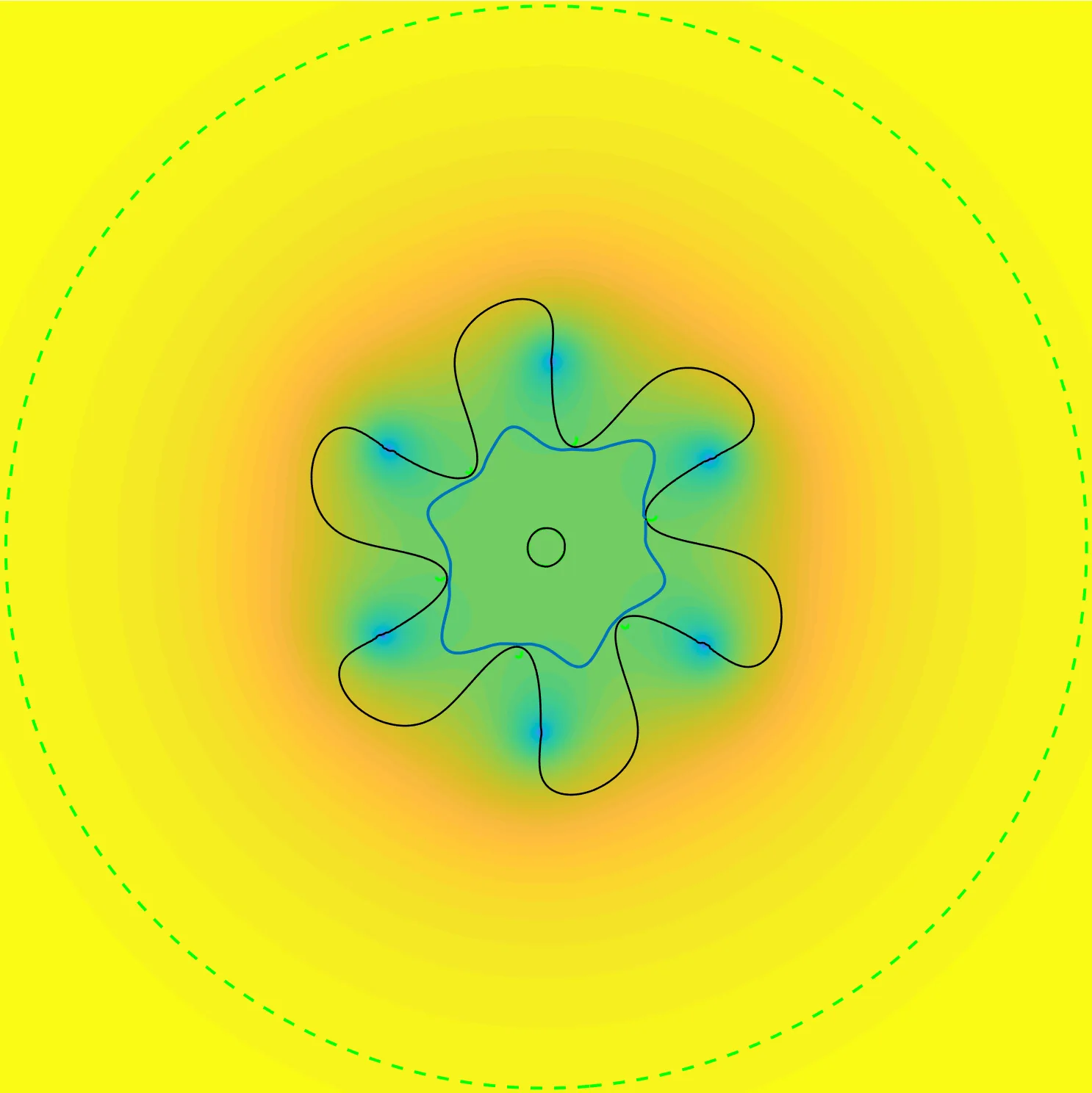
The authors of the new study asked: can two or more such vortices merge into one, like real black holes do when they collide? It turned out that two vortices cannot form a common horizon: they always remain separate. But four or more vortices can fully merge, and then a common horizon emerges, whose radius is determined by a simple geometric law: it equals the geometric mean of the radii of the original vortices. This means that by observing vortices in the lab, we can study how black holes merge in space, but at an accelerated pace and under full control.
Such experiments help us better understand not only black holes but also the very nature of space and time. After all, if an analog system behaves like a real black hole, then some properties of black holes may be universal and independent of the specific physical implementation. And perhaps the key to unraveling the mysteries of gravity lies not in distant space, but in a cold laboratory setup with lasers and mirrors.
A polariton condensate exists at a temperature just a few degrees above absolute zero (−273 °C). At such temperatures, atoms almost stop moving, and quantum effects become visible to the naked eye.
The idea of analog black holes resembles the plot of the movie 'Interstellar', where heroes use a black hole for time travel, but in reality such experiments help test theories without leaving Earth.