Hunting for Sterile Neutrinos express

Original: "KATRIN Sensitivity to keV Sterile Neutrinos with the TRISTAN Detector Upgrade"
· H. Acharya, M. Aker, D. Batzler, A. Beglarian, J. Beisenkötter, M. Biassoni, B. Bieringer, Y. Biondi, B. Bornschein, L. Bornschein, M. Böttcher, M. Carminati, A. Chatrabhuti, S. Chilingaryan, B. A. Daniel, M. Descher, D. Díaz Barrero, P. J. Doe, O. Dragoun, G. Drexlin, E. Ellinger, R. Engel, K. Erhardt, L. Fallböhmer, A. Felden, C. Fengler, C. Fiorini, J. A. Formaggio, C. Forstner, F. M. Fränkle, G. Gagliardi, K. Gauda, A. S. Gavin, T. Geigle, T. Geier, S. Gentner, W. Gil, F. Glück, C. Goupy, R. Grössle, K. Habib, V. Hannen, L. Hasselmann, K. Helbing, S. Heyns, R. Hiller, D. Hillesheimer, D. Hinz, T. Höhn, A. Jansen, M. Kandler, K. Khosonthongkee, C. Köhler, J. Kohpeiß, A. Kopmann, N. Kovac, L. La Cascio, L. Laschinger, T. Lasserre, J. Lauer, T. L. Le, O. Lebeda, S. M. Lee, A. Lokhov, M. Mark, T. Marrodán Undagoitia, A. Marsteller, E. L. Martin, K. McMichael, S. Mertens, S. Mohanty, J. Mostafa, I. Müller, A. Nava, S. Niemes, I. Nutini, A. Onillon, D. S. Parno, M. Pavan, U. Pinsook, J. Plößner, J. M. L. Poyato, J. Ráliš, S. Ramachandran, C. Rodenbeck, M. Röllig, R. Sack, A. Saenz, R. Salomon, P. Schäfer, M. Schlösser, L. Schlüter, S. Schneidewind, U. Schnurr, J. Schürmann, A. K. Schütz, A. Schwemmer, A. Schwenck, J. Seeyangnok, C. Silva, F. Simon, J. Songwadhana, D. Spreng, W. Sreethawong, M. Steidl, J. Štorek, X. Stribl, M. Sturm, T. Stürwald, N. Suwonjandee, N. Tan Jerome, H. H. Telle, L. A. Thorne, T. Thümmler, K. Trost, K. Urban, K. Valerius, D. Vénos, P. Voigt, V. Wallner, C. Weinheimer, S. Welte, J. Wendel, C. Wiesinger, J. F. Wilkerson, J. Wolf, S. Wüstling, J. Wydra, W. Xu, G. Zeller
arXiv:2603.23256 · 2026-03-24 · CC BY 4.0 · 1 min
Invisible particles may give themselves away by a tiny kink in the energy of electrons.

Radioactive tritium decays, emitting an electron. Its energy is almost always the same, but sometimes, just a little less. This shortfall could mean that alongside the ordinary neutrino, another, hidden particle was born.

The Standard Model describes three types of neutrinos, but scientists suspect there is a fourth — the sterile one. It takes part in no interactions except gravity, so it cannot be caught directly. But it can be inferred from a kink in the electron spectrum: like a missing step in an otherwise even staircase.

The KATRIN experiment has already measured the mass of the ordinary neutrino, and now it is switching to the search for the sterile one. For this, they are building the TRISTAN detector — an array of silicon drift detectors capable of counting electrons at an enormous rate.

In four months of operation, KATRIN could spot a sterile neutrino admixture even if it is only one part per million. That is tens of times better than previous searches.

If the kink is found, it will be the first real trace of a particle that could make up dark matter, the invisible substance that holds galaxies together.
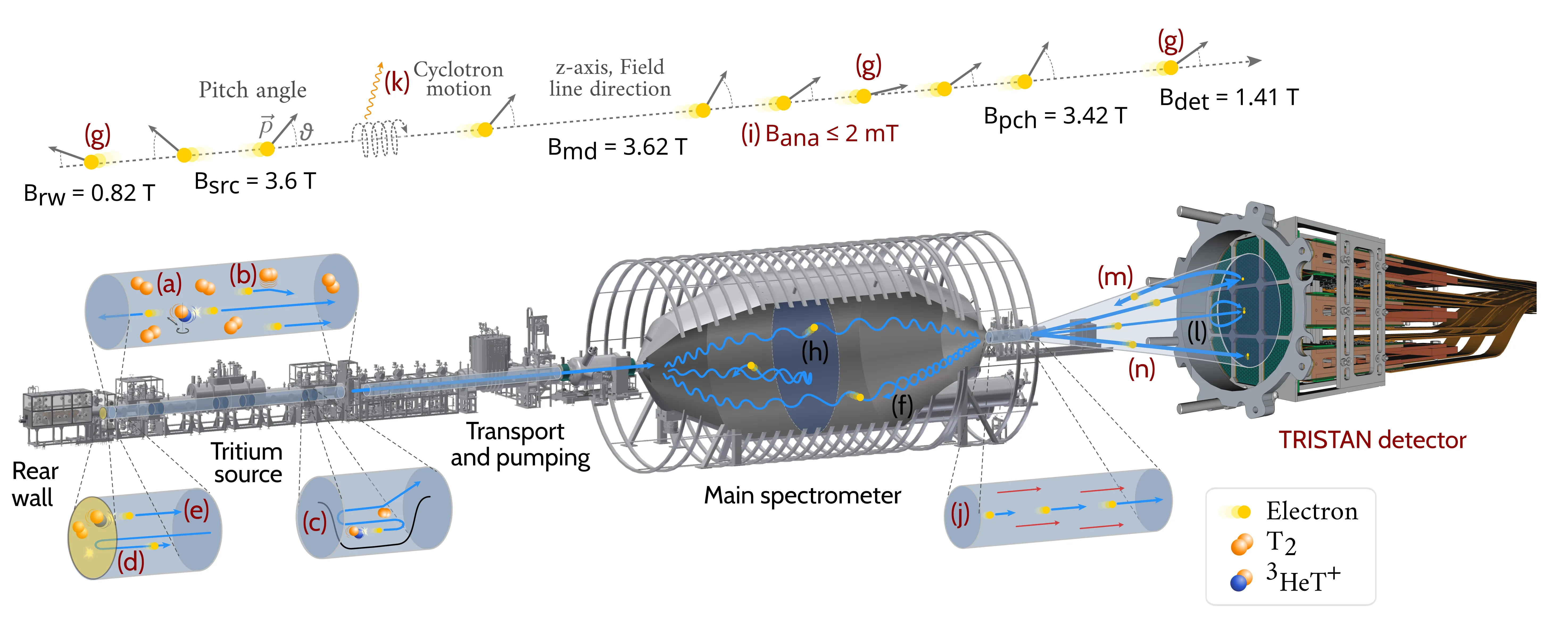
The sterile neutrino is so named because it is 'sterile' with respect to the weak interaction, the only one in which ordinary neutrinos participate.

Scientists
Paul DiracFritz ZwickyDavid DeutschErwin SchrödingerJohn Stewart BellLouis de Broglie
Concepts
katrin sterile neutrino dark matter nustar neutrino detection kiloelectronvolt km3net diamond nv center spectroscopy neutron mass dune juno kagra hyper kamiokande millikelvin sterile neutrino lz