Are you one of the authors of this paper? Email us from your institutional or work email address mentioning this article's arXiv ID and we'll verify you and give you edit access to this page.
Are you an author who sees something we missed or got wrong? Write to us — the subject line already carries the paper id. We read every note and correct the write-up.
Radioactive radon settles on detector components and creates interference that mimics signals from dark matter particles.
📄 Showing the "Simple" version — "Advanced" is not ready yet. Add it to favorites to help prioritize it.
A dark matter detector is like a room where you're trying to hear a whisper while static electricity crackles nearby. This crackle is produced by radon atoms — a radioactive gas that seeps out from materials and air. Settling on metal grids inside the liquid xenon chamber, they knock out electrons when decaying, mimicking the signal from a dark matter particle.
Physicists built a model of this noise and compared it with data from the LUX and LZ experiments. The calculations matched, confirming the culprit. Now it's clear: to hear the whisper, you need to get rid of the crackle — either by cleaning the components more thoroughly or by changing the design, since the sought-after events carry energy of just a few electrons.
A curious twist: radon is born from uranium, which is present in trace amounts in the materials of the detector itself — the setup creates its own interference.
The interference distorts the energy spectrum — the distribution of electrons where physicists look for anomalies pointing to new physics beyond the standard model. Eliminating this background will bring us closer to solving the mystery of the Universe's hidden mass.
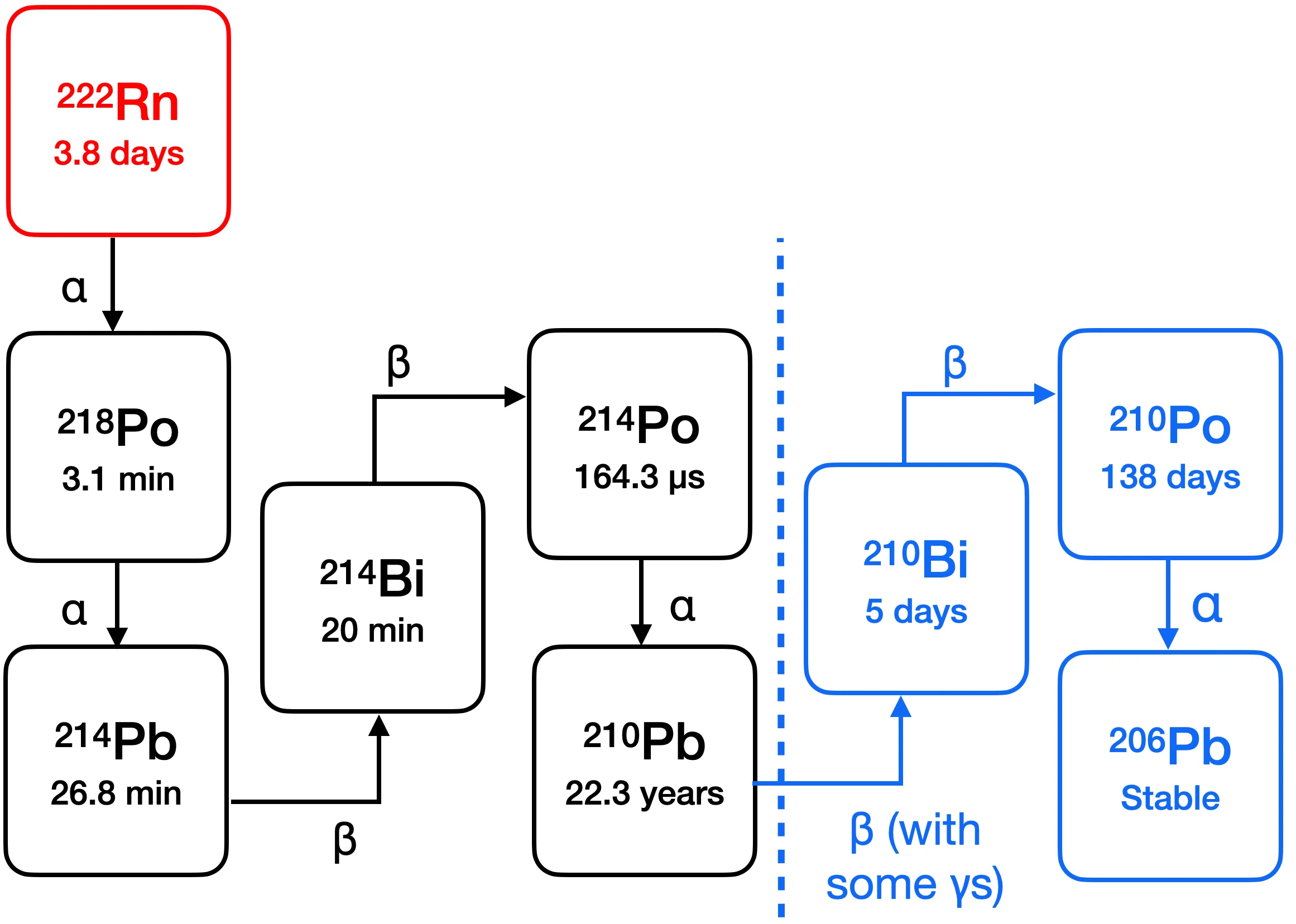
The dual-phase xenon time projection chamber (TPC) is a powerful technology to detect rare interactions such as scatters of dark matter particles on nuclei. In particular, the built-in gain of ionization signals in a dual-phase TPC makes it sensitive to events in the few-electron regime, as expected from low-mass dark matter interactions. The pursuit of this low-energy sensitivity through ionization-only signal detection has so far been hindered by excessive electron backgrounds observed across experiments. Much of this background is attributed to the plate-out of $$^{222}$$Rn decay chain isotopes on the high voltage electrode grid surfaces that span the full cross section of the TPC. This work presents a first-principle model constructed for this background, the predictions of which are consistent with data from the LZ and LUX experiments. We then discuss mitigation strategies of this background in future dual-phase TPCs and the possibility of applying this grid background model to ionization-only dark matter searches.