Hunting for Sterile Neutrinos express
Original: "KATRIN Sensitivity to keV Sterile Neutrinos with the TRISTAN Detector Upgrade"
· H. Acharya, M. Aker, D. Batzler, A. Beglarian, J. Beisenkötter, M. Biassoni, B. Bieringer, Y. Biondi, B. Bornschein, L. Bornschein, M. Böttcher, M. Carminati, A. Chatrabhuti, S. Chilingaryan, B. A. Daniel, M. Descher, D. Díaz Barrero, P. J. Doe, O. Dragoun, G. Drexlin, E. Ellinger, R. Engel, K. Erhardt, L. Fallböhmer, A. Felden, C. Fengler, C. Fiorini, J. A. Formaggio, C. Forstner, F. M. Fränkle, G. Gagliardi, K. Gauda, A. S. Gavin, T. Geigle, T. Geier, S. Gentner, W. Gil, F. Glück, C. Goupy, R. Grössle, K. Habib, V. Hannen, L. Hasselmann, K. Helbing, S. Heyns, R. Hiller, D. Hillesheimer, D. Hinz, T. Höhn, A. Jansen, M. Kandler, K. Khosonthongkee, C. Köhler, J. Kohpeiß, A. Kopmann, N. Kovac, L. La Cascio, L. Laschinger, T. Lasserre, J. Lauer, T. L. Le, O. Lebeda, S. M. Lee, A. Lokhov, M. Mark, T. Marrodán Undagoitia, A. Marsteller, E. L. Martin, K. McMichael, S. Mertens, S. Mohanty, J. Mostafa, I. Müller, A. Nava, S. Niemes, I. Nutini, A. Onillon, D. S. Parno, M. Pavan, U. Pinsook, J. Plößner, J. M. L. Poyato, J. Ráliš, S. Ramachandran, C. Rodenbeck, M. Röllig, R. Sack, A. Saenz, R. Salomon, P. Schäfer, M. Schlösser, L. Schlüter, S. Schneidewind, U. Schnurr, J. Schürmann, A. K. Schütz, A. Schwemmer, A. Schwenck, J. Seeyangnok, C. Silva, F. Simon, J. Songwadhana, D. Spreng, W. Sreethawong, M. Steidl, J. Štorek, X. Stribl, M. Sturm, T. Stürwald, N. Suwonjandee, N. Tan Jerome, H. H. Telle, L. A. Thorne, T. Thümmler, K. Trost, K. Urban, K. Valerius, D. Vénos, P. Voigt, V. Wallner, C. Weinheimer, S. Welte, J. Wendel, C. Wiesinger, J. F. Wilkerson, J. Wolf, S. Wüstling, J. Wydra, W. Xu, G. Zeller
arXiv:2603.23256 · 2026-03-24 · CC BY 4.0 · 1 min
Invisible particles may give themselves away by a tiny kink in the energy of electrons.

📄 Showing the "Simple" version — "Advanced" is not ready yet. Add it to favorites to help prioritize it.

Radioactive tritium decays, emitting an electron. Its energy is almost always the same, but sometimes, just a little less. This shortfall could mean that alongside the ordinary neutrino, another, hidden particle was born.

The Standard Model describes three types of neutrinos, but scientists suspect there is a fourth — the sterile one. It takes part in no interactions except gravity, so it cannot be caught directly. But it can be inferred from a kink in the electron spectrum: like a missing step in an otherwise even staircase.

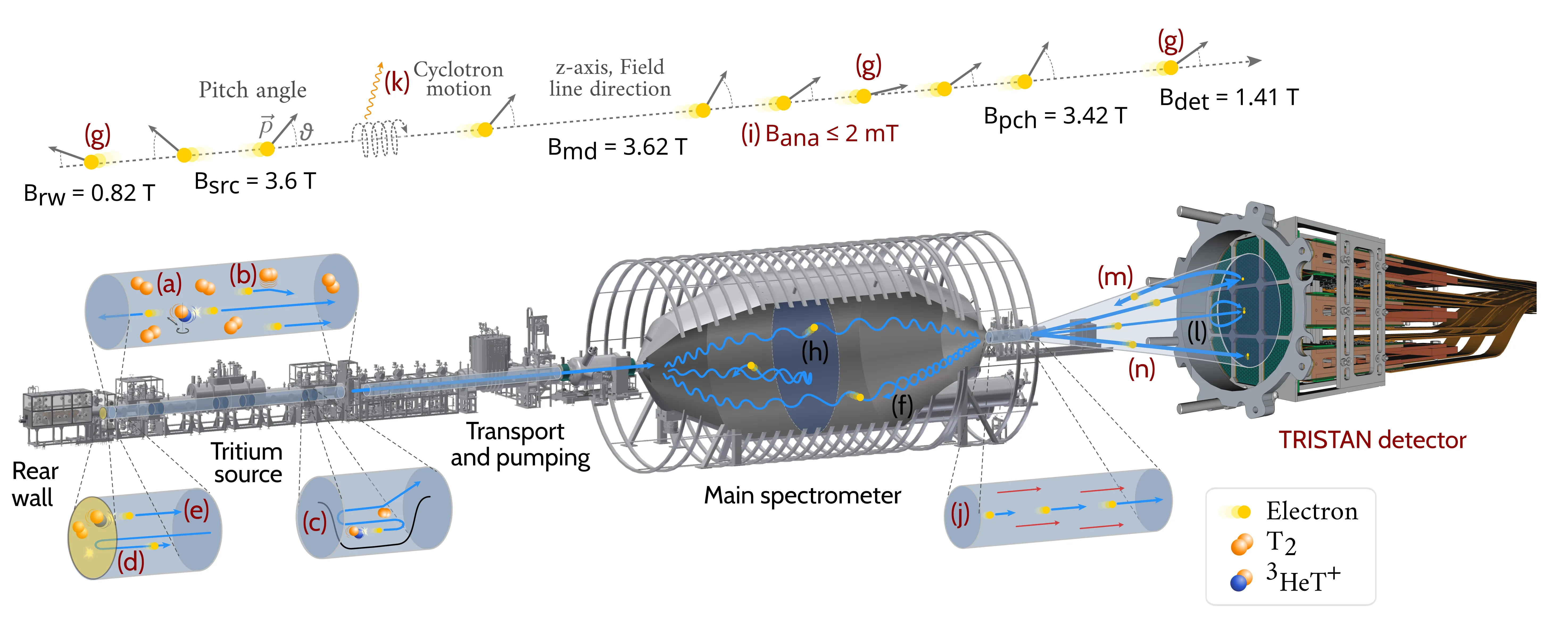
The KATRIN experiment has already measured the mass of the ordinary neutrino, and now it is switching to the search for the sterile one. For this, they are building the TRISTAN detector — an array of silicon drift detectors capable of counting electrons at an enormous rate.

In four months of operation, KATRIN could spot a sterile neutrino admixture even if it is only one part per million. That is tens of times better than previous searches.

If the kink is found, it will be the first real trace of a particle that could make up dark matter, the invisible substance that holds galaxies together.

Original abstract

as written by the authors arXiv:2603.23256

Sterile neutrinos in the keV mass range are a well-motivated extension of the Standard Model and viable dark matter candidates. Their existence can be probed in laboratory experiments, as the admixture of a sterile state would induce a characteristic kink-like distortion in the $$\beta$$-decay electron energy spectrum. The KATRIN experiment is designed to measure the effective electron neutrino mass with sub-eV sensitivity by analyzing the endpoint region of the tritium $$\beta$$-decay spectrum. Following the completion of its neutrino mass program, KATRIN will extend its physics reach to the search for keV-scale sterile neutrinos. This effort will be enabled by the TRISTAN detector, a newly developed silicon drift detector array optimized for differential measurements at high rates and energies well below the endpoint. In this article, we present the projected sensitivity of KATRIN to keV-scale sterile neutrinos using a dedicated simulation framework. With four months of detector livetime, KATRIN has the statistical power to probe mixing amplitudes at the level of $$|U_{e4}|^2 \sim 10^{-6}$$ for sterile neutrino masses in the (4$$-$$13) keV range, significantly extending the reach of previous laboratory searches. The major experimental systematic uncertainties investigated in this work reduces the sensitivity by a factor of 10$$-$$50 over the same mass range.

The sterile neutrino is so named because it is 'sterile' with respect to the weak interaction, the only one in which ordinary neutrinos participate.

Scientists
Paul DiracFritz ZwickyDavid DeutschErwin SchrödingerJohn Stewart BellLouis de Broglie
Concepts
katrin sterile neutrino dark matter nustar neutrino detection kiloelectronvolt km3net diamond nv center spectroscopy neutron mass dune juno kagra hyper kamiokande millikelvin sterile neutrino lz