Simple

Radon Hides Dark Matter express

Original: "Low-Energy Radon Backgrounds from Electrode Grids in Dual-Phase Xenon TPCs"
· D. S. Akerib, A. K. Al Musalhi, F. Alder, B. J. Almquist, S. Alsum, C. S. Amarasinghe, A. Ames, T. J. Anderson, N. Angelides, H. M. Araújo, J. E. Armstrong, M. Arthurs, X. Bai, A. Baker, J. Balajthy, S. Balashov, J. Bang, J. W. Bargemann, E. E. Barillier, A. Baxter, K. Beattie, T. Benson, E. P. Bernard, A. Bernstein, A. Bhatti, T. P. Biesiadzinski, H. J. Birch, E. Bishop, G. M. Blockinger, E. M. Boulton, B. Boxer, C. A. J. Brew, P. Brás, S. Burdin, D. Byram, M. C. Carmona-Benitez, M. Carter, C. Chan, A. Chawla, H. Chen, Y. T. Chin, N. I. Chott, S. Contreras, M. V. Converse, R. Coronel, A. Cottle, G. Cox, D. Curran, J. E. Cutter, C. E. Dahl, I. Darlington, S. Dave, A. David, J. Delgaudio, S. Dey, L. de Viveiros, L. Di Felice, C. Ding, J. E. Y. Dobson, E. Druszkiewicz, S. Dubey, C. L. Dunbar, S. R. Eriksen, A. Fan, N. M. Fearon, N. Fieldhouse, S. Fiorucci, H. Flaecher, E. D. Fraser, T. M. A. Fruth, P. W. Gaemers, R. J. Gaitskell, A. Geffre, J. Genovesi, C. Ghag, J. Ghamsari, A. Ghosh, S. Ghosh, R. Gibbons, M. G. D. Gilchriese, S. Gokhale, J. Green, M. G. D. van der Grinten, C. Gwilliam, J. J. Haiston, C. R. Hall, T. Hall, R. H Hampp, E. Hartigan-O'Connor, S. J. Haselschwardt, M. A. Hernandez, S. A. Hertel, D. P. Hogan, G. J. Homenides, M. Horn, D. Q. Huang, D. Hunt, C. M. Ignarra, R. G. Jacobsen, E. Jacquet, O. Jahangir, R. S. James, K. Jenkins, W. Ji, A. C. Kaboth, A. C. Kamaha, K. Kamdin, M. K. Kannichankandy, K. Kazkaz, D. Khaitan, A. Khazov, J. Kim, Y. D. Kim, J. Kingston, D. Kodroff, E. V. Korolkova, H. Kraus, S. Kravitz, L. Kreczko, V. A. Kudryavtsev, C. Lawes, E. Leason, D. S. Leonard, K. T. Lesko, C. Levy, J. Liao, J. Lin, A. Lindote, R. Linehan, W. H. Lippincott, J. Long, M. I. Lopes, W. Lorenzon, C. Lu, S. Luitz, W. Ma, V. Mahajan, P. A. Majewski, A. Manalaysay, R. L. Mannino, N. Marangou, R. J. Matheson, C. Maupin, M. E. McCarthy, G. McDowell, D. N. McKinsey, J. McLaughlin, J. B. McLaughlin, R. McMonigle, D. -M. Mei, B. Mitra, E. Mizrachi, M. E. Monzani, K. Morå, J. A. Morad, E. Morrison, B. J. Mount, M. Murdy, A. St. J. Murphy, A. Naylor, C. Nehrkorn, H. N. Nelson, F. Neves, A. Nguyen, A. Nilima, C. L. O'Brien, F. H. O'Shea, I. Olcina, K. C. Oliver-Mallory, J. Orpwood, K. Y Oyulmaz, K. J. Palladino, N. J. Pannifer, N. Parveen, S. J. Patton, B. Penning, G. Pereira, E. Perry, T. Pershing, A. Piepke, S. S. Poudel, Y. Qie, J. Reichenbacher, C. A. Rhyne, Q. Riffard, G. R. C. Rischbieter, E. Ritchey, H. S. Riyat, R. Rosero, P. Rossiter, N. J. Rowe, T. Rushton, D. Rynders, S. Saltão, D. Santone, A. B. M. R. Sazzad, R. W. Schnee, G. Sehr, B. Shafer, S. Shaw, W. Sherman, K. Shi, T. Shutt, C. Silva, G. Sinev, J. Siniscalco, A. M. Slivar, R. Smith, A. M. Softley-Brown, M. Solmaz, V. N. Solovov, P. Sorensen, J. Soria, A. Stevens, T. J. Sumner, A. Swain, N. Swanson, M. Szydagis, D. J. Taylor, R. Taylor, W. C. Taylor, B. P. Tennyson, P. A. Terman, D. R. Tiedt, M. Timalsina, W. H. To, Z. Tong, D. R. Tovey, J. Tranter, M. Trask, K. Trengove, M. Tripathi, L. Tvrznikova, U. Utku, A. Usón, A. Vacheret, A. C. Vaitkus, O. Valentino, V. Velan, A. Wang, J. J. Wang, Y. Wang, R. C. Webb, L. Weeldreyer, J. T. White, T. J. Whitis, K. Wild, M. Williams, J. Winnicki, M. S. Witherell, L. Wolf, F. L. H. Wolfs, S. Woodford, D. Woodward, C. J. Wright, Q. Xia, X. Xiang, J. Xu, Y. Xu, M. Yeh, D. Yeum, J. Young, W. Zha, C. Zhang, H. Zhang, T. Zhang, Y. Zhou
Radioactive radon settles on detector components and creates interference that mimics signals from dark matter particles.
Abstract

Imagine you're taking a photo of a distant star, but dust settles on your lens, ruining the shot. It's the same in dark matter detectors: tiny traces of radioactive decay build up on the wire grids, masking rare signals. Scientists have built a model that explains this 'dust', and suggested ways to clean it off. What if this is what's been keeping us from seeing the invisible?

Links in the knowledge graph 1

A dark matter detector is like a room where you're trying to hear a whisper while static electricity crackles nearby. This crackle is produced by radon atoms—a radioactive gas that seeps out from materials and air. Settling on metal grids inside the liquid xenon chamber, they knock out electrons when decaying, mimicking the signal from a dark matter particle.

Physicists built a model of this noise and compared it with data from the LUX and LZ experiments. The calculations matched, confirming the culprit. Now it's clear: to hear the whisper, you need to get rid of the crackle—either by cleaning the components more thoroughly or by changing the design, since the sought-after events carry energy of just a few electrons.

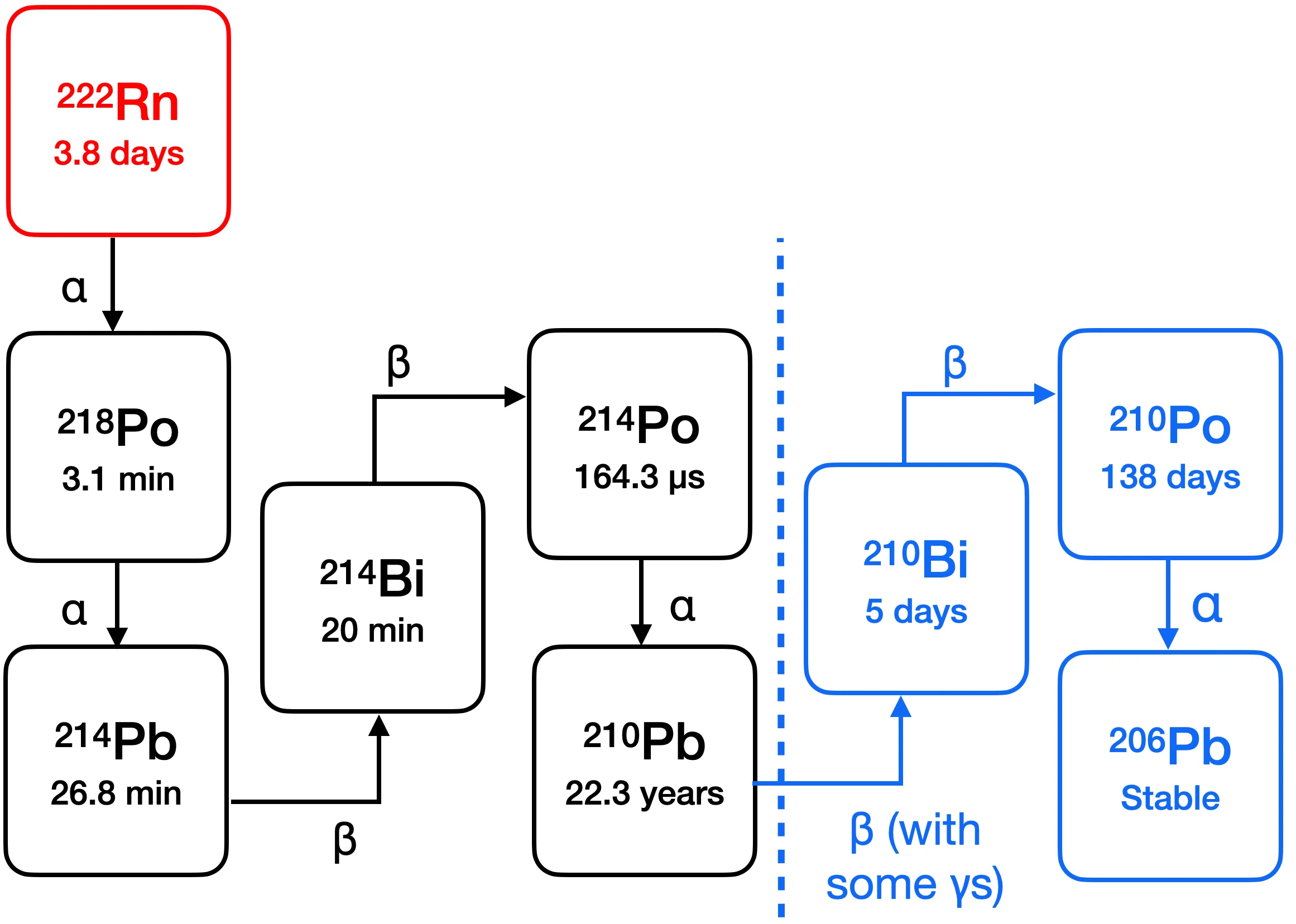
A curious twist: radon is born from uranium, which is present in trace amounts in the materials of the detector itself—the setup creates its own interference.

The interference distorts the energy spectrum—the distribution of electrons where physicists look for anomalies pointing to new physics beyond the standard model. Eliminating this background will bring us closer to solving the mystery of the Universe's hidden mass.
🎯 Radon, which hinders the search for dark matter, is the same gas that accumulates in basements and is the second leading cause of lung cancer.

Scientists
Christian DopplerD. B. McLaughlinDidier QuelozMichel MayorR. A. RossiterAlbert Einstein
Tags
dark matter Standard Model spectroscopy
Laws
Doppler effectgravitational lensingNoether's theoremMaxwell's equationsPlanck's lawPlanck–Einstein relation
Original: arXiv:2602.21177 · CC BY 4.0 · bridge42worlds