Dark matter resonance refers to hypothetical interactions where dark matter particles or structures resonate with ordinary matter or with each other, producing detectable signals. Unlike direct or indirect detection, which relies on scattering or annihilation, resonance effects can amplify weak interactions at specific frequencies or energies, making them observable. This concept is explored in various contexts, from the early universe's density fluctuations to the dynamics of stars and black holes.
History
The term 'dark matter resonance' is not a single established theory but a collection of ideas that have emerged in the 21st century, particularly in the context of ultralight dark matter (like axions) and dark matter substructure. No single originator can be credited.
How it works
The mechanism typically involves a periodic or oscillatory process. For example, if dark matter forms clumps or waves, they might exert a periodic gravitational force on ordinary matter, such as stars in a galaxy. If the frequency of this force matches a natural oscillation frequency of the system (like a star's orbital period), resonance can amplify the effect, leading to observable anomalies. Alternatively, in the early universe, resonant interactions between dark and ordinary matter could have enhanced the generation of certain particles or perturbations, leaving imprints in the cosmic microwave background.
In practice
It is used in astrophysical searches for dark matter, such as looking for resonant effects in stellar motions or in the polarization of light from distant galaxies, and in cosmological models of structure formation.
Fun fact
Some proposals suggest that dark matter could form 'boson stars' that resonate with the orbital motion of stars around them, potentially causing observable periodic variations in stellar velocities.
The universe is like a vast warehouse where a strict inventory was taken long ago. The cosmic microwave background is an ancient record of everything in stock 380,000 years after the big bang. According to it, the fraction of matter in the cosmic 'budget' (the parameter Omega_m) is known with high precision.
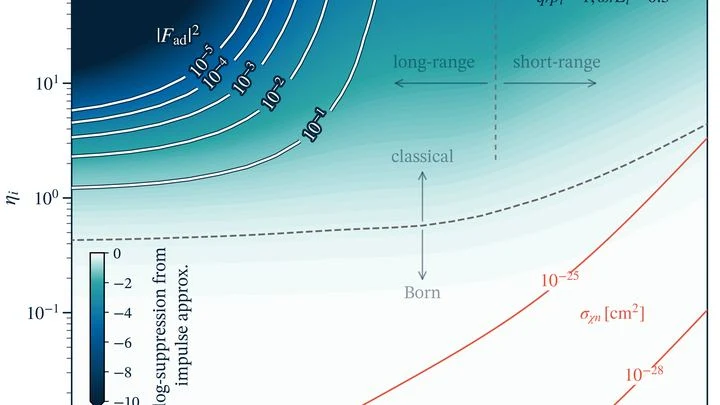
A billiard ball slams into another. Impact, and the balls scatter. But if the push is not sharp but very gentle, the balls just roll together without bouncing. An atom behaves much the same way when hit by a dark matter particle.
The Universe is pervaded by an invisible substance — ultralight dark matter, which doesn't collide with ordinary matter but can tremble like a taut string. Its oscillations alter the world's most fundamental properties: the electron charge, the speed of light — as if the tuning of a single cosmic note slightly drifts.
In the first moments after the Big Bang, the universe was a boiling cauldron. But then, according to a new hypothesis, it suddenly cooled dramatically — far more than previously thought. In this icy world, dark matter particles, like tiny pendulums, froze and did not begin their oscillations.
Two tiny emitters, each about the size of an atom, can together do what neither can do alone. We're talking about light scattering — when light hits particles and bounces off in all directions. Usually, a pair of particles scatters light only slightly more than a single one.
A dark matter detector is like a room where you're trying to hear a whisper while static electricity crackles nearby. This crackle is produced by radon atoms — a radioactive gas that seeps out from materials and air.
In its infancy, the universe was a hot, plasma-like mixture of particles. Microseconds after the Big Bang, as it cooled, the temperature fluctuated slightly.
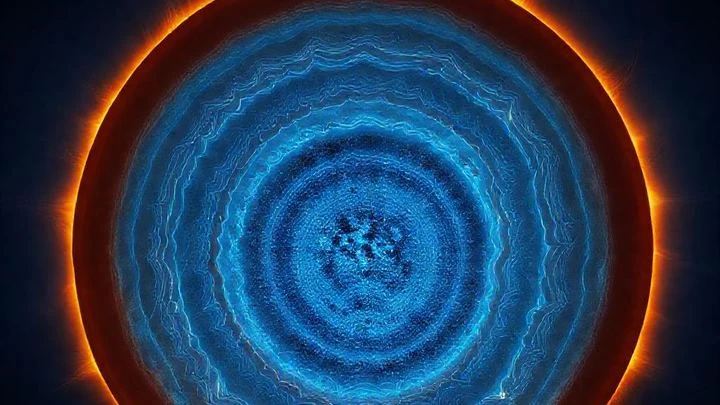
The Sun’s gravity creates an invisible goblet, in which dark matter of a special kind — ultralight — doesn’t splash around chaotically, but occupies strict energy steps, like transparent layers of liquid. So around the Sun, a natural spectroscope emerges, sorting the invisible substance into levels, just like electrons in an atom.
In the 1930s, Fritz Zwicky, observing the Coma cluster, noticed anomalously high galaxy velocities: their motion pointed to a huge hidden mass gravitationally binding the system.
A century ago, magnetic observatories recorded only the slow breathing of Earth's core. Today, their data have become hunting grounds for particle physics. At the Eskdalemuir Observatory in northern England, fluctuations of the magnetic field are recorded every hundredth of a second.