A White Hole in the Lens: What the Telescope Will See express
A black hole is a place from which nothing can escape. But some theories allow that deep inside, at the quantum level, it might bounce and turn into its opposite — a white hole, which only spews out matter and light.
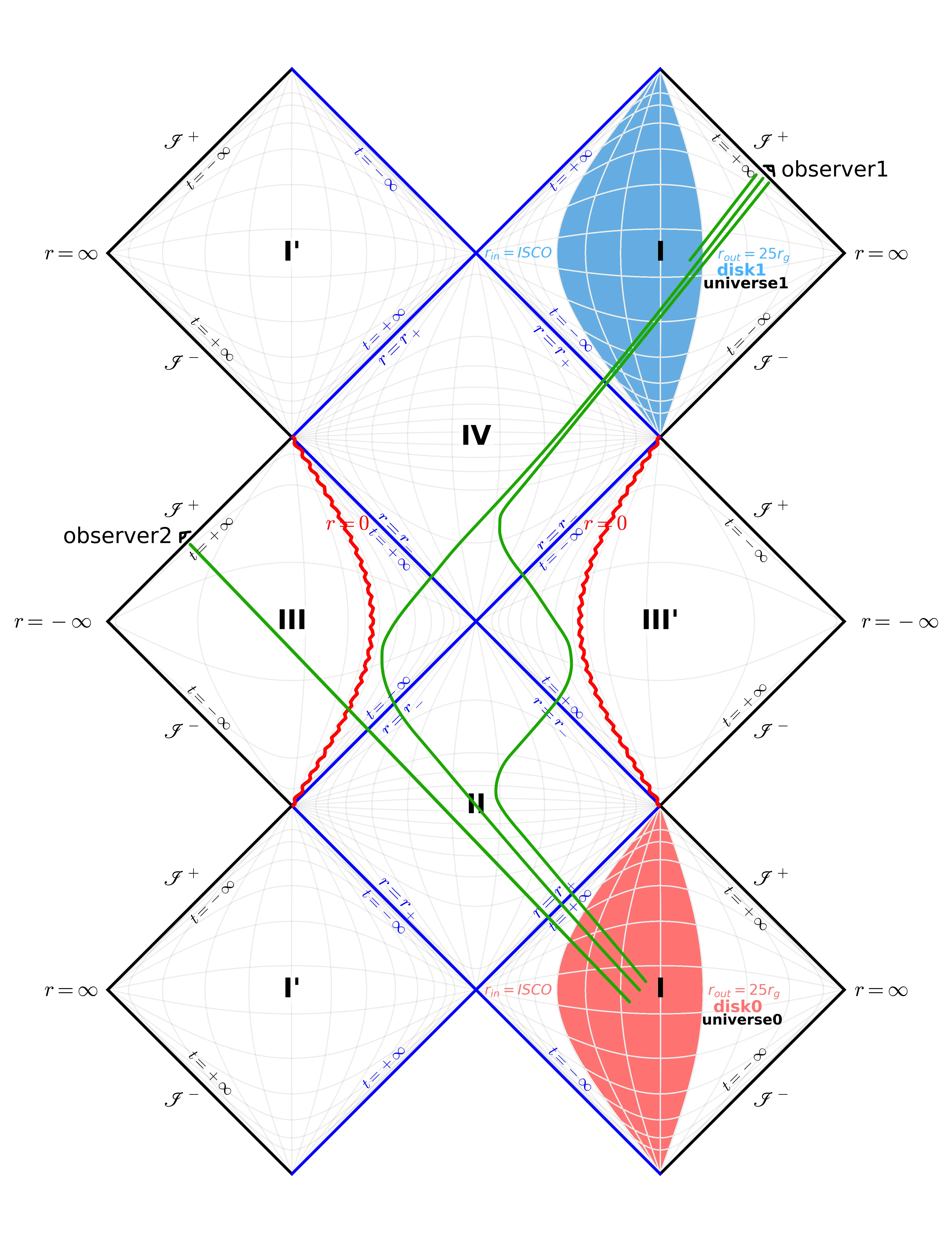
A group of physicists built a computer model of such a transformation. They took a rotating black hole and traced the paths of light rays from the hot disk around it — first while the hole is still black, and then after it has become white. For the black hole, the familiar picture emerged: a bright crescent and a dark void in the center. But when light from the previous universe passed through the white hole, the image became completely different.
Because of the hole's rotation, spacetime twists, and light rays bend in strange ways. The synthetic image showed asymmetric, nested rings of varying brightness. The faster the rotation and the stronger the tilt, the more complex the pattern. The authors also calculated how this light would be polarized. It turned out that from ring to ring, the direction of polarization changes sharply, in a jump — something not seen in black holes.
This "ragged" polarization is the key to identifying a white hole. If future networks of telescopes, working as a single giant eye (the method of interferometry), spot such a pattern, it would be strong evidence for a quantum bounce.
Original abstract
as written by the authors arXiv:2607.20945
Within theoretical frameworks such as loop quantum gravity, black holes may evolve into white holes through a quantum bounce. This paper uses general relativistic ray-tracing techniques to calculate the ray-traced imaging of accretion disks from the previous cosmic stage during the Kerr black hole and post-bounce Kerr white hole phases. Calculations show that the black hole image presents a crescent emission ring and a central shadow. In contrast, after radiation from the previous universe penetrates the rotating white hole, eccentric and asymmetric nested intensity ring structures form in the synthetic image due to frame-dragging and lensing effects. We analyze the influence of spin parameters, observation inclinations, and accretion disk geometric configurations on the distribution of this nested ring structure using synthetic images and intensity profiles. Building upon this, we introduce polarized ray-tracing calculations for radiation across evolutionary stages. This process results in the polarization image features after the polarization vector is subjected to the gravitational field and spacetime spin dragging during the photon propagation through the white hole horizon and internal spacetime. The spatial rotation patterns and concentric interference fringes in the white hole polarization images exhibit a distinct inter-ring polarization discontinuity. This phenomenon differs from the polarization behavior of black holes. The intensity ring structures and polarization inter-ring discontinuity features provide multi-band and polarimetric interferometry baselines to overcome morphological observational degeneracies. This provides theoretical guidance for future very-long-baseline interferometry (VLBI) to distinguish black holes and white holes.
The rotation of a white hole twists space itself — an effect known as "frame-dragging." Because of it, the light rings in the image become asymmetric, as if stretched to one side.
In Stanislaw Lem's novel "Fiasco," an alien civilization uses a white hole as a weapon capable of destroying entire planetary systems.