A White Hole in the Lens: What the Telescope Will See express
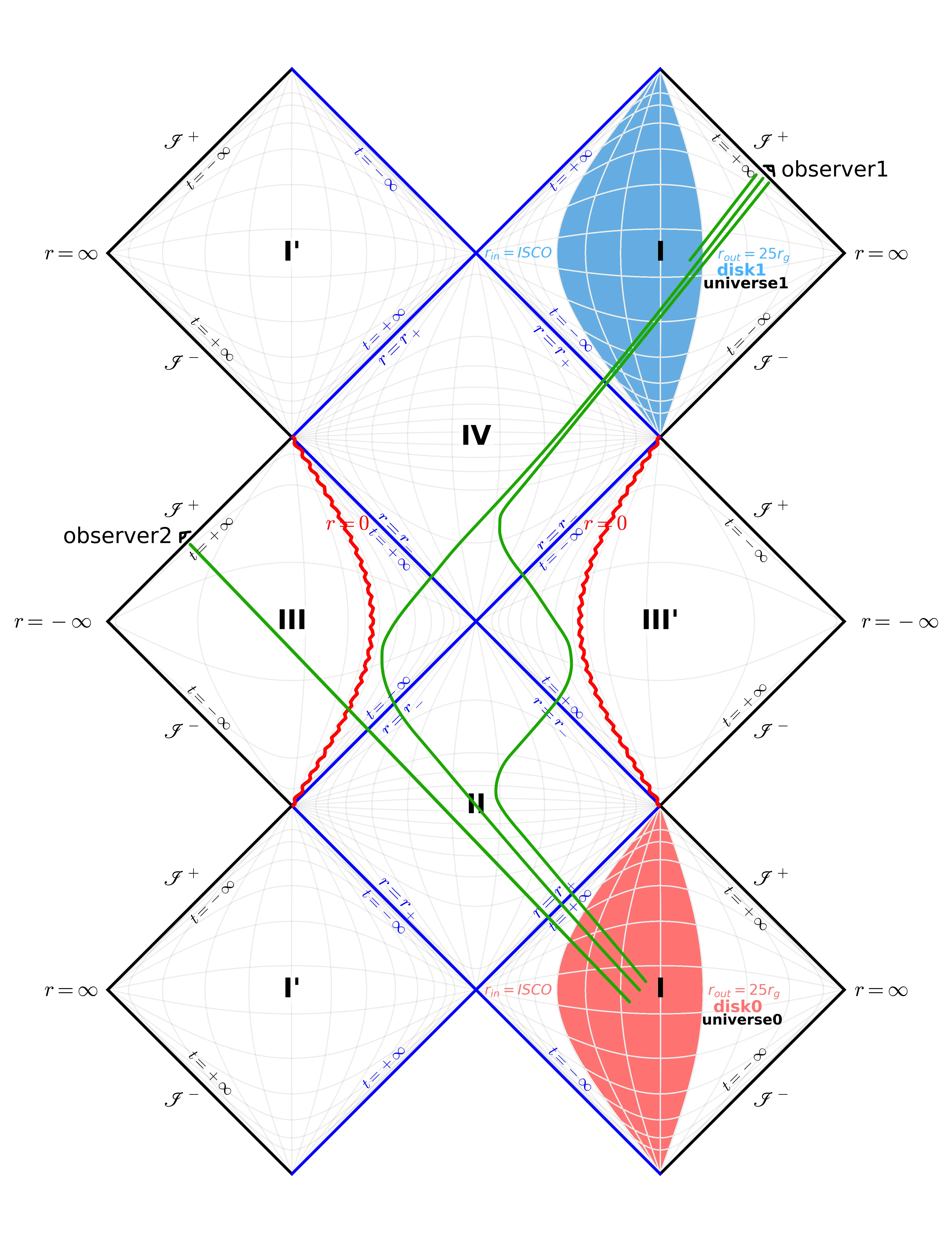
A black hole is a place from which nothing can escape. But some theories allow that deep inside, at the quantum level, it might bounce and turn into its opposite — a white hole, which only spews out matter and light.
A group of physicists built a computer model of such a transformation. They took a rotating black hole and traced the paths of light rays from the hot disk around it — first while the hole is still black, and then after it has become white. For the black hole, the familiar picture emerged: a bright crescent and a dark void in the center. But when light from the previous universe passed through the white hole, the image became completely different.
Because of the hole's rotation, spacetime twists, and light rays bend in strange ways. The synthetic image showed asymmetric, nested rings of varying brightness. The faster the rotation and the stronger the tilt, the more complex the pattern. The authors also calculated how this light would be polarized. It turned out that from ring to ring, the direction of polarization changes sharply, in a jump — something not seen in black holes.
This "ragged" polarization is the key to identifying a white hole. If future networks of telescopes, working as a single giant eye (the method of interferometry), spot such a pattern, it would be strong evidence for a quantum bounce.
The rotation of a white hole twists space itself — an effect known as "frame-dragging." Because of it, the light rings in the image become asymmetric, as if stretched to one side.
In Stanislaw Lem's novel "Fiasco," an alien civilization uses a white hole as a weapon capable of destroying entire planetary systems.