Black holelight bending refers to the gravitational deflection of light rays as they pass near a black hole. This effect is a direct consequence of general relativity, where massive objects curve spacetime, and light follows the curved paths. Near a black hole, the bending can be so extreme that light can orbit the black hole multiple times before escaping, creating what are known as photon rings. This phenomenon is crucial for testing general relativity and for imaging black holes, as done by the Event Horizon Telescope.
History
The bending of light by gravity was first calculated by Einstein in 1915 and confirmed by Eddington's 1919 solar eclipse expedition. The specific case of light bending around black holes was studied in the 1930s and later refined with the concept of photon spheres by Bardeen, Press, and Teukolsky in 1972.
How it works
The bending angle depends on how close the light passes to the black hole and on the black hole's mass and spin. For a non-rotating black hole, the critical impact parameter for photon capture is at 3 times the Schwarzschild radius, where light can orbit in an unstable circle. Light passing closer than this is captured, while light passing slightly farther is deflected by large angles. The shadow of a black hole — the dark region seen in images — is the projection of this photon capture region, and its size and shape encode the black hole's properties.
In practice
It is used to measure black hole masses and spins from their shadows, to test general relativity in strong-field regimes, and to study the distribution of matter around black holes via gravitational lensing effects.
Fun fact
Light can orbit a black hole multiple times before escaping, and these higher-order photon rings are predicted to appear as a series of increasingly faint concentric rings in high-resolution images.
A black hole is a place from which nothing can escape. But some theories allow that deep inside, at the quantum level, it might bounce and turn into its opposite — a white hole, which only spews out matter and light.
A group of physicists built a computer model of such a transformation.
A light ray passing by a massive body gets deflected: this is the effect of gravitational lensing, familiar from images of distant galaxies. The astrophysicists started with a rotating black hole (Kerr spacetime) and added a tiny correction to how light itself propagates.
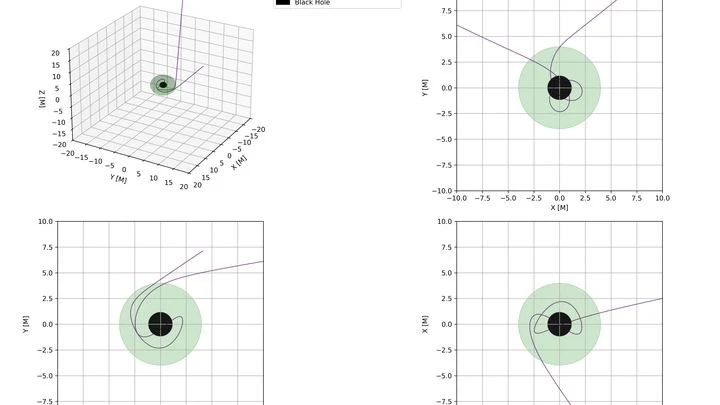
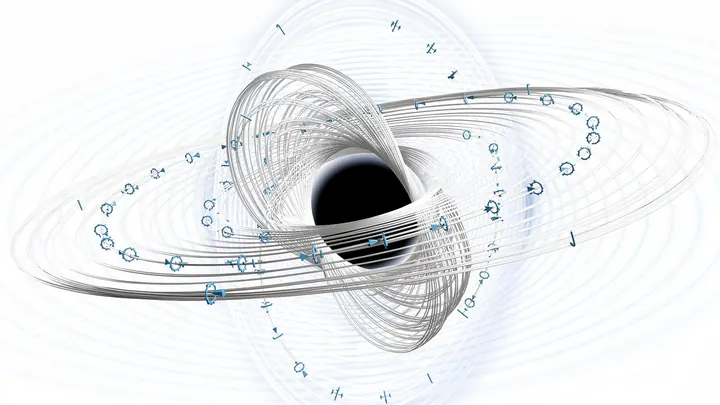
A cosmic ray approaches a black hole almost tangentially. Instead of falling straight in, it lingers on an unstable orbit, like an acrobat balancing on a tightrope over an abyss. After a few loops, the light finally escapes toward a distant observer. Such rays produce multiple images of the same source, known as higher-order images.
Two dead stars circle in a final dance. Their approach creates ripples in space — gravitational waves. But there may be a third, invisible partner in this dance. Its gravity accelerates the pair, and the signal changes pitch slightly, like the siren of a passing car.
Drop a pebble into a pond, and ripples spread across the water. A black hole 'sounds' much the same when matter falls into it or when its spacetime gets a gentle jolt. These fading oscillations are called quasinormal modes, like the tolling of a bell that gradually fades away.
Light passing by a black hole swirls like water down a bathtub drain. The most intriguing part is the thin ring where rays can orbit forever, neither falling in nor escaping. This is the photon sphere — an invisible boundary that paints the hole's shadow on the sky.
The gravity of a black hole creates a curvature of spacetime, acting like a lens: light from a distant galaxy splits in two, stretching into arcs. Dark matter around the hole barely changes the picture, as if a transparent curtain was added to a window pane.
Light passing by a black hole falls into a gravitational trap: its trajectory curves and the particle bounces along a nearly closed orbit, like a pinball.
Two black holes smash head-on at full speed — while a third one circles nearby. In ordinary life, such a crash would produce a burst of gravitational waves (ripples in space, like the ripples from a stone thrown into a pond). But here, part of the ripple passes by the massive neighbor, and changes, like light in a funhouse mirror.
When two black holes merge, they shake the very fabric of spacetime. The newborn giant doesn't settle instantly (it rings like a cosmic bell, emitting a characteristic pattern of damped gravitational waves) the so-called ringdown.
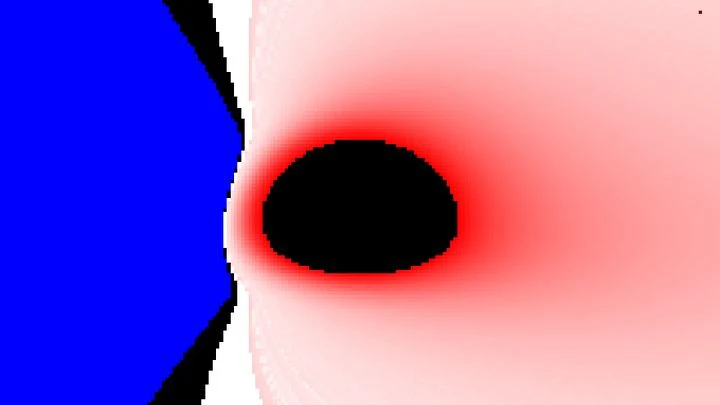
A black hole is invisible, but it's betrayed by light from superheated matter swirling nearby. That light is like a double agent: on one side of its orbit, it blueshifts as it races toward us; on the other, it redshifts as it recedes.
A black hole is like a perfect vault: everything that falls in disappears without a trace. But in the 1970s, Jacob Bekenstein and Stephen Hawking discovered that the horizon carries an indelible "sticker" — entropy (a measure of hidden information about swallowed matter).
Light passing by a massive body bends around it, like a stream of cars swerving around a deep pothole in the road. The steeper the pothole's slopes, the more the trajectories curve, and the fewer straight paths remain to the observer. That's how a black hole's shadow is born: a region from which light can no longer escape.
In the dark depths of space lurks invisible matter. It doesn't shine, but its pull holds galaxies together. Usually, we assume dark matter obeys the same laws of gravity as tables and chairs. A new study offers a different perspective: dark matter might subtly alter gravity itself.
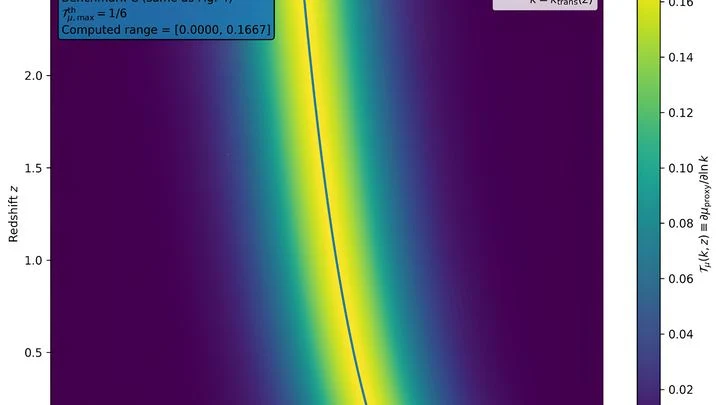
Light from distant galaxies passes through clumps of matter, and the gravity of those clumps slightly bends its path, like a lens. By measuring how much the images of distant galaxies are distorted, we can infer the distribution of matter and how gravity affects light.
A black hole doesn't just suck in matter — like a giant cosmic whirlpool, it warps the very fabric of reality and bends light rays around itself, focusing them. The effect is even stronger for black holes that spin at nearly the speed of light: their rotation twists space into a tight spiral.