EHT uses the technique of Very Long Baseline Interferometry (VLBI). Eight observatories, from the South Pole to Greenland, are synchronized by atomic clocks, recording signals at a frequency of 230 GHz. This frequency corresponds to a wavelength of 1.3 mm – the submillimeter range where the superheated plasma near the black hole radiates. After years of processing on supercomputers, signal correlation achieved an angular resolution of 20 microarcseconds – equivalent to reading a newspaper from 500 km away.
History
The concept of combining radio telescopes for interferometry dates back to the 1960s, when the first VLBI experiments were conducted. By the 1990s, advances in millimeter-wave receivers made it possible to consider observing compact sources such as Sgr A*. The EHT project began to take shape around 2009, and the first full observations were conducted in April 2017. After two years of data processing, the collaboration, involving more than 200 researchers from different countries, presented the image of the black hole shadow in M87 in 2019. In 2022, the image of Sgr A* – the black hole at the center of our Galaxy – was published.
How it works
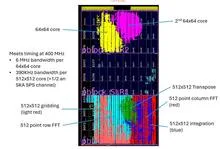
The telescopes record the amplitude and phase of incoming radio waves. Pairwise correlation of signals (product with delay) yields complex visibilities. Then image reconstruction algorithms, such as CLEAN or regularized maximum likelihood methods, translate the visibilities into a brightness map. The interferometer's resolution is given by the diffraction formula θ ≈ λ / D. With λ = 1.3 mm and D ≈ 10,000 km, we obtain θ ~ 20 μas (microarcseconds). The key challenge is achieving sub-nanosecond accuracy synchronization with hydrogen masers and accounting for atmospheric fluctuations. Due to Earth's rotation, the relative positions of the telescopes change, filling the UV-plane and improving image quality.
In practice
Direct images of the event horizon and testing gravity theories under extreme conditions.
Fun fact
The volume of data collected in one observing campaign exceeds the total daily Internet traffic; it was transported on hard drives by airplanes because network transmission would have taken years.
The heart of a black hole beats unevenly. One thump is brighter, another dimmer, and this rhythm encodes the temperature of the electrons swirling right at the horizon. Astronomers call this rhythm the spectral index: a number that shows how much brightness changes as you move from one radio frequency to another.
A radio telescope with thousands of antennas is like a giant ear that hears the whole sky at once. But an ear cannot draw a picture: signals from every pair of antennas must be multiplied, and in an array of ten thousand elements there are already fifty million pairs. A classical correlator does exactly that, and its complexity grows as the square of the number of antennas.
Galaxy Mrk 590 behaves like a radio receiver that sometimes picks up a signal and sometimes fades into static. Its supermassive black hole has been brightening and dimming for decades, and astronomers caught every such 'switch-on.' In 2017, the receiver came alive again, but the VLA radio telescope heard not the signal they expected.
In 2015, the LIGO detectors caught the first ripple of spacetime from a black hole merger. Since then, hundreds of such events have piled up, each carrying the imprint of its ancestry: whether the holes were born together from a single pair of stars or met by chance in a dense cluster. The difference shows in the direction of their spin axes.
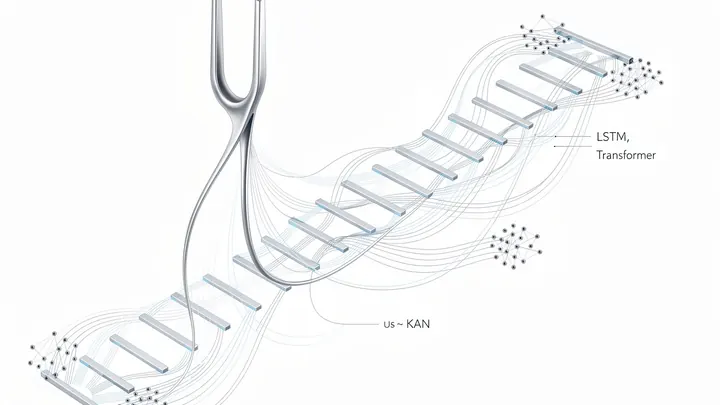
A network of radio telescopes scattered across the planet catches the whisper of a distant black hole. Each antenna records a signal, but how do you combine these recordings if the clocks at the stations tick at different rates and the atmosphere distorts incoming waves?
A network of radio telescopes scattered across the planet catches the whisper of a distant black hole. Each antenna records a signal, but how do you combine these recordings if the clocks at the stations tick at different rates and the atmosphere distorts incoming waves?
In the shaft leading to the Large Hadron Collider, an unusual tenant may soon move in: a hundred-meter vertical tube where clouds of strontium atoms will be dropped. Each cloud is cooled to near absolute zero, so the atoms move slowly and in sync, like dancers in slow motion.
A radio telescope, like a sensitive ear, picks up the whispers of distant galaxies. Hidden among that noise are giants — giant radio sources. These are clouds of charged particles ejected from the vicinity of supermassive black holes.
The universe is constantly sending us signals, but many are too faint to notice. Relic neutrinos, particles left over from the Big Bang, pass through Earth by the billions every second, yet catching even one is a feat on the edge of possibility. We need a detector that can sense energy a thousand times smaller than what it takes to move a speck of dust.
Somewhere in the depths of space, two supermassive black holes are circling each other. Their dance is not smooth — the orbit is stretched, like a rubber band that alternately tightens and relaxes. Each revolution sends ripples through the fabric of spacetime — gravitational waves.
The calm surface of a lake suddenly ripples — somewhere in the depths, an underwater cliff has collapsed. The water trembles almost imperceptibly, and the circles spread wider and wider until they reach a bobber near the shore.
Imagine a quiet room where you need to pick out a single melody among many barely audible rustles. That's roughly what it's like to search for signals from extreme systems of two black holes — one huge, the other millions of times smaller.
A flashlight beam cuts through fog. The denser the fog, the more the light scatters and the later it reaches your eye. A similar principle works with fast radio bursts — mysterious, super-powerful pulses from distant galaxies. As their radio waves travel through space, they interact with free electrons — particles stripped from atoms.
You could send a short radio pulse toward a black hole and wait for the reflected echo. Intuitively, the shorter the signal, the better it would probe the finest details of spacetime right at the horizon: that region from which even light cannot return.
In the dark outskirts of our Galaxy, far from bright star clusters, millions of black holes lurk. They are invisible: they don't shine and don't noticeably accrete matter. Conventional search methods, designed for dense stellar fields, are useless here. A different approach is needed.
Astronomers have proposed using the very fabric of space as a detector.
A cosmic object spins, but its shadow isn't round. Astrophysicists examined a black hole in an unusual version of gravity — the so-called brane world (where our universe is a three-dimensional surface in a space of higher dimensions).
Photographing an exoplanet orbiting another star is like trying to spot a firefly in front of a spotlight. Earth's atmosphere is constantly churning, which makes stars appear as dancing speckles through a telescope.
In a distant galaxy about 290 million light-years away, the object HLX-1 lies hidden. It once flared brighter than hundreds of billions of suns, but now it has quieted down. From 2018 to 2022, the Hubble, Chandra, and Swift space telescopes tracked its fading.
380 thousand years after the Big Bang, the universe cooled enough for light to decouple from plasma. That cosmic microwave background still pervades space, like the first chord of a symphony, the echo of a fiery beginning.
In 2034, a rocket leaves a spaceport with an unusual payload: two spheres the size of a large globe, each weighing nearly a ton. No engines, no electronics. Just a mirrored surface of hundreds of corner-cube reflectors — tiny prisms that return light exactly to where it came from. This is the future space tuning fork.
Predicted by Albert Einstein, gravitational waves are like beacons in the dark ocean of space. They flare up when black holes collide, sending ripples through the fabric of the Universe.
In 2019, the world saw the first image of a black hole's shadow — an orange doughnut on a black background, becoming a symbol of scientific progress. But this image wasn't captured by a camera: it was born from mathematical alchemy, where data from eight radio telescopes, which gathered only crumbs of signal, merged into a single picture.
At the center of most galaxies lurk supermassive black holes — the overlords of gravity. Since 2019, thanks to interferometry with very long baselines, we’ve glimpsed their shadows: dark silhouettes set against a blazing gas backdrop. But what exactly is painting that shadow?
The cosmos is full of screams we can't hear. Every time a black hole tears a star apart, a blinding flash is born, and often — a narrow relativistic jet, shooting out thousands of light-years. But if that searchlight is aimed away from Earth, we see only a faint afterglow — a radio echo arriving with a delay.
The LIGO detectors caught the signal GW250114—a gravitational wave from the merger of two black holes. After the main burst, a decaying 'tail' remained — direct waves from the newborn hole's horizon. It was expected that their damping would reveal the gravitational strength at the horizon's surface. But the measured value came out smaller.
Modern cosmology has hit a dissonant chord. Local measurements of the Hubble constant from supernovae and Cepheids give around 73 km/s/Mpc, while global constraints from the cosmic microwave background within the standard ΛCDM model point to 67 km/s/Mpc.
Fast radio bursts — millisecond radio pulses arriving from distant galaxies — long remained a puzzle. Their colossal energy, compressed into instants, pointed to cataclysms on neutron stars, perhaps pulsars or magnetars.
Isolating the signal from a single pair of supermassive black holes is like hearing a dancer's footsteps amid the roar of a hurricane. Somewhere in space, these monsters spin in a slow gravitational tango, distorting spacetime itself.
At the center of galaxy M87, 55 million light-years away, lurks a black hole with a mass of 6.5 billion Suns. In 2019, the Event Horizon Telescope (EHT) gave us its first portrait: an orange donut with a dark core. But the donut is not the abyss itself.
A black hole is not a frozen void, but a living magnetic engine. Its 'heart'—the accretion disk, pulsates: inhale, matter spirals into the funnel, exhale — magnetic reconnection tears the field lines, and plasma shoots away from the horizon.
A tiny star spirals around a giant rotating black hole. Slowly, it moves closer in a spiral, and this dance lasts thousands of years. All the while, waves ripple through space, like ripples on water, but these are gravitational waves. They can be "heard" with special detectors.
Galaxy clusters are the greatest gravitational ensembles in the Universe. In X-ray glow from hot plasma, the story of cosmic expansion, hidden dark matter, and enigmatic dark energy is encoded.
The light of a distant star briefly brightens when a massive invisible object passes between it and a telescope. This phenomenon, gravitational microlensing, acts as a natural telescope. Usually, the lens is a black hole, warping the spacetime around it.
The universe as painted in Einstein’s textbooks is a smooth four-dimensional canvas. But string theory adds a frame of extra dimensions — invisible, yet tangible to gravity. Imagine our universe as a membrane that trembles under the pressure of hidden layers.
The Schwarzschild black hole is the simplest model in general relativity. But when you switch to teleparallel gravity (TEGR), where torsion replaces curvature, the horizon develops a problem. Some quantities built from torsion tend to infinity.
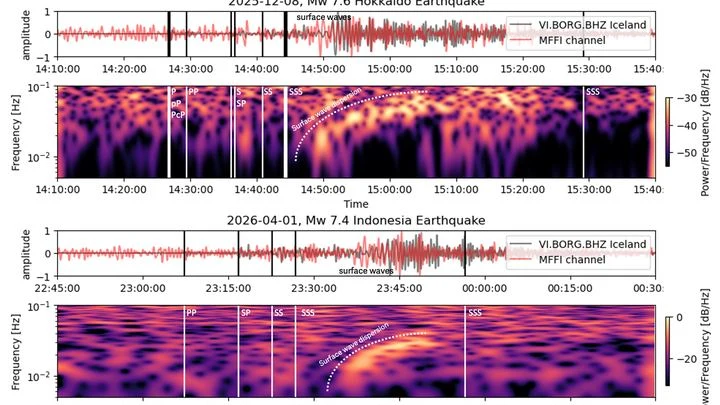
The planet-spanning web of undersea internet cables acts like a giant ear. The glass thread inside responds to water movements: currents, tides, and distant earthquakes bend the cable. Light traveling along the thread takes slightly longer: this delay is measured on shore against a reference. That’s how the speed of light reveals itself.
A spinning top whirling so fast that it forces light around it into spirals: that's a fitting image for what happens near a black hole's horizon. Hot plasma falls in and emits radio waves. Their polarization (the plane in which the wave oscillates) becomes an arrow pointing in the direction of energy flow.
A tiny coin circles a heavy bowling ball. The coin is a small black hole or a neutron star, and the ball is a supermassive black hole at the center of a galaxy.
Gravitational waves are ripples in the very fabric of spacetime, akin to vibrations of a giant cosmic string. Conventional detectors like LIGO and Virgo pick up low-frequency "notes"—disturbances from mergers of massive black holes of stellar masses.