Speed is the rate at which an object covers distance, defined as the distance traveled divided by the time taken. It is a scalar quantity, meaning it has magnitude but no direction, unlike velocity which includes direction. In everyday life, speed is what a car's speedometer shows, and in physics it is fundamental to describing motion, from a falling apple to a speeding photon.
History
The concept of speed has been used since antiquity, but Galileo Galilei in the early 17th century formalized the relationship between distance, time, and speed, laying groundwork for classical mechanics.
How it works
Speed is calculated as the total distance traveled divided by the elapsed time, giving an average speed. Instantaneous speed is the limit of this ratio as the time interval approaches zero, which is the magnitude of the instantaneous velocity vector. In uniform motion, speed is constant; in accelerated motion, it changes over time.
In practice
Speed is used in navigation, traffic engineering, sports analytics, and in physics to calculate kinetic energy (½mv²) and to determine travel times in space missions.
Fun fact
The speed of light in a vacuum is exactly 299,792,458 meters per second, a fixed constant that defines the meter itself since 1983.
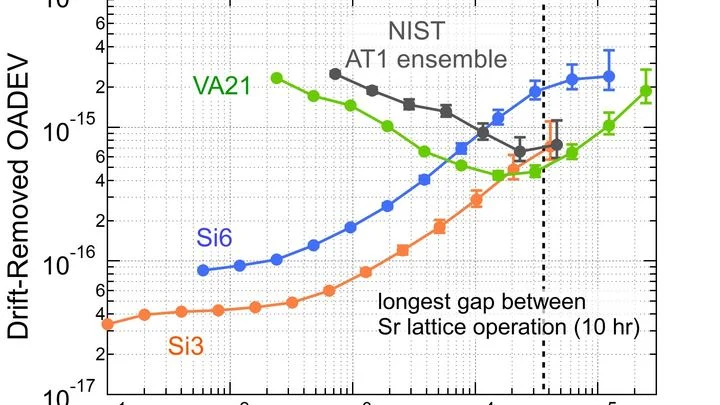
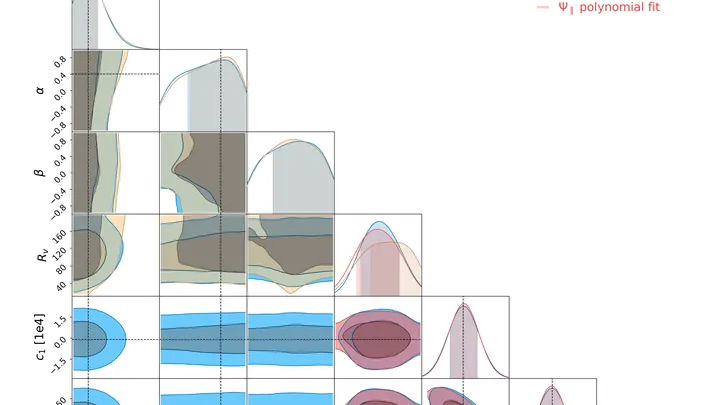
The world's most precise stopwatch still runs with one eye on an old pendulum. Hydrogen masers — the best radio-frequency flywheels (devices that keep the rhythm between comparisons with a reference)—accumulate error because noise between ticks leaks into the final signal.
Water droplets shoot out of a nozzle one after another, like cyclists on a narrow track. The faster ones catch up with the slower ones and merge into larger drops. This simple mechanism is called ballistic aggregation, and until now it had only been observed on cosmic scales: this is how dust particles stick together to form planets.
Decades of radio astronomy have listened to space, hoping to catch narrowband radio transmissions — the technogenic 'voice' of distant exoplanets. But our own technological evolution reveals a paradox: loud analog signals, like 1960s TV broadcasts, are just a brief squawk of a newborn civilization.
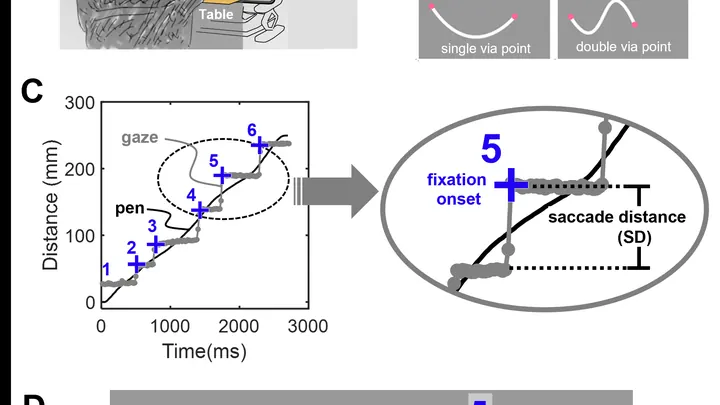
When the hand draws a line, the gaze almost always runs ahead, like a scout peeking around the corner before the column turns. But how far ahead? It turns out that each person has their own distance, and it does not change from attempt to attempt.
In the experiment, professional calligraphers and ordinary people traced a contour on a screen while instruments recorded eye and pen movements.
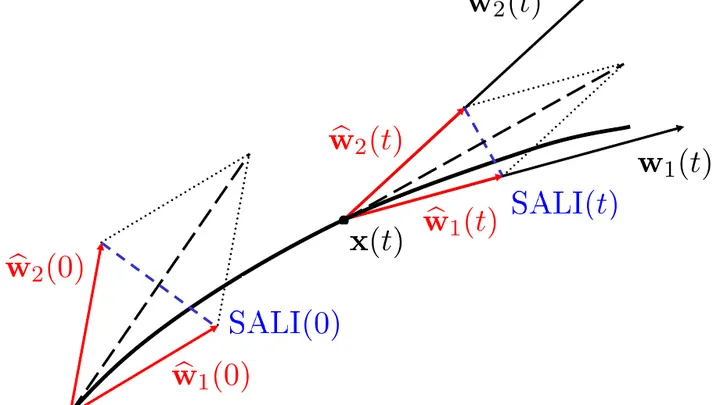
Drop a stone into a calm pond — the ripples spread evenly. Drop it into a churning stream — the water swirls unpredictably. Scientists have long wrestled with a similar question: how can you tell from a single particle's path whether its motion is chaotic? Previously, this meant comparing the particle's path with neighboring ones, which is complicated and time-consuming.
Galaxies in the Universe are not scattered randomly: neighboring ones move in the same direction, like a school of fish, while distant ones each go their own way. Where the boundary between 'together' and 'apart' lies has been unclear until now.
When entropy reaches its maximum, the play is over. The curtain falls, the actors leave, the scenery freezes. But the stage remains. So it is with time: the heat death of the universe erases the direction 'past—future', but not time itself.
The clock on the kitchen wall ticks, and each tick relentlessly carries us from breakfast to lunch. This is so familiar that it seems like a law of nature, but physics says otherwise. In Einstein's equations, time is reversible: you can rewind the film, and no frame will give the trick away.