Born in the depths of functional analysis through the efforts of David Hilbert and John von Neumann in the 1920s-30s, the spectral theorem became a bridge between algebra and quantum mechanics. It states that any Hermitian operator (named after Charles Hermite), describing an observable quantity, can be diagonalized: represented as a sum (or integral) over its spectral projections, each corresponding to a specific instrument value. If you have a set of color filters, then any beam can be decomposed into pure colors and then reconstructed by mixing them. The spectral theorem does the same in infinite-dimensional spaces, guaranteeing that for any observable there is a 'set of filters'—spectral projectors—allowing the decomposition of a quantum state into components with definite values.
History
In 1906, David Hilbert introduced the concept of spectrum for integral equations and proved the first versions of the theorem for bounded operators. In the 1920s, John von Neumann generalized it to unbounded self-adjoint operators, creating a rigorous mathematical foundation for quantum mechanics (1932, 'Mathematische Grundlagen der Quantenmechanik'). In parallel, Marshall Stone in 1932 gave a proof for unitary operators. The ideas of spectral decomposition date back to the work of Joseph Fourier (1822) and Henri Poincaré, but the modern form owes to von Neumann and André Weil.
How it works
Applications span quantum physics, where the eigenvalues of the Hamiltonian determine the energy levels of atoms and molecules; control theory and signal processing (singular value decomposition); quantum chemistry (molecular orbital method). Limitations: the theorem guarantees the existence of spectral decomposition, but finding eigenvectors for complex systems can be computationally infeasible (exponential growth of dimensionality). In quantum field theory, operators are often unbounded, and self-adjointness issues are nontrivial.
In practice
It is precisely what allows predicting quantum measurement results, building stable search engine algorithms, and compressing images into JPEG.
Fun fact
Without the spectral theorem, the Schrödinger equation would have remained a mathematical abstraction—it is precisely this that links the electron's wave function to the real spectrum lines we see in a rainbow or in the light of distant stars.
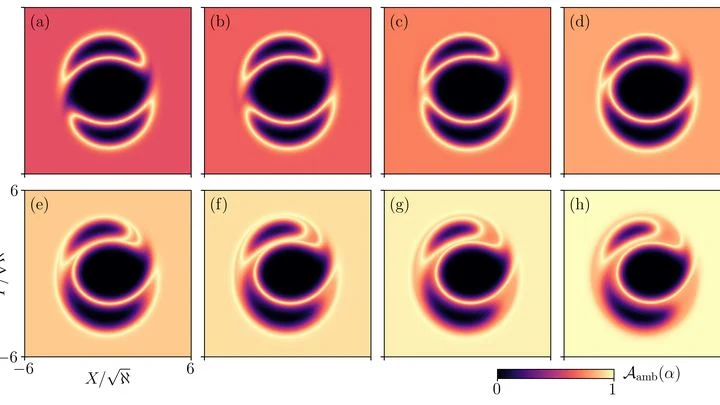
The quantum world never stands still. Even in the most perfect resonator, a trap for particles of light, energy gradually leaks away, and information is erased. Physicists call this process decay, and it has its own rhythm: some 'notes' fade quickly, while others linger.
Quantum calculations often resemble assembling a complex mechanism: a physicist knows a part will fit, but can't always explain why. One favorite trick is to insert a 'unity' into the middle of a formula — not an ordinary one, but one built from an infinite set of all possible states of the system. This turns a cumbersome expression into a chain of simple integrals.
The Standard Model of particle physics is a catalog of all known building blocks of the universe: electrons, quarks, and others. But it is silent about dark matter and doesn't get along with gravity.
In the first moments after the big bang, the universe was filled with quantum jitters — tiny fluctuations that could later turn into gravitational waves, ripples in space itself. But when physicists try to calculate this process, infinitely large numbers pop up in the equations.
In the mid-20th century, physicists noticed something odd: the energy levels of complex atomic nuclei behaved like lottery balls — completely unpredictable. Since then, the search for such hidden chaos in the microworld has never stopped. Until recently, it was thought that chaos only appeared in systems that are constantly pushed, like a blender.
In 1953, mathematician Alexander Grothendieck proved a theorem that became a cornerstone in the theory of tensor products. It states that for ordinary function spaces, two natural norms, the projective and the injective, are equivalent up to a universal constant. In other words, two ways of measuring the 'size' of combinations of vectors give similar results.
Light from an ordinary bulb seems utterly chaotic: its waves oscillate out of sync, like a crowd where everyone walks in their own direction. Such light is called incoherent. For a long time, it was believed that elegant topological structures (knots, rings, links) could only be created in coherent laser light, where all waves march in step.
In the world of elementary particles, there's a long-standing puzzle: why are the masses of the electron, muon, and tau particle so vastly different? And why are quarks, the building blocks of protons and neutrons, also split into three generations with sharp jumps in mass?
A squad of soldiers marches across a parade ground. As long as everyone keeps in step, the movement remains sharp and coordinated. But if someone falls out of line, the order is lost. In the microworld, electrons play the role of such a squad: when their oscillations are synchronized, the substance emits a narrow, sharp line.
A black hole is like a giant whirlpool in a river — space and time swirl around it and get pulled inward. Mathematically, this whirlpool is described by the Kerr solution, but it has remained a mystery why perturbations on such a background split into independent parts.
An orchestra without a conductor is playing, and suddenly, without any visible cue, the violins grow louder and the woodwinds shift slightly in time. From the outside, nothing seems to have changed, but inside the ensemble, a regrouping has occurred. This is roughly how small physical systems behave during so-called third-order pseudotransitions.
A conventional antenna array is like a choir: many voices singing in unison, with the sound amplified in only one direction. To catch a signal from another side, you have to rearrange the whole choir. Now imagine a single voice that can change its timbre so that the sound itself focuses in the desired direction.
In everyday life, time flows on its own, like a river past its banks. But in quantum gravity, things are different: time does not flow; it emerges from relations between objects, like a pattern in a carpet that is only visible when viewed from a certain spot.
In quantum theory, a particle can run along two paths at once. When measured, we catch it on just one. According to Niels Bohr, all other possibilities vanish instantly — like a branch snapped off a trunk. Yet Hugh Everett insisted: the tree of reality grows all its branches at once, and we only see the one we’re on.
Each qubit has its own little ring, freely sliding on the doughnut. All quantum logic boils down to smooth movements: shift, flip, connect. Entanglement, for example, is when two doughnuts stick together, and the rings on them begin to spin synchronously, like figure skaters in pairs skating.
The key insight: the geometry of the surface dictates the rules of the game.
A quantum particle, an inhabitant of the elementary particle world, resembles a coin spinning in the air: neither heads nor tails, but a blend of possibilities. Yet when it lands on the table, the outcome becomes definite. What serves as the table in a measurement?
Open systems exchange energy with their surroundings, like a guitar string fading into the air. Scientists built such a system out of light, twisting the beams into corkscrews and forming an artificial lattice — a maze where losses can be controlled at every step. Light in this maze always moves at the maximum possible speed, but its energy can fade or grow.
Physicists have created a quantum analogue of a musical instrument. Its “notes”—the allowed energy levels — precisely replicate the first numbers from a set that governs the distribution of primes. These numbers are the imaginary parts of the zeros of the famous Riemann zeta function, a mathematical object inextricably linked to prime numbers.
The Social Laser theory describes society by borrowing the inner workings of a laser. People, like atoms in a crystal, absorb streams of information and become charged by it. When the number of those charged with a single idea outweighs the indifferent, even a weak signal (a post, a call to action) makes everyone act as one.