The variational method is a powerful approximation technique widely used in physics and applied mathematics. Its essence is to minimize or maximize a functional — a rule that assigns a number to a function. In quantum mechanics, the functional is usually the average energy. You set up a trial wave function with adjustable parameters and find those parameter values that minimize the energy. According to the variational principle, the obtained energy is never lower than the exact ground state, so by deepening the trial function (increasing the number of parameters), one can approach the truth arbitrarily closely. A similar approach is used in elasticity theory, hydrodynamics, and machine learning, where variational autoencoders learn to compress and reconstruct data.
History
The roots of the method go back to the 17th century — the brachistochrone problem solved by Johann Bernoulli. Systematic development of the calculus of variations was achieved in the works of Leonhard Euler and Joseph-Louis Lagrange. Walter Ritz in 1908 published a method of trial functions for solving boundary value problems, and in 1928 applied it to the quantum-mechanical helium atom, obtaining energy values close to experimental ones. Later, the method was generalized into a powerful computational tool with the advent of computers. In statistical physics, the variational approach was developed by Richard Feynman.
How it works
For a quantum system, a trial wave function ψ(α; x) with variational parameters α = (α1, α2, ...) is set up. The functional E(α) = ∫ ψ* H ψ dτ / ∫ |ψ|^2 dτ is calculated, where H is the Hamiltonian. Then E(α) is minimized: ∂E/∂α_i = 0. The solution gives optimal α and an energy estimate E0 ≤ E_exact. Convergence is guaranteed by the completeness theorem: if the trial family is dense in the required functional space, then the limit of E_min coincides with the exact energy. In variational Bayesian inference, the Kullback-Leibler divergence between the approximation and the true posterior distribution is minimized.
In practice
Quantum chemists calculate molecular shapes this way, and engineers determine the optimal rocket trajectory with minimal fuel consumption.
Fun fact
A path worn across a lawn by people is often the shortest route — a natural manifestation of the variational principle: the trajectory minimizes effort.
A gas target is like a funnel: the steeper its walls, the stronger the flow. But in this funnel, it is not water that flows, but ultraviolet light, born when a powerful laser pulse passes through a cloud of argon. The efficiency of this conversion is usually minuscule, about 0.001%: out of a thousand laser photons, only one turns into useful ultraviolet.
A mountain pass connects two valleys. In one, the protein is folded; in the other, it is unfolded. To get from one to the other, you must cross the saddle — the highest point on the path. In protein science, this point is called the transition state, and the coordinate that shows the distance to it is the committor.
An electrical grid stuffed with power electronics resembles a huge orchestra without a conductor. Each converter, each line adds its own note, and sometimes the instruments start playing out of tune.
A phase transition is like the moment water turns into ice. In the quantum world, such transitions occur at absolute zero, and seeing them directly is nearly impossible. Usually, this requires building extremely complex computer models that demand enormous resources.
The Delta-VQE method offers a workaround.
An interpreter gets distracted by every rustle in the hall, and a one-hour meeting stretches into two. That's roughly how scientists have spent years searching for special states in tiny electrical chains: they watched the total current but missed how the signal was corrupted by noise.
Usually, a black hole is described as a frozen frame: there's mass, there's charge, and it's all static. But real objects live in time. They radiate, lose energy, and change.
When a particle carries a large amount of internal energy, like a massive spinning top, its motion can be split into a fast part and a slow part. The fast part is a jitter that barely affects the big picture. Physicists have developed a method to discard this jitter and keep only the slow, meaningful motion. It's like skimming the foam off boiling soup to see the clear broth underneath.
A tiny magnetized sphere floats in a vacuum, held by invisible fields. It starts to spin around the axis of the magnetic field, just like a top that's been given a gentle nudge. That's precession. But when the sphere becomes really small, quantum laws come into play.
Any battery, from a AA to a quantum one, is simple in principle: there's a store of energy, and there's a way to get it out. In the quantum world, this 'way' looks like a careful switching between particle states, akin to moving a ball from a high shelf to a low one.
Reconstructing a full picture from fragments is like discerning an orchestra's melody in a noisy hall. Such challenges arise in photometry, where a star's brightness is recovered from faint twinkling. Traditional methods need precise noise information, which is almost always unknown.
The quantum many-body world is a jazz ensemble, where each electron improvises, continuously listening to all the others, and the overall wave function is born from this tense dialogue.
A black hole is not just a dark spot. It rotates, drags space along with it, and can carry imprints of the quantum world. To describe such a hole, one must solve gravitational field equations.
A quantum computer is like a finicky musical instrument: the slightest change in temperature, humidity, or string tuning, and the melody sounds different.
A tightrope walker steps onto the wire. Every move is a calculation: shift your weight just right, or you’ll fall. In the world of quantum particles described by the Dirac equation, there’s a different kind of abyss — the wave function’s furious oscillations.
A builder checks the strength of an arch not by running through all possible shapes in their head, but by mentally nudging it and seeing how much force is expended. That's essentially how the principle of virtual work works in mechanics. The authors of a new study have applied this approach to the very geometry of spacetime.
They constructed a covariant framework of virtual work for the metric.
Every quantum system (whether an atom, a crystal, or the entire Universe) has its own set of allowed energies, like the steps of a ladder. The hotter the system, the more readily particles climb to higher rungs.
A quantum computer measures a molecule's energy much like an old tape measure that only has markings every meter. If the actual length of a table is 2.37 meters, the tape shows “two and a bit,” and you can't do better. Physicists call this resolution: the step of the grid, finer than which you cannot go.
The authors of the new work turn this flaw into an advantage.
Dip your finger into water once, and from that single sensation, try to guess its temperature. In the quantum world, such one-shot measurements happen all the time, except you have to guess invisible parameters: say, the squeezing strength of a laser beam.
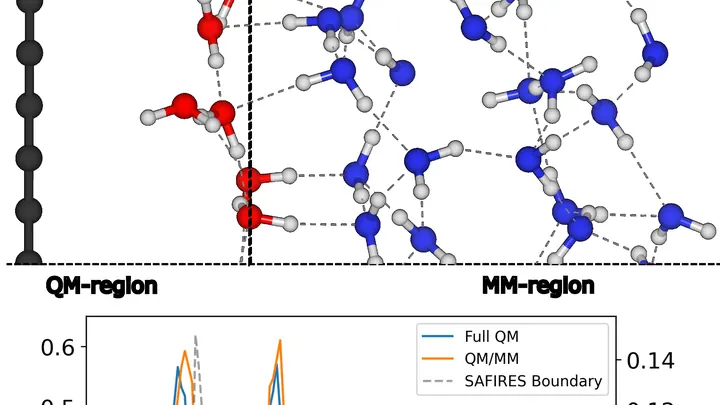
Imagine a huge swimming pool. In one corner, a chemical reaction is underway that needs to be calculated with jeweler-like precision. But the surrounding water is not just decoration: its molecules jostle, attract, and influence the reaction. How do you account for this endless dance of particles without drowning in calculations?
A long string of beads settles into a tiny box — some beads press together, others spread apart. That's the puzzle a protein solves when it folds into a working molecule. Except the beads, amino acids, can number in the hundreds, and every contact between them reshapes the whole structure.
Quantum vacuum resembles a sea, constantly rippling with tiny splashes. An electron in an atom moves in this sea, and its path slightly changes due to the waves. Previously, such corrections were accurately calculated only for hydrogen-like ions with a single electron. But in highly charged ions with several electrons, the picture becomes more complex.
A tailor cuts a suit, but the seams pucker and the buttons won't align. In quantum field theory, similar glitches are called anomalies: they appear when a symmetry of the equations breaks down in the transition to a quantum description. Usually, they are fixed by sewing in extra patches, the so-called Bardeen–Wess–Zumino counterterms.
Quantum annealing works like a smart way to find a path through a maze: instead of checking every dead end, it uses quantum effects to find the exit faster. But this maze has a quirk: the numbers that describe the walls and corridors must be roughly the same size.
When chemists calculate the behavior of molecules on a computer, they use approximate methods because exact calculations are too complex. For light atoms, there are well-established benchmarks, but for heavy atoms, where relativistic effects matter, such benchmarks did not exist. It's like checking a ruler against another ruler rather than against a standard meter.
A water molecule resembles a tiny dumbbell: two hydrogen atoms attach to an oxygen atom at an angle. This dumbbell doesn't stay still: it stretches, compresses, and rotates. Each such motion has its own energy, like steps on a ladder.
A laser beam holds a single ion in a vacuum, and that ion behaves like a ball trapped between two cups. The cups aren't pits in the ground but regions where the ion energetically prefers to be. In the classical world, a ball would roll into one cup and stay there.
IBM's Heron R3 quantum computer handled a task that made a classical method back down. The challenge was finding the ground state, the lowest energy level, of a system of 49 quantum bits.
During a course of radiation therapy, the tumor and surrounding tissues can shift or change size. Doctors regularly take images and sometimes adjust the plan to keep the radiation on target. But how do you know how much dose has already been delivered and how much is still to come? Usually, this is estimated using simple rules that don't account for uncertainty.
A good chef tastes the soup and adds a pinch of salt. Ordinary scales won't notice that pinch, but sensitive ones will. In the quantum world, pairs of entangled particles play the role of such scales. It was previously thought that the entanglement had to be as strong as possible, otherwise precision wouldn't improve.
Light can be more than just a stream of particles; it can be a wave with a specific shape over time. Sometimes this shape changes so rapidly that capturing it is like photographing a bullet in flight. Scientists have devised a way to measure such fleeting quantum states of light.
For this, they use a device called a balanced homodyne detector.
When making popcorn, a microwave uses electricity only to heat the kernels. A gas stove heats the entire burner and the air around it. The same difference applies between a photonic quantum chip and a classical supercomputer when solving a problem devised by Scott Aaronson.
Electrons — tiny particles in molecules — constantly maneuver, avoiding collisions like passengers during rush hour. To calculate their behavior, scientists set a personal distance rule: a mathematical function that indicates how close one electron can get to its neighbor.
All bodies fall the same: this was first observed by Galileo. Einstein elevated the observation to the equivalence principle: gravity and acceleration are indistinguishable, giving birth to curved spacetime.
In the quantum world, particles do not have precise properties until they are measured. The official model refuses to explain what lies behind this uncertainty. But the idea that invisible 'pilots' control particles has been around since the 1920s.
An orchestra plays a complex piece, and each group of instruments enters on its own schedule. The violins might slow down while the woodwinds keep the same tempo, and the percussion might suddenly burst into a roll. The conductor hears everything at once, but pinpointing the exact moment when the flutes, not the cellos, changed rhythm is nearly impossible.