Weighing the W boson in a jet express
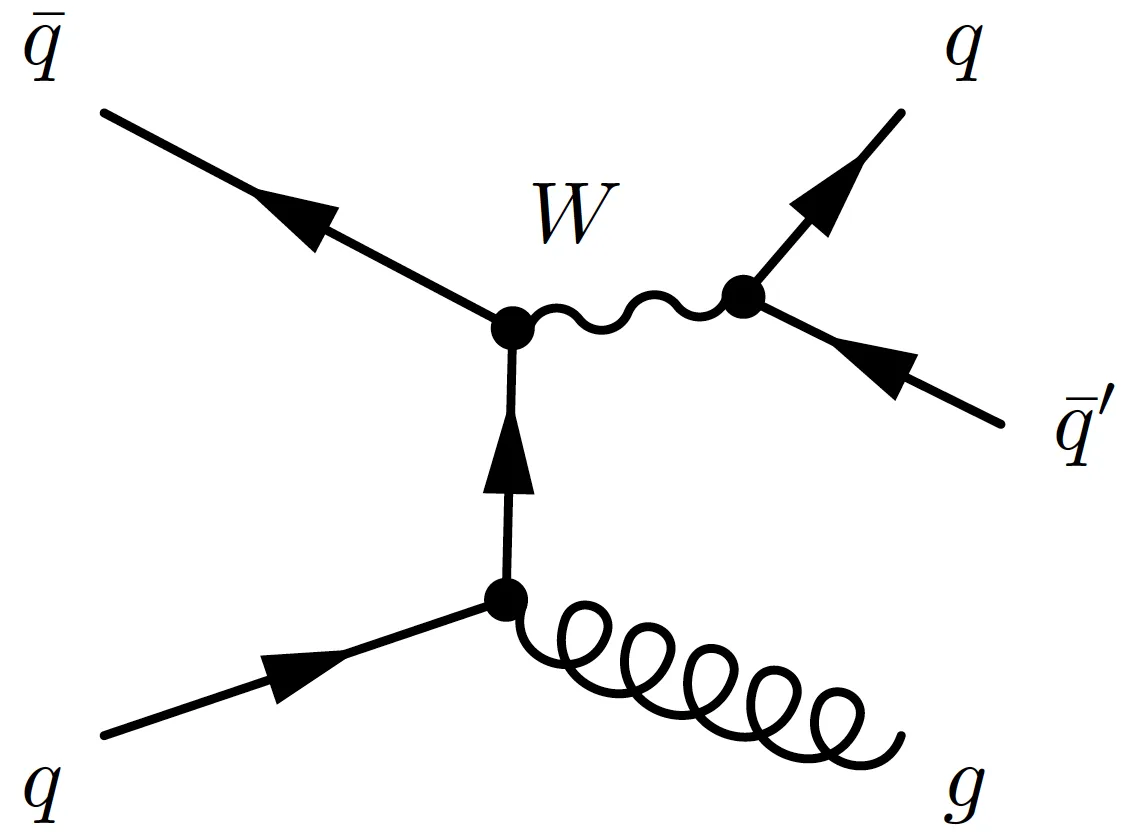
When a W boson, the particle that carries the weak force, decays into a quark and an antiquark, these two fragments fly off in nearly the same direction at the collider's immense speeds. The detector doesn't see two separate particles but one wide jet, much like two runners crossing the finish line blurring into a single smudge in a photograph. Hidden inside that jet is information about the original W boson's mass.
The catch is that the jet gets coated in 'noise': soft radiation at wide angles smears its mass, like splashes distorting the trail of a thrown stone. To strip away this noise, physicists used the soft-drop algorithm, which carefully trims the outer, overly broad parts of the jet, leaving only the dense core. It's similar to how a gardener prunes overgrown branches to see the tree's shape.
Using this method, the CMS team has, for the first time, built a two-dimensional picture: how many events correspond to each combination of jet transverse momentum and mass after trimming. From this picture, they extracted the W boson mass—80.83 ± 0.55 GeV. The uncertainty of just 0.55 GeV is the smallest ever achieved at a hadron collider for a channel where the W boson is seen only through jets.
Precision here isn't just a race for impressive numbers. The smaller the uncertainty, the more sensitive the test of theory. If future measurements with even smaller errors show a deviation from expectations, it would signal the existence of unknown particles or interactions. For now, the new result agrees perfectly with the Standard Model, but the method paves the way for even more refined tests.
Original abstract
as written by the authors arXiv:2603.19963
The jet mass of W bosons decaying to a quark-antiquark pair is measured in W+jets events from proton-proton collisions at a center-of-mass energy of 13 TeV. The data used were collected by the CMS experiment at the CERN LHC and correspond to an integrated luminosity of 138 fb$$^{-1}$$. Hadronic decays of W bosons with high momenta produce strongly collimated decay products due to the large Lorentz boost, and are reconstructed as single large-radius jets. These jets have a characteristic substructure that is exploited to distinguish them from the large background of quark- and gluon-initiated jets. The jet mass is computed using the soft-drop algorithm, which suppresses soft wide-angle radiation that leads to a broadening of the jet mass distribution. For the first time, unfolded measurements are presented of the double-differential W+jets cross section as a function of the jet transverse momentum and soft-drop mass. From these distributions, the W boson mass is obtained, with a value of 80.83 $$\pm$$ 0.55 GeV, achieving the smallest uncertainty available today from an all-jets final state at a hadron collider.
The W boson is about 80 times heavier than the proton, yet it lives for less than one trillionth of a second.