Catching the Neutrino Wind: Why the Faintest Breeze in the Universe Demands the Impossible ✛ ✎
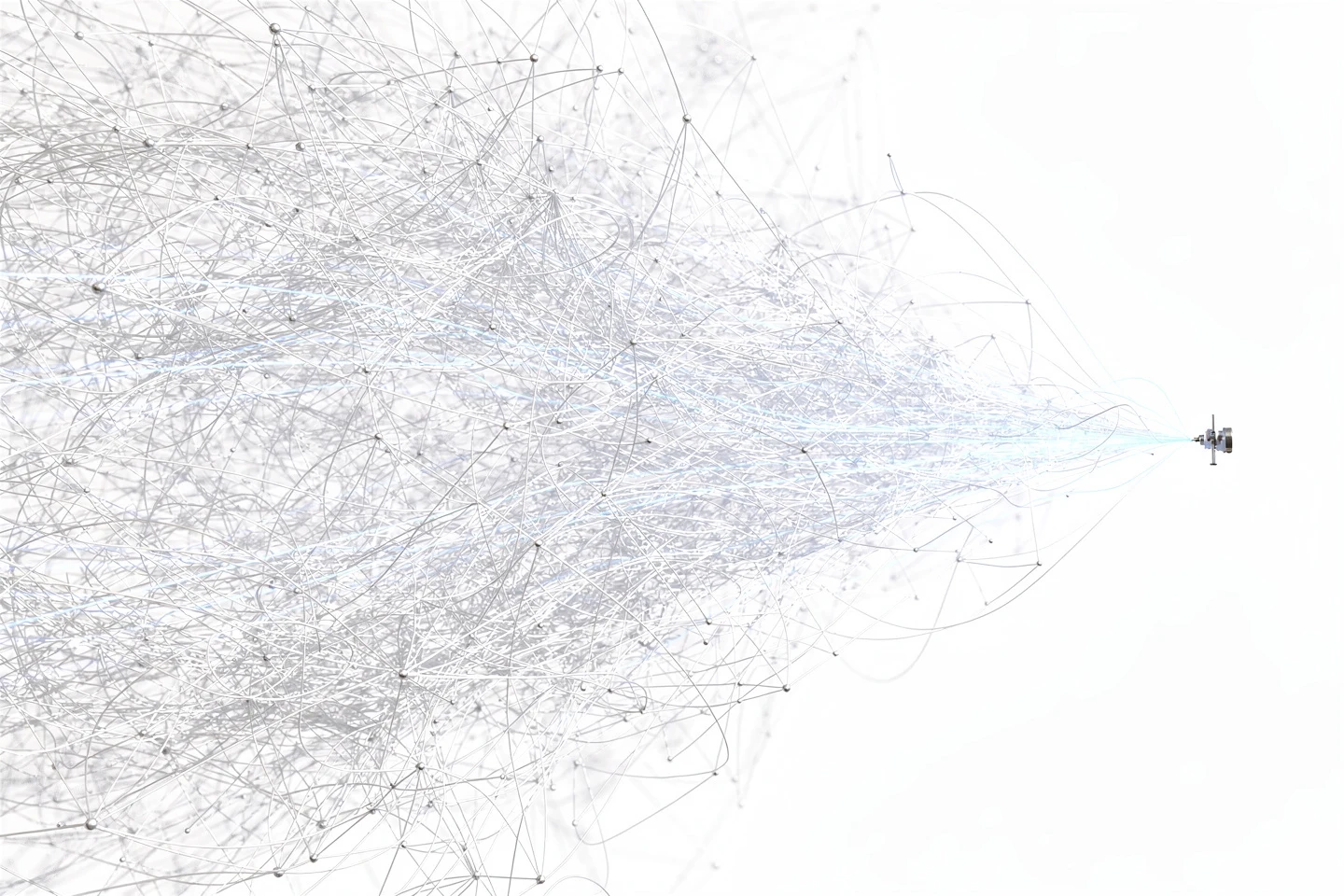
In the first seconds after the Big Bang, the Universe left us not only light but also something far more elusive — the relic neutrino background. This echo of creation permeates every cubic centimeter, yet we barely notice it. Georges Lemaître first proposed that the Universe is expanding, Edwin Hubble confirmed it through observations, and Ralph Alpher described how the first nuclei were born in that hot beginning. The neutrino background is a living witness to those events, and now scientists want not just to record it, but also to catch the subtlest whisper of the 'neutrino wind'. Like a ship cutting through the ocean surface, our Earth moves through this neutrino gas at 370 km/s — about 0.12% of the speed of light. The headwind should be ever so slightly stronger than the tailwind, and therein lies a key to the secrets of the cosmos.
A new theoretical work has just estimated how fragile this wind truly is. Scientists considered the method of neutrino capture on tritium nuclei — super-heavy hydrogen — and found that the amplitude of the dipole anisotropy, the very non-uniformity due to our motion, is a vanishingly small fraction of the total background. For Dirac neutrinos with a mass of about 0.1 eV, it is roughly 0.001, and for Majorana neutrinos — a thousand times smaller. The difference is like trying to hear which direction the gentlest zephyr is blowing from, while standing inside a roaring hurricane.
But there's more. Calculations of the spectroscopic analysis of the tritium signal showed that to reliably register this dipole, an exposure 100,000 times greater than for simple detection of the neutrino background is needed. If the isotropic background can be caught with approximately 100 g·yr (the product of target mass and observation time), then for the wind, you need $10^7$ g·yr with excellent energy resolution. And if the resolution falls short of ideal, the required exposure skyrockets to $10^{20}$ g·yr. It's like trying to determine the direction of an ocean current by measuring a difference in water pressure on the hull comparable to the weight of a few bacteria.
Yet the game is worth the candle. The fact is that Dirac and Majorana neutrinos interact with matter differently, and the dipole anisotropy is one of the few real ways to distinguish between the two fundamental natures of this particle. The answer to whether the neutrino is its own antiparticle will determine why the Universe is filled with matter rather than an equal mixture with antimatter. Moreover, the neutrino wind could serve as an independent check of cosmological parameters and point to traces of gravitational clustering predicted by dark matter.
For now, the task seems almost impossible — like a sailor's dream of crossing an ocean on a plank. But progress is relentless. Cryogenic bolometers, graphene targets, polarized nuclei, perhaps future space observatories — all this will one day allow us to hear the neutrino wind. It will require calibration accuracy no worse than that of the Hubble Space Telescope, and suppression of background from black holes, which can generate their own dipole noise. Just as the discovery of gravitational waves stretched over a century from prediction to the triumph of LIGO, the hunt for neutrino anisotropy will become a crusade of 21st-century physics. And at the end of the road, we will hold a compass that points not to countries and continents, but to the very starting point of our universe.
If neutrinos were a bit heavier — around 0.5 eV — their wind could be felt physically. The pressure on the pendulum of a gravitational-wave interferometer would cause an acceleration on the order of $10^{-14}$ cm/s². That's like noticing sand being blown off a beach by the light of distant stars.
The theme of immense cosmic currents resonates with Olaf Stapledon's novel 'Star Maker', where unseen flows guide the evolution of civilizations. If the neutrino wind were slightly more tangible, humanity might use it for interstellar navigation.