How Neutrinos from a Star Explosion Give Away Their Hierarchy express
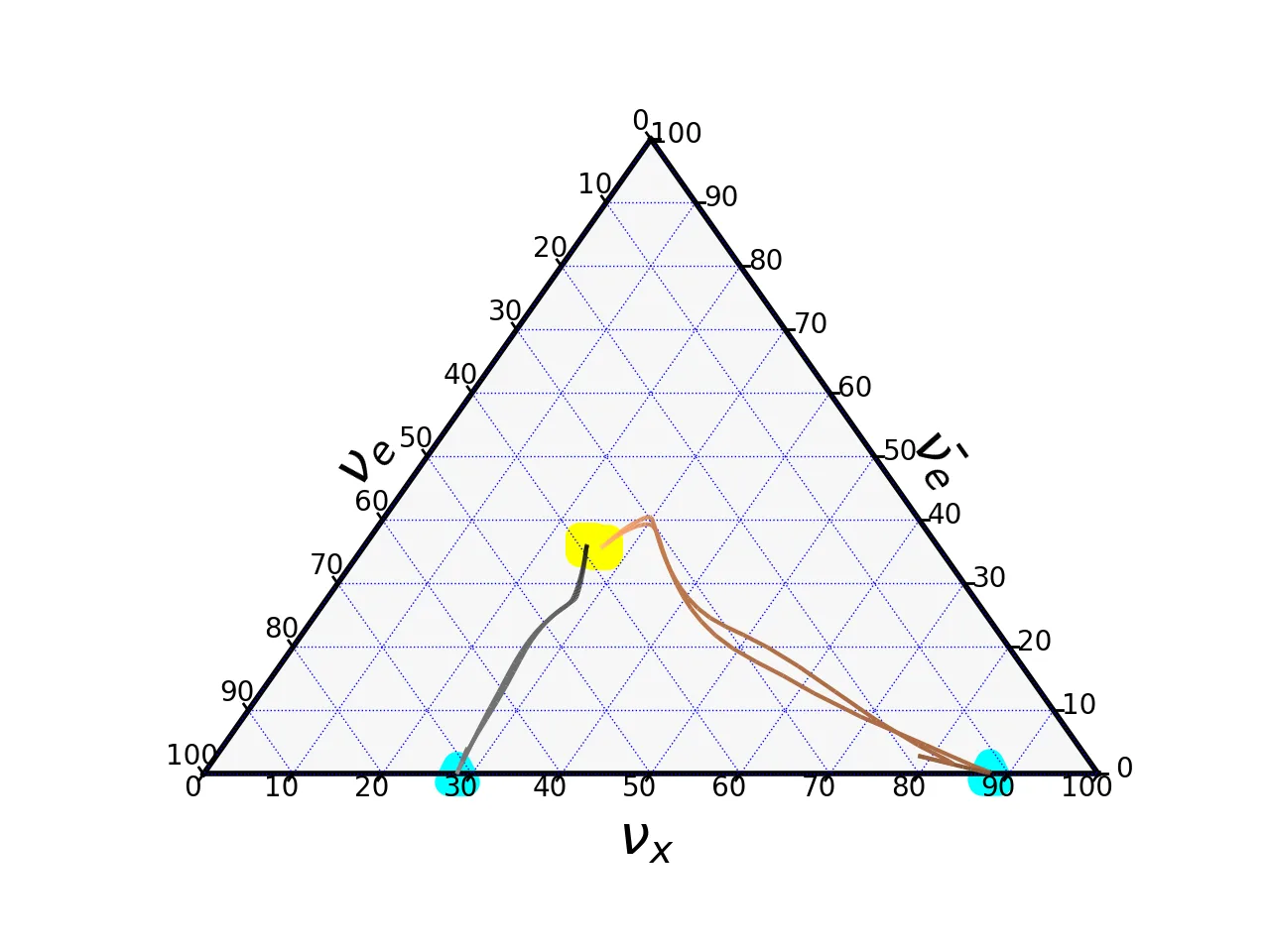
A pot of soup simmering with three ingredients. The chef adjusts the proportions on the fly, and the progress is tracked by the position of a point on a triangular scale. That's roughly how physicists tackle neutrinos from a supernova explosion.
When a star's core compresses to a staggering density, a flood of neutrinos is born — light particles that barely interact with matter. They come in three types, and their composition changes on the way from the star to the detector. The authors of the study used ternary diagrams (a triangle where each corner represents the fraction of one type) to show how this composition evolves over time. The trajectory of the point inside the triangle depends on the neutrino mass hierarchy — normal (two lighter and one heavy) or inverted (two heavy and one light).
To test their idea, the scientists took several explosion models from the SNEWPY package and roughly reconstructed the initial neutrino composition from signals in Earth-based detectors. They found that the trajectories for normal and inverted hierarchies generally diverge into different regions of the triangle. This gives hope that a single future supernova in our Galaxy could reliably reveal how neutrino masses are arranged — a question that has remained open for many years.
This method is a bit like reading tea leaves, except instead of tea leaves, you have neutrinos, and instead of a cup, you have a triangle. And when the sky is again lit by a supernova, physicists will watch the point's motion, hoping to finally learn which "recipe" nature chose.
Original abstract
as written by the authors arXiv:2604.16652
We explore what may be deduced about the neutrino mass ordering problem from the observation of core-collapse supernova burst neutrinos in modern terrestrial detectors. We employ ternary plots in a novel way to visualize the time evolution of the flavor composition of various supernova neutrino flux models from the SNEWPY software package. Through our analysis of several models using a simplified unfolding process, we have explored potential robust discriminants between the normal and inverted mass orderings. We find that the normal and inverted mass orderings tend to occupy different regions in ternary space across different models.
If neutrinos were visible to the naked eye, a supernova in our Galaxy would outshine the Sun, but only in neutrino "light."