Quantum Knots from Particle Trajectories express
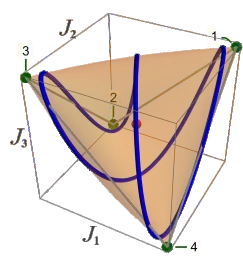
A thrown stone follows a smooth arc: its path is easy to predict. But if the stone skips across water, the trajectory becomes jagged and far more interesting. Quantum particles behave much the same way when their state is not a calm wave with fixed energy but a turbulent mix of several waves at once. Physicists have long sought a way to describe this jumble without cumbersome calculations, and now they have proposed an elegant trick: instead of tracking the wave function itself, follow how its "center of mass" shifts over time — the particle's average position or average electric current. This trace over time is called a quantum hodograph.
Take a free electron and superpose three plane waves: its current hodographs lie on a surface that resembles a crumpled sheet of paper with sharp creases — mathematicians call it a cubic surface with conical singularities. When the wave frequencies are in integer ratios, the lines close into loops that cannot be shrunk to a point, and each loop gets its own winding number. In an inhomogeneous harmonic trap, the picture is even richer: the average position of the particle traces out three-dimensional knots, just like Lissajous figures drawn by an oscilloscope beam, but in space. This idea echoes the vortex model of the atom proposed by William Thomson (Lord Kelvin) back in the 19th century.
The authors developed an optical modulation spectroscopy scheme to reconstruct these patterns in experiments with trapped ions or single electrons. In essence, the particle is "illuminated" with a laser, and the response is used to reconstruct the knot-like path it took. This approach provides a new tool for analyzing complex quantum dynamics — not through abstract numbers, but through tangible geometry.
Original abstract
as written by the authors arXiv:2606.08528
In quantum mechanics, the wave function encodes all information about a particle through its probability density and phase. While stationary states are characterized by conserved quantum numbers such as energy and, in central potentials, angular momentum, non-stationary superpositions - particularly in anisotropic or time-dependent fields - generally lack equally universal descriptors of their spatiotemporal dynamics. Here we introduce quantum hodographs: the trajectories traced in time by the expectation value of observable vector quantities. For a free electron in a superposition of three plane waves, all hodographs of the probability current lie on a universal cubic surface with conical singularities. Rational frequency (energy) difference ratios produce non-contractible loops with well-defined winding numbers. In anisotropic harmonic oscillators the Ehrenfest trajectories - hodographs of the expectation value of particle radius-vector - form three-dimensional Lissajous knots, echoing the classical Thomson vortex-atom model. Externally driven quantum systems allow controllable initiation of knotted hodographs. We propose an optical modulation spectroscopy scheme for reconstructing these topological features in trapped ions and single-electron systems. The topological indices of the loops and knots are robust to parameter variations, offering a new tool for characterizing complex quantum dynamics.
In classical physics, the velocity hodograph was first constructed by William Hamilton in 1846—he showed that for a planet moving along an ellipse, the tip of the velocity vector traces a circle.
In Greg Egan's novel Schild's Ladder, quantum states intertwine into higher-dimensional knots, determining the very existence of spacetime.